


Topline
New analysis from TS Lombard shows the United States is on track to devote approximately 2% of gross domestic product to artificial intelligence and data center infrastructure in 2026, an investment well above that of any other major country that places it among the largest concentrated spending booms in modern U.S. history.
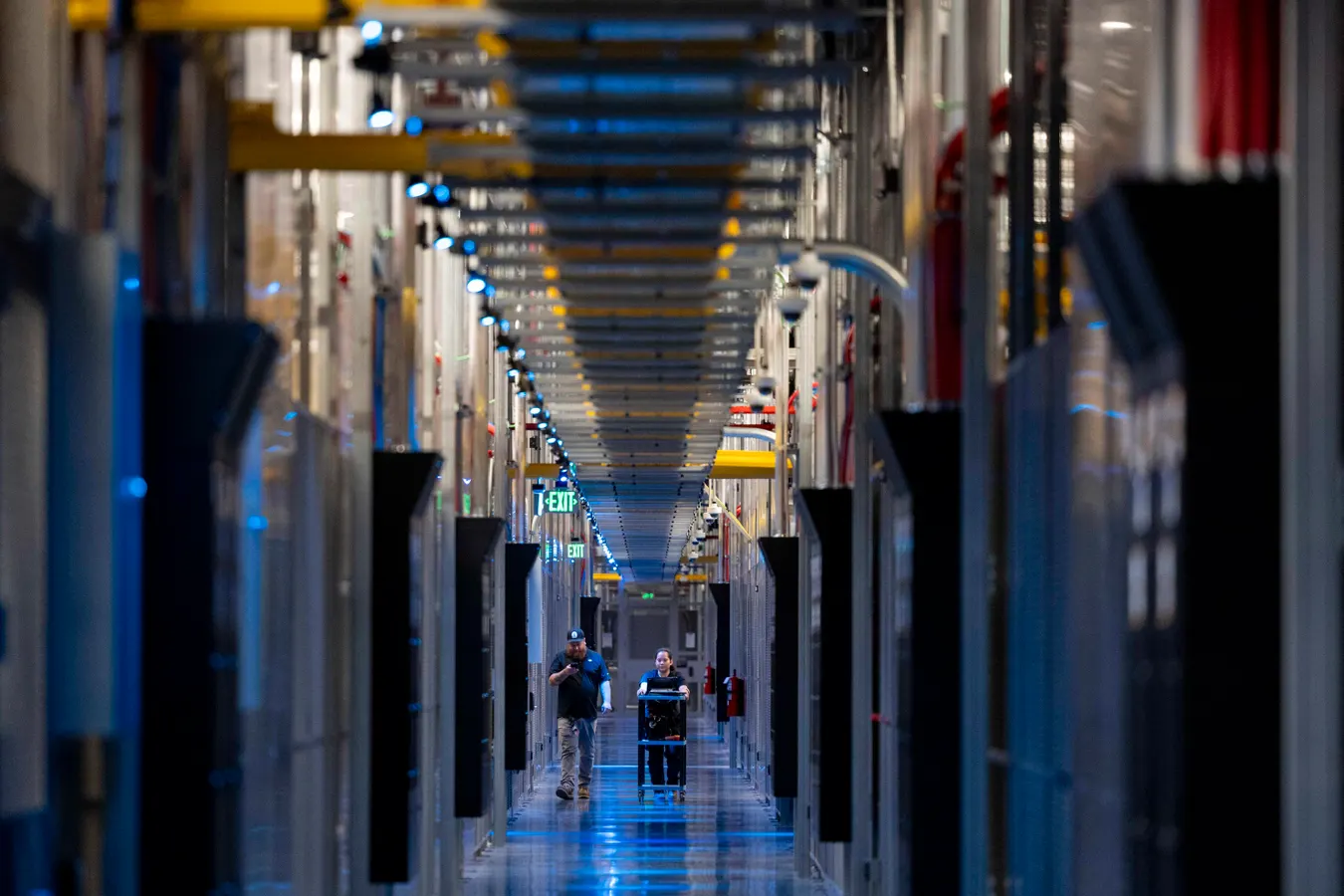
People walk through the hallways at Equinix Data Center in Ashburn, Virginia, on May 9, 2024.
The Washington Post via Getty Images
Key Facts
TS Lombard, an economic research and investment strategy firm, predicts the U.S. will be responsible for more than 80% of an $800 billion global spend in the sector this year and that AI buildout is on track to surpass the Gilded Age’s so-called “Railway Mania” to become the biggest infrastructure project in US history.
The nation’s AI buildout is comparable in economic scale to the county’s entire higher-education sector—which accounts for about 2.3% of the GDP—and approaches the size of the national defense budget, which was 2.9% of GDP in 2025 at $954 billion.
And while defense spending as a share of GDP is expected to decline over the coming years — to 2.4% in 2036 according to the Peter G. Peterson Foundation—spending on artificial intelligence is only expected to rise.
By comparison, the peak of the dot-com telecom buildout around 2000 accounted for roughly 1% to 2% of GDP, Apollo-era space spending peaked around 0.4% of GDP and the Interstate Highway System cost about 0.4% of GDP annually.
BIG NUMBER
0.7%. That’s how much of their GDPs the next highest-spending countries—Norway and Saudi Arabia—will spend on AI this year, according to TS Lombard. China’s data center spending as a share of GDP sits at approximately 0.4%, below Malaysia and Sweden, while the Eurozone allocates roughly 0.2% and Canada trails the entire field at approximately 0.15%.
Key background
The surge in AI spending is being driven primarily by massive capital expenditures from tech companies racing to build data centers, acquire advanced semiconductor chips and expand computing capacity. Training and running AI models requires vast amounts of scarce physical infrastructure and a huge amount of energy—making it much more expensive than technologies that can run on traditional coding. Tech giants Amazon, Microsoft, Alphabet, Meta and Oracle are responsible for the majority of AI infrastructure investment in the United States and while supporters see the buildout as the foundation of a new technological era, skeptics question whether the enormous investment can create enough new revenue or productivity gains to justify the cost. They argue that many AI use cases remain experimental, competition may drive prices down and the industry could be building more computing capacity than customers ultimately need.
What to watch for
Some of the world’s biggest AI companies—including Anthropic, SpaceX and OpenAI—will go public at valuations close to $1 trillion each in the coming months.
CRUCIAL QUOTE
“The next few months of initial public offerings have every possibility of proving a peak rather than the start of another boom.” Bloomberg opinion columnist Parmy Olson wrote Thursday.
















Leave a comment