


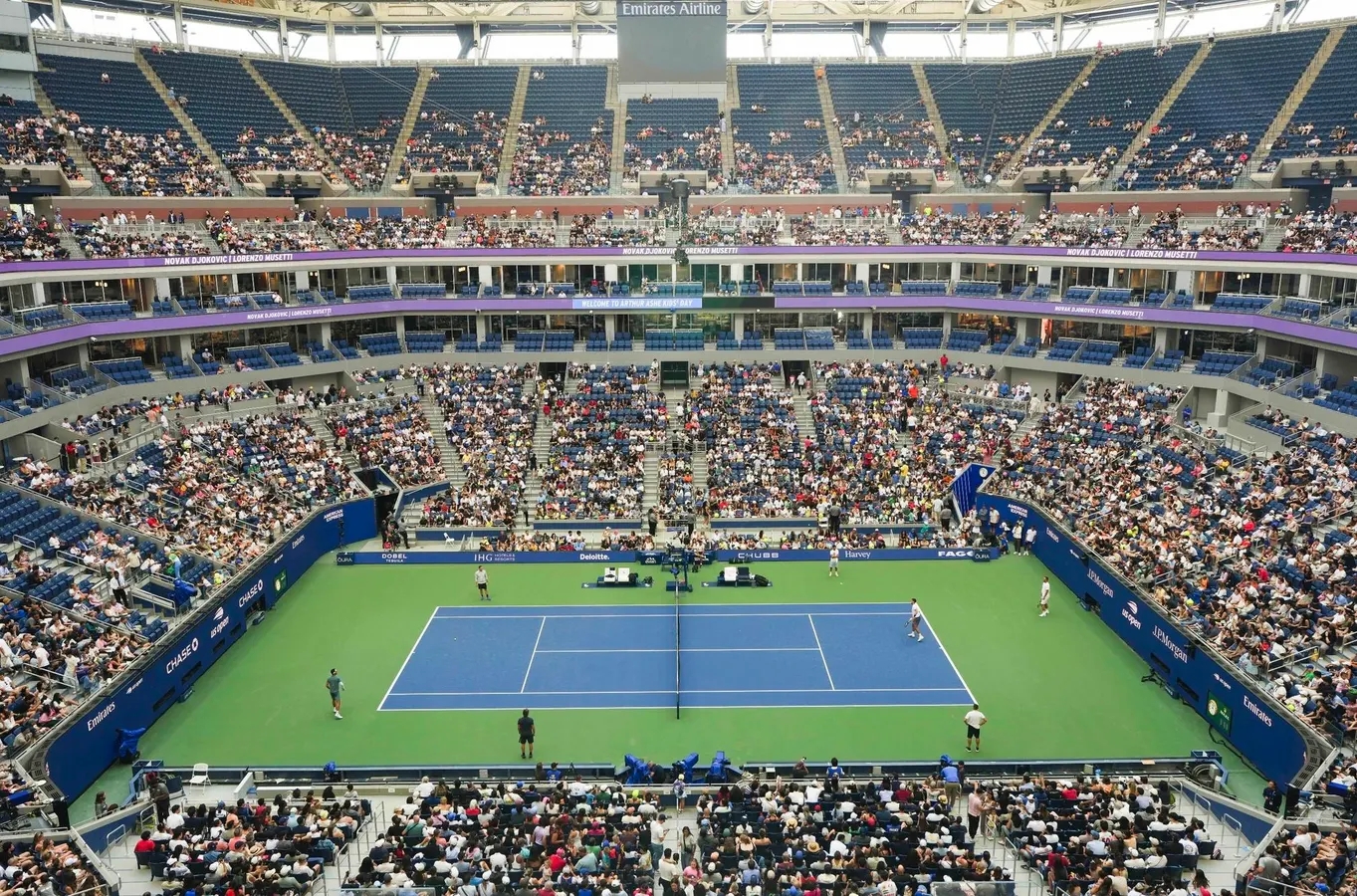

A look inside Arthur Ashe Stadium during the 2026 U.S. Open with a completely updated seating bowl.
Chris Krusberg/USTA
Parts of Arthur Ashe Stadium, the largest tennis-specific venue in the world, look brand new. Others have a temporary feel. That’s all part of the plan as the USTA Billie Jean King National Tennis Center pauses major construction to stage the 2026 U.S. Open.
“It is all there, it is all functioning. The seats are in, there are all new restrooms, concession stands, retail, but many are not 100% yet,” Daniel Zausner, chief operating officer of the USTA Billie Jean King National Tennis Center, tells me. “We knew there would be a lot of temporary things. It is not 2027, when we’ll be all done.”
The $800 million upgrade to the center is part of the plan to “reimagine” Ashe and give players a completely new performance center. Announced in 2025 as a $550 million project to upgrade the stadium and a $250 million effort to create a new player center required the USTA to get creative with construction timetables. “We knew we had about 18 months-worth of work to squeeze into 10 months,” Zausner says. “My goal was to make sure when people walk into the seating bowl, they have an equal or better experience than what was there. That is where we are.”
An exterior view of Arthur Ashe Stadium during the 2026 U.S. Open.
Shea Kastriner/USTA
The construction between the 2025 and 2026 U.S. Open events was largely structural. The concourses expanded 40% and the lower seating bowl rose from 3,000 to 5,000 seats by completely reworking the design—no seat is in an identical location to 2025—and pushing the two levels of suits higher. To make room, 2,800 seats got pulled out of the upper loge and promenade levels. The entire stadium’s capacity now sits at 23,933.
MORE: The U.S. Open Player Walk-Out Starts In Ashe Stadium
Still, there’s a lot left in the Rossetti-designed plan. “This is a work in progress,” Zausner says. “It is unfinished, but it functions.” He used the analogy of building a house and getting the foundation and the structure in place but still needing to add all the finishings. Ashe has that feel. The time between 2026 and 2027 gives the USTA time to complete the process.
After the 2026 tournament ends, the USTA has two weeks to close out the site and move out of Ashe. Construction resumes at the start of October. “It’s not lighter at all, it’s different,” Zausner says about the workload. “Last year was all about structural steel and concrete. This year will be much more about finishes. They are much more intricate, and things have to look perfect. It will be a push.”
The lower seating bowl in Arthur Ashe Stadium now features 2,000 more seats than it did previously.
Tim Newcomb
Even with plans for 40% more restrooms and 30% more points of sale, much of the updated fan-facing activations—such as hospitality and concessions—won’t take flight until 2027. Part of the overhaul includes the new player performance center, connected to Ashe by a skybridge. The top two floors are dedicated to the 2,800 players and their guests who visit the Queens site over the three weeks, featuring expanded indoor and outdoor fitness and warmup areas, redesigned and expanded locker rooms, lounges, a new player courtyard and dedicated café and dining spaces.
Much of the structure is built, but nothing in the site is yet open. Once this year’s tournament ends, work will move all player facilities to the new center, freeing up back-of-house space in Ashe for repurposing. Current player locker rooms will turn into administrative offices, player dining and lounge spaces become hospitality and current administrative offices become bunker suites. Restaurants and clubs will move around, with plenty more space for both in 2027 compared to 2025 (let alone 2026, which is in a pinch for hospitality space within Ashe).
Every seat in the lower bowl of Arthur Ashe Stadium is new and in a new location.
Tim Newcomb
Clues to the new sculptured grand entrance, designed by Daniel Libeskind, show up in 2026, a slight precursor to the final edition in 2027.
The original stadium was built in 1964 as a temporary venue for the World’s Fair. The U.S. Open moved to the site in 1978 and turned the stadium into a tennis venue. It was rebuilt in 1997, and since Arthur Ashe Stadium started to show its age, especially with tight concourses sparse on points of sale since original plans called for fans to visit the grounds for amenities between matches.
“I am totally excited for this year,” Zausner says. “I’m always excited to see if the fans are going to react as positively to the changes we have made as we envision they will. Next year will be spectacular.”















Leave a comment