


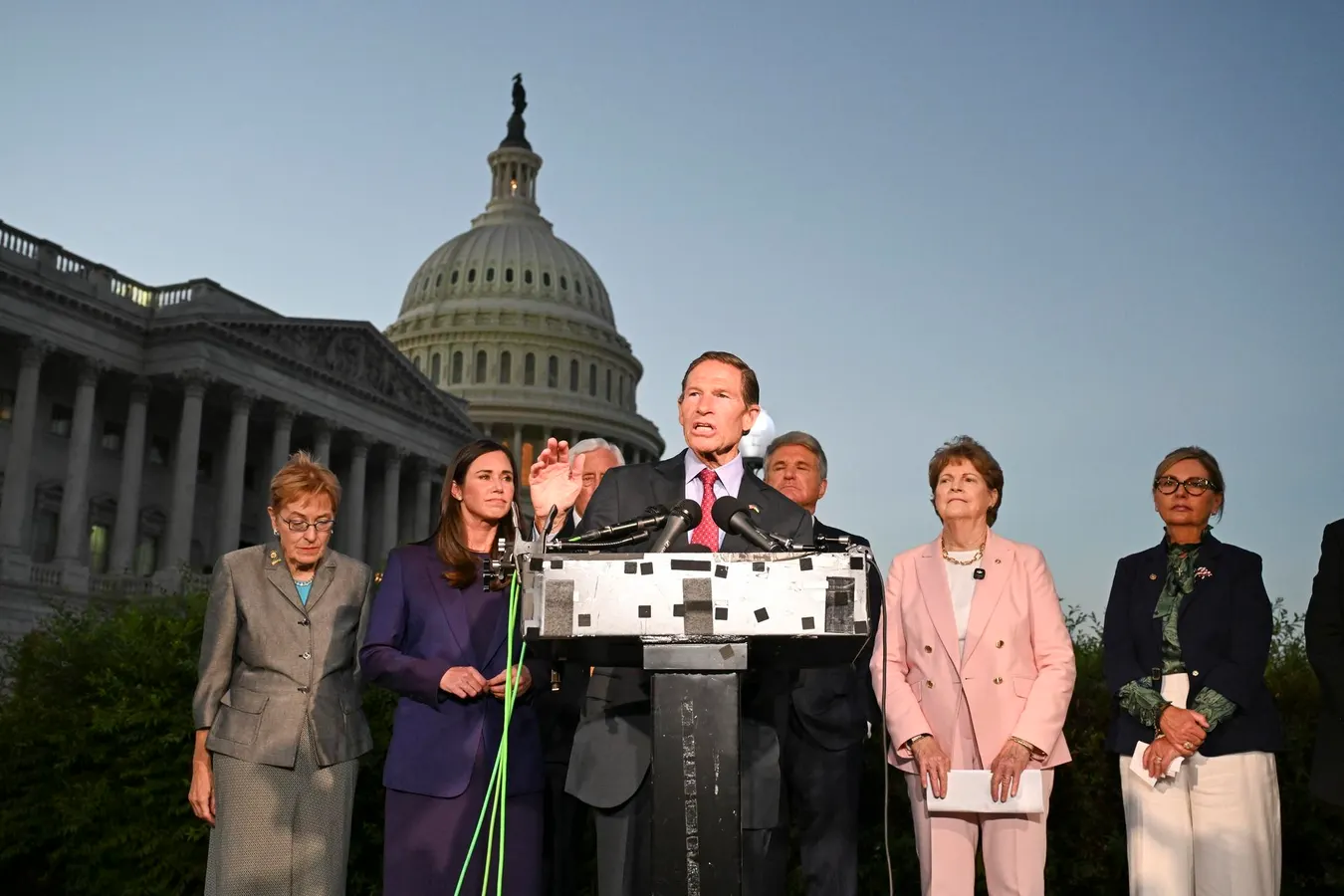

WASHINGTON, DC – SEPTEMBER 16: U.S. Sen. Richard Blumenthal (D-CT) speaks after the House passed further sanctions on Russia on Capitol Hill on September 16, 2026 in Washington, DC. (Photo by Roberto Schmidt/Getty Images)
Getty Images
More than four years after Russia launched its full-scale invasion of Ukraine, Congress has delivered one of its most significant recent actions against Moscow, underscoring that Ukraine remains an important issue in American politics.
The House voted 262-159 on Sept. 16 to approve the Lindsey O. Graham Sanctioning Russia and Iran Act of 2026, sending the legislation to President Donald Trump, who is expected to sign it. The Senate passed the measure 86-11 in August. Named for the late South Carolina Republican senator, who spent more than a year working on the package, the sanctions bill targets Russian officials, companies and financial institutions involved in fueling the war. The package puts pressure on the Russian economy and is intended to force President Vladimir Putin to end his war in Ukraine. It also gives the president authority to impose tariffs of up to 100% on countries that remain among the biggest buyers of Russian oil and gas, potentially extending the economic consequences to major trading partners, including China and India.
The vote is notable at a moment when Washington is trying to negotiate an end to the war while confronting how much pressure to maintain on Moscow. Despite expected war fatigue — Russia’s full-scale aggression against Ukraine is well into its fifth year — the American public continues to show interest in the war. Efforts to bridge the realities between the two countries — the U.S. and Ukraine — are going beyond the top diplomatic channels.
From Washington to Kyiv
An ongoing dialogue continues among American lawmakers, defense and technology companies, the private sector, constituents and their counterparts in Ukraine. About 90 participants from the U.S. came last week to the 22nd annual meeting of the Yalta European Strategy, organized by the Victor Pinchuk Foundation. Roughly 700 participants from various countries — including American lawmakers, Ukrainian officials, military commanders and European policymakers — gathered in Kyiv as Russia continued its missile and drone attacks across Ukraine.
Founded in 2004 in Yalta, Crimea, and moved to Kyiv after Russia’s 2014 annexation of Crimea, YES has become a prominent international forum for debating Ukraine’s future. This year’s discussions took place as the Trump administration pushes to revive stalled negotiations between Moscow and Kyiv.
U.S. envoys Steve Witkoff and Jared Kushner traveled to Moscow and Kyiv earlier this month to restart talks. For Ukrainian officials, however, the argument at YES went beyond territory. They warned that any settlement would have to address whether Russia could use a pause in fighting to rebuild its military and eventually attack again.
Ukraine’s position in the war is not as weak as it may appear. The drone revolution and technological innovations implemented by the Ukrainian military, combined with its extensive combat experience, have made it one of Europe’s most experienced fighting forces. With continued support from its partners, investment in the defense sector and expanded production of drones and long-range weapons, Ukraine has the potential to strengthen its position on the battlefield.
“Ukraine, after four and a half years of war, knows what it is doing,” Eric Schmidt, former CEO and chairman of Google, said. “The country is organized to win this. What’s missing? Money, and the second is scaling. This is a big war. You need a lot of everything.”
The solution, Schmidt said, is to use contract manufacturers in the West to help provide Ukraine with the defensive and offensive systems it needs.
Vadym Skibitskyi, deputy chief of Ukraine’s Defense Intelligence, described the possibility of continued Russian attacks as “a real threat,” pointing not only to Ukraine’s defense industry but also to its economy and electricity, heating and water systems.
That concern is particularly acute as another winter approaches. Andrii Biletskyi, commander of the 3rd Army Corps of the Ukrainian Armed Forces, warned at YES that Ukraine’s ability to protect its cities from ballistic missiles and increasingly sophisticated drones could determine how the country gets through the coming months.
For Washington, those battlefield realities are colliding with a different challenge: maintaining public attention and determining the extent of future U.S. involvement.
Kyiv, Ukraine. September 13, 2026. YES summit, “The View from the US House of Representatives” Photos are provided by the VictorPinchukFoundation©2026. Photographer: Valentyna Reostovikova, Nicolas Lobet, Frederic Garrido-Ramirez (PRYZM photography), and Oleksandr Piliugin.
PRYZM
What Americans Think About Ukraine
American opinion on Ukraine is more complicated than either broad support or broad opposition. A Pew Research Center survey conducted in March 2026 found that 29% of Americans believed the United States was providing too little support to Ukraine, compared with 20% who said it was providing too much and 26% who considered the level about right. Another 24% were unsure.
At the same time, 54% said the Russia-Ukraine war was at least somewhat important to them personally. That was lower than the 59% recorded in 2024 but essentially unchanged from 2025.
The largest divide remains partisan. Half of Democrats and Democratic-leaning independents said the United States was not doing enough for Ukraine, compared with 11% of Republicans and Republican leaners. Yet views have also shifted within the Republican electorate: The share of Republicans saying Washington was providing too much support declined substantially between early 2025 and later that year.
At the YES summit in Kyiv, Rep. Eugene Vindman, D-Va., spoke of what he described as bipartisan American support for Ukraine but also acknowledged a sense of fatigue after decades of U.S. involvement in conflicts abroad. Sen. Thom Tillis, R-N.C., focused on a different constraint: America’s ability to manufacture enough weapons and air-defense interceptors for modern warfare, warning that production capacity cannot be rapidly expanded.
The House sanctions vote offers another measure of where Congress stands. It demonstrated substantial bipartisan agreement on increasing economic pressure on Russia, even as lawmakers disagreed over how much authority the legislation should give the president and how those powers might affect U.S. allies and consumers.
Bringing Ukraine Back to Capitol Hill
While Congress was moving the sanctions legislation, hundreds of Ukraine supporters were also gathering in Washington for the ninth Ukraine Action Summit, held Sept. 12-16.
Organized by the American Coalition for Ukraine, the event combined a two-day conference with three days devoted to advocacy and meetings with congressional offices. Ukraine supporters from across the United States have been walking the halls of Congress, trying to ensure that Russia’s war on Ukraine remains part of lawmakers’ conversations with their constituents.
That becomes increasingly important as the war competes with domestic concerns for Americans’ attention. Inflation, immigration, health care, taxes and the economy are likely to command much of the political debate. Ukraine is one foreign-policy question among many.
Yet this week’s developments show that the issue has hardly disappeared.
More than four years into the full-scale invasion, Americans remain divided over exactly how much the United States should do. But between the sanctions vote on Capitol Hill, renewed diplomacy and organized constituent advocacy in Washington, Ukraine remains on the U.S. political agenda.
















Leave a comment