


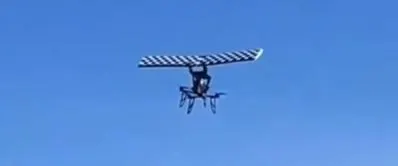

A Ukrainian FPV with detachable wing giving extended range
Ukraine MoD via X
Serhii Sternenko, leading drone fundraiser and drone warfare advisor to Ukraine’s Ministry of Defense, recently posted on X to celebrate an achievement of a drone created by one of his secret projects:
“102 kilometers — the target engagement distance with your FPV quadcopter type without using a mothership. Deeper further!”
A video of the long range strike shows the drone targeting a Russian Bukhanka logistics van far behind the lines. Legions of Bukhankas have been wiped out by similar FPVs.
102 kilometers is 61 miles, an impressive range for a portable weapon, and a staggering achievement for a quadcopter. Is this even possible? How has the humble FPV evolved into a strategic weapon?
Quadcopter FPVs: An Accident Of Drone History
Multicopters never looked like a great basis for a loitering munition, because rotary wing aircraft like helicopters expend so much effort just staying in the air. Fixed wings expend far less effort, and can even glide with no propulsion at all. The aerodynamics are vastly better.
A Chinese SKywalker X8 commercial drone fitted with a warhead by ISIS in 2017 in pre-FPV days.
YPG Via Facebook
As a simple comparison, the C-27 Spartan transport plane carries the same amount of cargo as the CH-47 Chinook helicopter, but flies twice as fast for four times the distance. It also burns less fuel and is cheaper to run. You can guess which has a lower accident rate.
So, unless hovering or vertical takeoff and landing are essential, fixed wings usually get the job. Any flight tracker shows skies full of aircraft, with just a handful of helicopters.
This is why, before this conflict, loitering munitions or one-way attack drones were almost invariably fixed wing, like the U.S. SwitchBlade and Russian Lancet. Even ISIS used commercial fixed wings like the Skywalker X8 for their improvised attack drones.
Multicopters are cheap, available technology, but their aerodynamics leave something to be desired.
Global Images Ukraine via Getty Images
FPV quadcopters emerged in Ukraine simply because they were there. A small but significant hard core of FPV racing drone enthusiasts found themselves at the front. They knew how to make and fly FPVs, and saw Mavic-type quadcopters being used for recon and grenade dropping. They knew they could do much better. In the summer of 2022 they were already strapping explosives to FPV racers to create bargain basement guided missiles. Soon they were taking out tanks.
Commanders insisted tactical attack drones needed to be bigger, with a longer range and heavier payload than these toys. But the FPV fliers knew what they were doing, and, as they were buying and building drones for themselves or getting them from fundraisers like Sternenko, they did not need support from the higher-ups.
Before long, FPVs costing $500 or less were Ukraine’s premier tank killers. And Russian soldiers had copied them and were flying them too, much to the disgust of their own commanders at the use of these unapproved, non-standard weapons. Eventually both sides started supplying FPVs vis official channels.
Range Limitations
Critics were quick to note that early FPVs could only fly a short distance, perhaps 3 – 5 kilometers. (This still outranged the 2.5 km of the celebrated Javelin anti-tank missile.)
Range was limited by control signal and battery life. Both of these were improved, notably by using repeater drones as flying relays, and adoption of high-capacity Li-Po batteries.
FPVs soon reached tactical ranges of 10-20 km. In October 2023 a Ukrainian pilot hit a Russian tank at a record-breaking 22km. The Russians started withdrawing armor well behind the lines until it was needed for an assault.
The Russian Molniya is a low-cost fixed-wing FPV
Serhii “Flash” via X
20 kilometers looked like the practical limit for quadcopter FPVs. For longer ranges, both Ukraine and Russia deployed a variety of fixed-wing FPVs such as the Russian Molniya and Ukrainian DARTS. These have at least twice the range of quadcopters but are more expensive and more challenging to fly. As ‘Michael,’ Commander of the Typhoon drone unit of the National Guard of Ukraine told me, they do not have the same hummingbird maneuverability.
“Multicopter pilots can simply stop and hover; fixed-wing pilots must constantly think ahead about energy states,” says Michael. “You must learn to work with momentum, altitude, and airspeed as interconnected variables…Once you begin an attack run, there’s less room for hesitation.”
Quadcopter FPVs can perform intricate maneuvers like flying inside a hangar to locate and strike a Russian personnel carrier, which would be simply impossible with a fixed wing. The ideal FPV would combine the long range of a fixed wing with the agility of a multicopter.
Sternenko’s latest project may have achieved that.
Sternenko Gives You Wings?
At the start of April, Sternenko announced that “Together with Ukrainian manufacturers, we have developed a new breakthrough technology in the field of FPV drones. It will give our military a much-needed advantage.”
Sternenko said the technology was already in small-scale use, but the plan was to ramp up numbers while the Ministry of Defence started the process of setting up commercial mass production. Sternenko launched a fundraising campaign for the secret project, raising $2.3m to acquire 3,600 of the upgraded drones. That works out at about $640 per drone, just a modest increase over the $500 or so for Sternenko’s standard FPVs.
Previously Ukrainian developers had posted video of a “wing-over-copter” design, an FPV with a wing attached above the rotor blades. This adds lift and extends the range.
A U.S. Army winged FPV design from 2021 derived from QBIT
U.S. Army
Similar designs have been seen around the drone hobbyist world, in particular Peter Ryseck’s Mini Qbit, a quadcopter with an added wing for added lift, speed and endurance. Originally developed during his work at the University of Maryland, Ryseck sold Qbit Mini kits commercially before moving on to other projects. His website states the wing gives “30-50% improvement in endurance over a standard quadcopter”. The U.S. Army has looked at the technology but does not appear to have developed it yet.
A heavily laden quadcopter, like an FPV carrying a warhead, might see more improvement. The Ukrainian version apparently has a release mechanism so it can act as a pure FPV quadcopter when it reaches the target area.
A different Ukrainian winged FPV has been used in action, being apparently filmed being brought down by a Russian
interceptor in April. This fits with Sternenko’s claim that the new technology was already in small-scale use.
Russian intercept of a Ukrainian winged FPV in April
Russian MoD
On May 27th, Sternenko commented on X that : “Ukrainian FPV drones are already easily covering 50-70 kilometers and more. The kill zone for the Russians is expanding. “
Previously this sort of range was only possible with drone carriers, another Ukrainian innovation which Sternenko has raised funds for. But in this case he is emphatic that the multicopter are reaching such distances “without using a mothership.”
Rival Wings Taking Flight
Further evidence that adding wings to FPVs works comes from other Ukrainian groups working in similar projects. Roy Gardiner, OSINT analyst and former Canadian Armed Forces officer, says his group Defense Tech for Ukraine has developed a version which will be tested in the field shortly.
“By using a wing for lift, the FPV motors only have to provide propulsion, giving much greater battery efficiency and range,” says Gardiner. “The ability to detach the wing when desired is important to restore the superb maneuverability of an FPV for the final attack, giving the best of both worlds.”
Gardiner says that, produced at scale, the wing kit would only add about $25, and the negative effects are minor.
“The FPV can be more challenging to fly initially, but it is quickly mastered by an experienced operator,” says Gardiner. “The settings of the standard flight controller firmware can be easily adjusted to improve the handling characteristics of this unusual configuration.
Russian FPV with added ring wing
Russian MoD
“The main advantage over a low-cost fixed-wing design is the ability to leverage the wide availability and dirt-cheap price of standard FPV drones, says Gardiner. “It’s surprising it hasn’t been tried previously.”
Inevitably the Russians have also sought to increase FPV range with wings. The Russian design known as KVS (“Prince Vladimir Svyatoslavych”) is a non-detachable ring wing, which provides similar benefit to biplane wings but in a simpler design. The drone rotates 90 degrees in foreard flight to gain the benefit of lift from the wing. The Russians claim the ring wing roughly triples the range of their FPVs to 50 km.
Again, we know these ring wing FPVs are in actual use because we have interceptor footage of one being brought down in April.
100 Kilometers Is Just The Start
Mid-Range strikes have suddenly become a key element of this conflict as Ukraine ramps up the number of strikes on Russian supply lines. This has mainly been achieved with American-supplied Hornet drones costing something over $5,000 each. The impact is limited by the number of Hornets available.
Wing kits mean that even low-cost FPVs can reach rear areas, potentially in vast numbers. This will push mid-range strikes to much higher levels very rapidly.
Looking ahead, it would be a mistake to assume that 100 km represents anything like the limit of FPV strike range. The current wings are just Version 1.0, and later iterations may bring major improvements. Other developments, like improved battery chemistry or software able to harnessing thermals and other natural phenomena may multiply range again.
In just four years FPVs have gone from 5 kilometer range to 20 to 100. With further increases, massed FPVs start to become truly strategic weapons, able to outrange artillery and rockets and attack facilities in supposedly safe areas.
The current focus on protecting front-line forces with jammers, shotguns, interceptors, netting and other counter-FPV protection might soon look as outdated at the Maginot line when FPVs are roaming freely in rear areas. With fuel, food and ammunition supplies cut off, front-line forces may be forced to retreat even if they do not encounter a single enemy drone.
FPV technology is moving fast. Strategy and tactics may struggle to keep up.















Leave a comment