


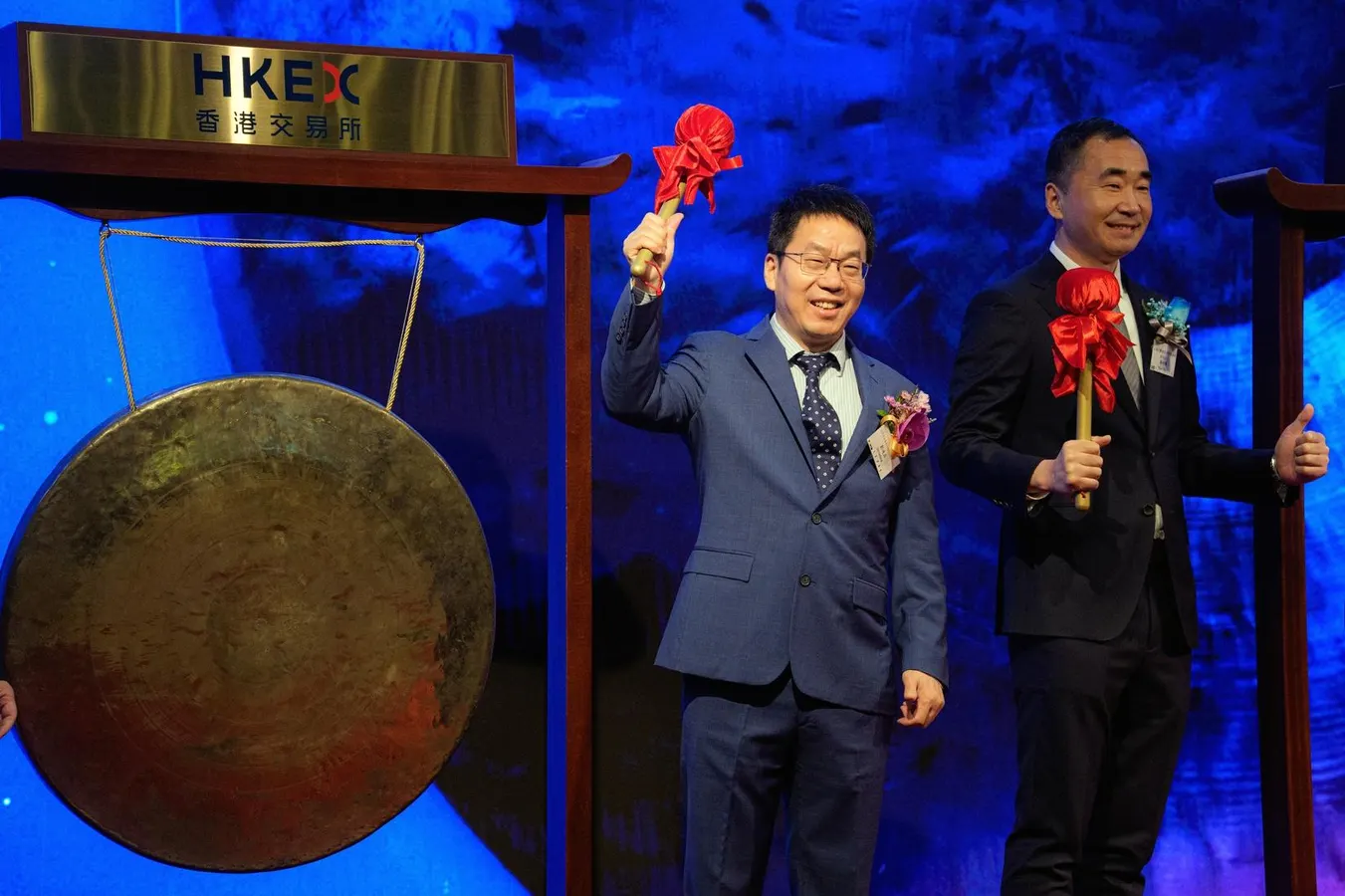
Liu Debing, chairman of Knowledge Atlas Technology JSC Ltd., better known as Zhipu, left, during the company’s listing ceremony at the Hong Kong Stock Exchange in Hong Kong, China, on January 8, 2026.
Lam Yik/Bloomberg
Chinese AI model developer Knowledge Atlas Technology had a lukewarm market debut when it listed in Hong Kong in January. However, as the company, better known as Zhipu, demonstrates steady technological progress, its shares have soared nearly 1,000% this year, leading Chairman Liu Debing to amass a fortune of $22.4 billion amid the blistering rally.
The 50-year-old mogul is now the richest billionaire minted by China’s recent AI boom, following a wave of initial public offerings that generated immense wealth. Overall, he is the 15th richest man in the country, according to Forbes’ Real-Time Billionaires List. Zhipu’s chief scientist Tang Jie, who is a professor of computer science at the country’s Tsinghua University, is also a billionaire with a net worth of $5 billion based on his own stake, according to Forbes estimates. A company spokesperson declined to comment on their respective net worth.
Investors are piling into Zhipu because they believe it has gone from “too small, too marginal a player” to a “real tech champion,” says Charlie Chai, a Shanghai-based analyst at research firm 86Research. The Beijing-based company initially faced skepticism over its ability to develop AI effectively after being blacklisted by the U.S. on national security grounds last year. It also faced fierce competition from local rivals, including fellow Hong Kong-listed MiniMax Group, when it raised $558 million in its January IPO.
But Zhipu has launched world-class models amid an accelerating shift toward domestic alternatives, including chips from Huawei and Cambricon Technologies. The company unveiled in February GLM-5, an AI model that can reason and write code. Zhipu says it has a performance comparable to Claude Opus 4.5, a product Anthropic released last November.
An updated version, the GLM-5.1 launched in April, made breakthroughs in response speed, according to a May research note from Macquarie Capital. Such improvements are especially crucial in the age of AI agents. These digital assistants need to tap models more frequently to perform complex tasks such as building websites and drafting business proposals, meaning cumulative delays across multiple steps can significantly degrade overall performance.
For its part, GLM-5.1 enables agents to “build a sophisticated website within 30 seconds,” according to the Macquarie note. Zhipu’s models are now considered first-tier in China, alongside products from Kimi and Alibaba Group Holding, according to Chai. To further its AI research, the company is now seeking to raise at least 15 billion yuan ($2.2 billion) by issuing up to 38.8 million new shares on Shanghai’s Nasdaq-style Sci-Tech Innovation Board, according to a Tuesday stock exchange filing.
“Zhipu made very strong progress in LLM (large language model) performance in recent months, securing a first-tier position in the global race and gaining global recognition,” Chai says. “Its capabilities in reasoning and coding are particularly strong, in fact fairly close to global leaders such as Claude.”
Last year, Zhipu’s revenues surged 132% year-on-year to 724.3 million yuan. Its losses went up by almost 60% to 4.7 billion yuan as the company invested heavily in research and development. The firm charges developers per million tokens used—a metric that measures the volume of data processed. Sales are projected to grow at least 100% over the next three years as its models become increasingly popular, says Kenny Ng, a Hong Kong-based securities strategist at Everbright Securities International. In April, Zhipu raised its model prices by at least 8%, marking its second price hike in two months, following a 30% increase in February.
Yet analysts warn that market enthusiasm might be running too high. Zhipu, along with MiniMax Group, often sees shares move by over 10% in either direction during a day. These AI companies are subject to bouts of speculative trading, as investors scout for industry leaders and rapidly reallocate capital.
Everbright’s Ng advises a wait-and-see approach given Zhipu’s dramatic rally. 86Research’s Chai, who has a price target of HK$1,300 for Zhipu (the company trades at HK$1,455 per share on Tuesday), agrees that the stock is quite expensive now.
“Model companies represent a very new business model and cost structure, which we have difficulty finding comparable reference points from the ‘old economy,’” he says. Chai adds that his target price for Zhipu already factored in growth over the next five years until 2030, and the company, due to heavy research investments, might not generate a profit over the next three years.















Leave a comment