


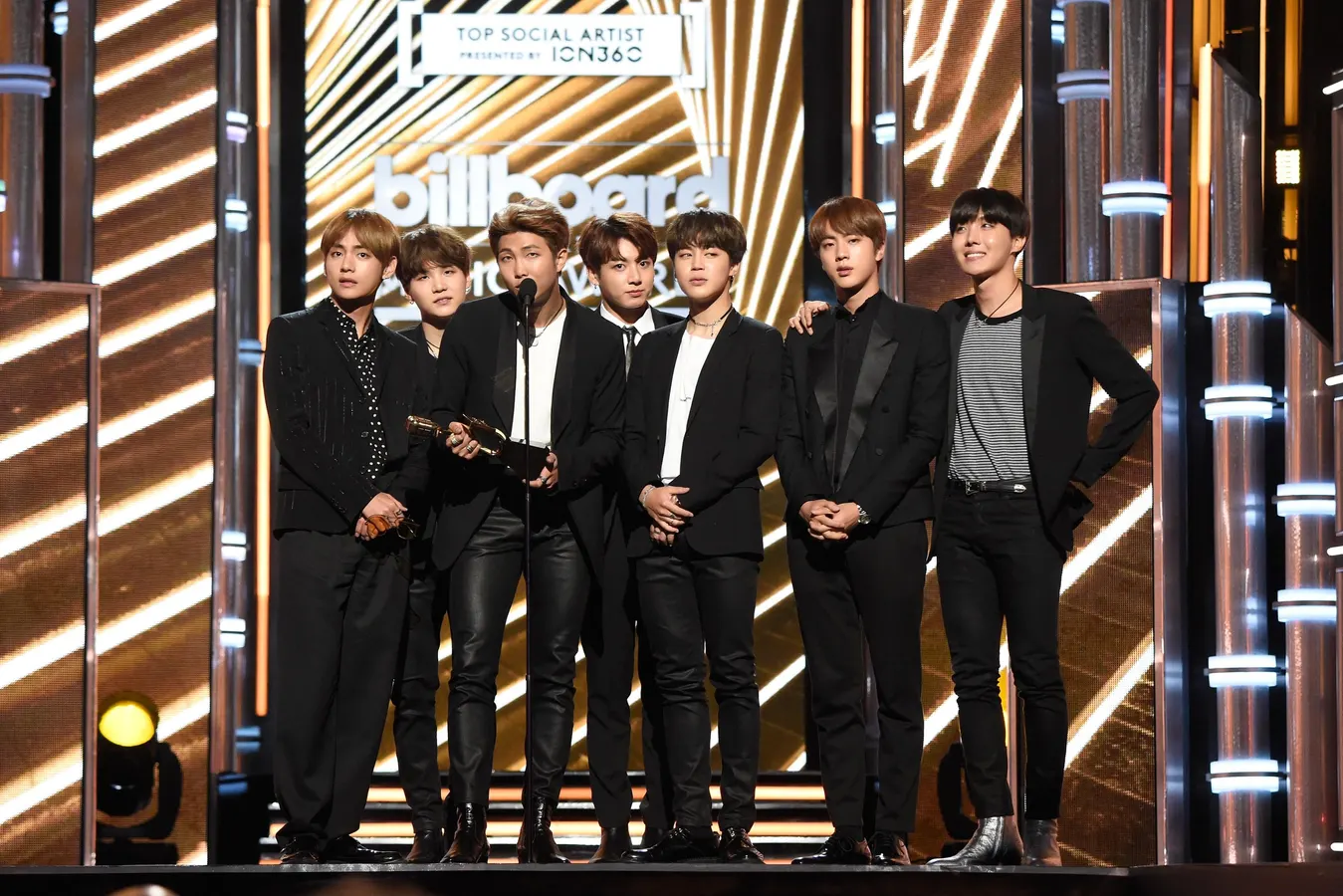

Music group BTS accepts the Top Social Artist award onstage during the 2017 Billboard Music Awards (Photo by Kevin Mazur/BBMA2017/Getty Images for dcp)
Getty
South Korean pop music, also known as K-pop, has been dominating the music scene and has transformed into a global phenomenon. Musical acts like BTS, BLACKPINK, and Stray Kids can be seen and heard everywhere — on the radio, online, in mainstream media, on the Billboard charts, in magazines, and in brand deals. Now, there are American films and television shows centered on the popular genre, further expanding its massive fandom. K-pop fans have been the driving forces for music and ticket sales, merchandise, viral social media campaigns and even mobilizing movements.
What Is K-Pop?
K-pop is a popular music genre originating in South Korea. The term was coined in the 1990s as music began to be influenced by Western and American culture, including hip-hop, rock, R&B, pop, rap and dance. It has since evolved further, incorporating Latin music, Afrobeats, EDM, experimental, reggae and more.
In the entertainment industry, K-pop is best defined by its visual aesthetics, sharp, intricate choreography, strong vocals and charismatic stage presence.
South Korean entertainment companies have long-established trainee programs that consist of singing lessons, dance classes, media training, language courses (Korean, English, and/or Japanese) and more. Trainees undergo rigorous training for months to years at an early age before their official debut as artists.
Initially started by SM Entertainment, led by the “Father of K-pop” Lee Soo Man, the system expanded to more companies like YG and JYP. Former executives, creatives and artists from those companies left to establish their own labels, bringing the knowledge along with them. Bang Si-hyuk, the founder of BIGHIT MUSIC (now HYBE), previously worked for JYP founder Park Jin-young before leaving to start his own company, and utilized the training system to form his own groups, including BTS.
Many trainees have failed to debut or have moved between entertainment companies. For example, G-DRAGON, one of the most successful South Korean artists, trained for 11 years (five years at SM Entertainment, six years at YG Entertainment) before debuting at 18 with BIGBANG in 2006.
The goal for many trainees is to pass the final test to debut as a group or a solo act. Even if an artist were to debut, there is no guarantee of success. An average of 100 rookie groups debut annually in the highly competitive industry, but few survive past the first year, let alone the five or seven-year mark (typically when a contract goes up for renewal).
The Origins And Evolution Of K-Pop
K-pop’s origins date back to the 1950s with The Kim Sisters. During the Korean War, three Korean girls — sisters Sook-ja and Ai-ja, and cousin Min-ja — performed for U.S. military personnel, singing popular American songs, a mix of country, hillbilly and folk music. An American promoter brought them to the U.S. for a tour, where they became regulars on The Ed Sullivan Show. The women dealt with sexism and xenophobia during their careers. They continued to perform for over 20 years before retiring as a group in 1975.
In the 1970s and ‘80s, popular music in Korea consisted of ballads and folk music. There were still no training programs or concepts involved with artists and performers. The earliest iteration of what audiences know as K-pop was back in 1987, with the dance-pop trio SonBangCha. The group later broke up, citing that the world “wasn’t ready for their style.”
Following SonBangCha, entertainment companies took notice and began creating K-pop trainee programs to equip budding artists with the skills to eventually become superstar idols. Different generations of K-pop idols have emerged to reflect changes in social and industry trends, music styles, technology, media, fan culture and global popularity.
First Generation of K-Pop (roughly 1992–2003)
In the 1990s, K-pop really took off and has maintained steady popularity in Korea. As hip-hop, rap and breakdancing dominated American airwaves during the ‘90s, Korean youth found themselves drawn to African American hip-hop and its social commentary. Hyun Jin-young was a pioneer in introducing hip-hop to K-pop, debuting in 1990. In 1992, Seo Taiji and Boys debuted and further pioneered the use of rap in K-pop. Many have cited them as the first-ever K-pop group, as their members have inspired or discovered many future idols. During the mid-to-late ‘90s, the term “K-pop” was first used to describe the first generation of K-pop groups, including H.O.T., S.E.S., Shinhwa, g.o.d., Fin.K.L, and Sechs Kies.
Second Generation of K-pop (2003–2012)
The second generation of K-pop artists emerged in the early to mid-2000s, focusing on expanding their global reach and introducing the Hallyu wave, the rise of international interest in South Korean pop culture. Groups like TVXQ, Super Junior, BIGBANG, 2NE1, Girls’ Generation (SNSD), Wonder Girls and 2PM became popular beyond South Korea, thanks to more attractive concepts, intricate choreography, inclusion of international idols and a stronger fan culture.
Global artists BIGBANG revolutionized K-pop by creating “Bang Bong,” the first modern lightstick, which G-DRAGON designed himself in 2007. Now, almost every K-pop group has a lightstick for fans to use during concerts and fan events.
To increase global presence and appeal, companies also began debuting non-Korean or international idols into their groups, including Chinese artist Han Geng (Super Junior), Thai American Nichkhun (2PM), Victoria Song and Amber Liu of f(x), who are both of Chinese descent, Chinese artists Fei and Jia (Miss A), and more.
Third Generation of K-Pop (2012 – 2019)
The third generation of K-pop groups has become the most well-known internationally, reaching mainstream levels, including BTS, BLACKPINK, EXO, NCT, GOT7, SEVENTEEN, MONSTA X, MAMAMOO and TWICE. With the rise of YouTube, Twitter (now X), Instagram, VLIVE (now Weverse) and other streaming platforms, artists became more accessible to their audiences. During this time, more entertainment companies emerged, including BIGHIT MUSIC (now the powerhouse HYBE Corp.), Kakao Entertainment and KQ Entertainment.
Fourth Generation of K-Pop (2019-2023)
Fourth-generation K-pop groups (2019-2023) were heavily influenced by the digital and social media age, which enabled more cinematic concepts, experimental sounds, self-production and greater digital access. More groups began building larger international fanbases and adopting more global marketing strategies. Artists include Stray Kids, ATEEZ, LE SSERAFIM, I-DLE, ENHYPEN, aespa, P1Harmony, NMIXX, TOMORROW X TOGETHER (TXT) and NewJeans.
Entertainment companies also began using the K-pop training system and survival competition shows to form their own groups composed entirely of non-Korean members, such as Honey Popcorn, Blackswan, NiziU, JO1, INI, XG, WayV, MODYSSEY and ME:I.
Fifth Generation of K-Pop (2024 – current )
Now, in its fifth generation of K-pop artists, newer groups like RIIZE, CORTIS, xikers, TWS, BABYMONSTER, Hearts2Hearts, All(H)ours, ZEROBASEONE, KIIIKIII, ILLIT, LNGSHOT, ALPHA DRIVE ONE and BOYNEXTDOOR have heavily relied on social and viral trends, authenticity and individuality, self-production, new technology and apps and have begun to define their own music style.
K-Pop’s Global Expansion
The Hallyu wave began in Japan, as K-dramas gained popularity in the early 2000s. Korean companies began incorporating Japanese into their music, with K-pop groups releasing full-Japanese albums. Korean artist BoA, who sang in Korean and Japanese, became a success, followed by TVXQ and BIGBANG, as their music climbed the music charts.
Other Asian countries followed suit as K-pop (and K-dramas) became mainstream across the continent, especially after K-pop groups began integrating members from other countries, including Thai artists like BLACKPINK’s Lisa, GOT7’s BamBam, and NCT’s Ten.
There have been many attempts to bring K-pop into North America and other Western countries. In 2006, Korean artist Rain sold out New York’s Madison Square Garden and was included in Time Magazine’s TIME 100 as the “Korean Justin Timberlake,” but, after a few failed business ventures, returned home to Korea. The next year, Wonder Girls made history as the first South Korean act to be charted on the Billboard Hot 100 with their song “Nobody” at No. 76. They opened for the Jonas Bros Tour in North America in the same year, but after going on hiatus in 2012, they eventually disbanded in 2017. Korean rapper Psy made the biggest entry into America with his 2012 mega-hit track, “Gangnam Style,” shattering YouTube records as the first video to reach 1 billion and 2 billion views, and sparking a worldwide dance craze, coming in at No. 2 on the Billboard Hot 100. Sadly, his subsequent tracks failed to make an impact, and he returned to Korea.
With the introduction of KCON, a convention dedicated to bringing Korean culture and music to the American fanbase, more K-pop groups were introduced to the masses. Yet it wasn’t until BTS began promoting themselves in the U.S. in 2014 that K-pop slowly broke into the mainstream and stayed there.
BTS heavily utilized social media to interact with their fans, releasing funny, unfiltered vlogs and music that was relatable and tackled mental health, depression, societal issues and politics. Western media took notice of the group after they won Top Social Artist at the 2017 Billboard Music Awards, resulting in an avalanche of accolades, increased sales, and No. 1 chart successes. But it wasn’t until the COVID-19 pandemic that the group became a household name, as people consumed their music, videos and performances while stuck at home.
Though BTS’s anticipated return and comeback after their mandatory military service have proven popular and economically successful for the group, they are not an indicator of K-pop’s global popularity. BTS has far surpassed its K-pop identity and is an anomaly in terms of success. Similar to Taylor Swift, Lady Gaga and Beyoncé, BTS cannot be compared to other artists in their respective genres.
K-Pop’s Global Popularity Shows No Signs Of Slowing
K-pop has seen significant growth in popularity due to the genre’s mainstream acceptance and its fandom’s buying power. K-pop fans spend an average of $100 to over $1,400 annually, depending on the number of groups they like and their dedication to them. “Superfans” spend even more a year on concert tickets, albums, merchandise and other collectibles. There are even K-pop sections in the music aisle in Target and Walmart.
Companies and organizations understand the value of including K-pop artists. K-pop groups have become a staple at American music festivals, such as Coachella, Lollapalooza, Outside Lands, The Governors Ball and Austin City Limits. For example, when j-hope was announced as the headliner for Lollapalooza 2022 in Chicago, Sunday ticket sales soared. According to Uproxx, the addition of the BTS member to the festival resulted in the most tickets ever in the festival’s history and performance for over 100,000 fans.
It’s not just with the music scene. After Netflix’s award-winning animated feature, KPop Demon Hunters, became a cultural phenomenon, it further introduced audiences to Korean culture and its popular music. It has secured multiple licensing deals with popular brands, such as McDonald’s, Vans, Mattel, Hasbro, LEGO, Nongshim and more. With the success of the film, more K-pop-based projects were greenlit, including the sequel to K-pop Demon Hunters, slasher thriller Perfect Girl, K-Pop Superstar: The Movie, K-Pop: Lost In America, and an untitled Benson Lee-directed 20th Century Studios K-pop film.
With high interest in K-pop and their massive fanbases, Western artists have taken notice. There has been a rise in Western artists collaborating with K-pop artists, allowing access to both fan bases. Rosé and Bruno Mars’ “APT” was nominated for a Grammy. G-DRAGON worked with the legendary Missy Elliott on the track, “Niliria.” Megan Thee Stallion worked with both BTS and TWICE. Snoop Dogg has had a long history with K-pop, having worked with Girls’ Generation in 2011 and since collaborating with PSY, 2NE1, MONSTA X and BTS. Jung Kook teamed up with R&B dance icon Usher for a song on his solo album, Golden.
What To Expect As K-Pop Continues To Build Global Momentum
Many Korean entertainment companies have begun to expand their global reach by establishing subsidiaries and partnerships with international labels to develop more artists and encourage cross-collaboration. HYBE and Geffen Records collaborated to form KATSEYE, who do not consider themselves K-pop but “K-pop adjacent,” and have been nominated for a Grammy. JYP Entertainment partnered with Republic Records to form the American group GIRLSET. CJ ENM, JYP CHINA, and Tencent Music Entertainment, a Chinese entertainment company, formed a joint venture to manage the Chinese K-pop group MODYSSEY.
It has also opened the door for other musical acts to enter the global scene, with many countries adopting Korea’s idol system, including the Philippines, Thailand, Indonesia, China and Japan. For instance, P-pop group BINI made history at this year’s Coachella as the first Filipino act to perform at the festival, and T-pop singer Jeff Satur was the first Thai artist to perform at the Grammy Museum.
The increased visibility of K-pop projects doesn’t always translate into the genre’s future success, though. The K-pop market is saturated, as several groups often have multiple comebacks within a year. Dedicated fans feel the urge to spend on their favorite group, especially for those who collect photocards.
While already established groups like BLACKPINK, Stray Kids, TWICE and SEVENTEEN have no trouble finding their fans, smaller, newer acts will struggle to gain attention. K-pop album and digital sales have also been declining since last year (again, not counting BTS). Fans are beginning to question whether or not the cost justifies the means, which may mean fewer new groups performing in the U.S. anytime soon.
As K-pop continues to grow in the mainstream, so does the demand for music and content. More K-pop artists are releasing English-language songs to gain more radio play and potentially chart higher on international streaming platforms, including BTS, MONSTA X, P1Harmony, TWICE, BLACKPINK and Stray Kids. P1Harmony, NMIXX, Super Junior and EXO’s D.O. have also released Spanish-language songs to reach their Latin American audiences, amid a boom in Korean culture and consumerism. If K-pop groups continue to cater to and evolve with their fanbases without losing their authenticity as artists, then K-pop will grow even more.














Leave a comment