


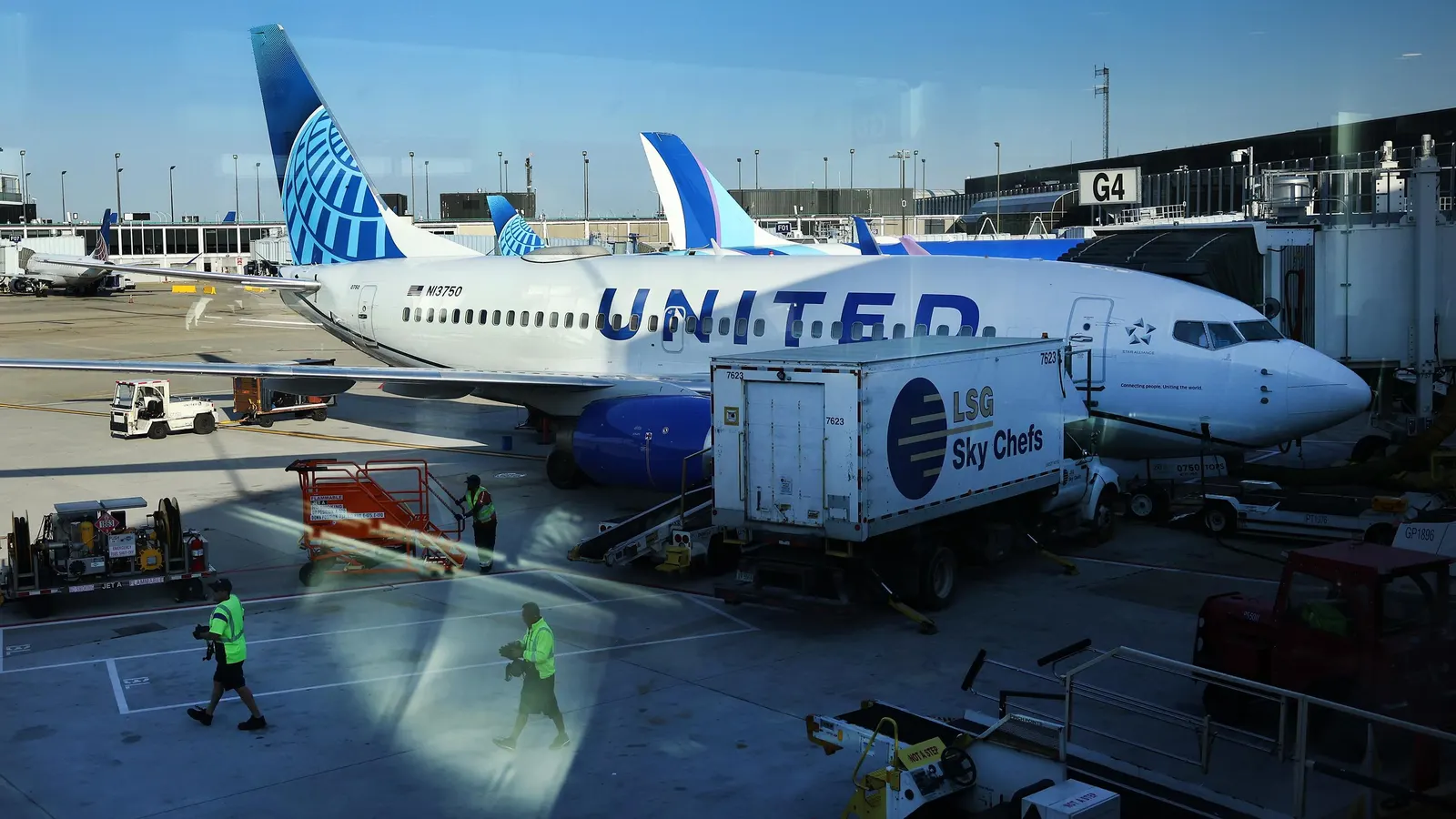

A United Airlines plane is parked at its gate at Chicago O’Hare in September 2025. (Photo by Chris Sweda)
TNS
United Airlines is facing a challenging week that includes a Federal Aviation Administration hearing likely to focus on its rapid planned growth at Chicago O’Hare, three days of negotiations with its flight attendants union and now an expected fuel price spike.
The anticipated fuel price spike, which follows the United States’ and Israel’s attack on Iran, of course impacts all airlines. “Operation Epic Fury and jet fuel volatility are likely to drive near-term performance of airline stocks,” Cowen analyst Tom Fitzgerald wrote in a Monday morning note. “Middle East exposure is modest for U.S. carriers, but fuel shocks will pressure earnings.” Fitzgerald wrote that a fuel price spike in 20222 saw earnings per share fall, “then recover as pricing offset fuel.”
Shortly after noon ET on Monday, American shares were down 4%, United shares were down 3% and Delta shares were down 3%.
Meanwhile, United will be facing off against both American Airlines and the Association of Flight Attendants in meetings this week. The two seem to have forged situational alliances, as AFA President Sara Nelson has favorably compared American CEO Robert Isom to United CEO Scott Kirby, and has also spoken out on United’s flight buildup.
The FAA announced Friday that it will conduct a scheduling reduction meeting on Wednesday in Washington. The agency said it has determined that planned increases in O’Hare flying will exceed airport capacity. Current published summer schedules exceed 3,080 daily operations on peak days, up from 2,680 daily operations in the summer 2025 schedule, the agency said.
United appears to be the carrier most likely to be impacted by a reduction, because United has vastly increased O’Hare flying. Both American and United have announced summer flight increases, but American planned capacity is up about 10% year over year. while United flying is up about 34% year over year. Several times per day, United alone appears to exceed the FAA’s posted air traffic control rate of 100 departures per hour.
Part of the competition involves adding flights because the airport’s gate allocation is based on the number of departures. United’s increase in the Chicago-Grand Rapids market have drawn attention, because in June United will operate up to 11 daily departures in the market.
Responding on Friday to an X post on the Grand Rapids increase by Reuters reporter David Shepardson, Nelson posted, “This is called ‘flooding the zone.’ It’s likely to lead to delays, cancelled flights, and a bad experience for everyone in and out of Chicago.
“Maybe focus on drastically underpaid flight attendants – negotiate a new contract rather than setting us up for a summer of hell,” Nelson wrote.
Kurt Ebenhoch, a Chicago based media consultant and formerly a spokesman for Northwest, Delta and United, questioned the apparent FAA assumptions. He noted that O’Hare has eight runways. (This includes six parallels and two diagonals.)
“Eight is the most runways of any airline hub airport in the world,” Ebenhoch wrote in an email. “What incentive does any airport have to add runway capacity if this is going to happen? I would imagine the FAA had an approving role in building the runways, and may even have approved funds. It defies logic.”
American said Monday that the issue is not runway capacity, but rather airspace capacity and taxiway congestion exacerbated by ongoing construction.
American welcomed the hearing, saying Friday in a press release that, “American commends Secretary Duffy, Administrator Bedford and the FAA for taking proactive action to ensure the operational integrity of the airfield and airspace in Chicago.”
United said Friday, “We appreciate Secretary Duffy and FAA Administrator Bedford’s leadership in convening this meeting. We share their commitment to running a safe and reliable operation out of ORD and look forward to a collaborative discussion.”
As for AFA Contract talks, United said Friday in a negotiations update that its proposal “would deliver the highest flight attendant pay among U.S. carriers.” It said that “AFA has proposed significant changes to how United operates, many of which would materially change scheduling, staffing and other operational practices,” which would increase costs beyond what United offered in the tentative agreement that flight attendants rejected in July 2025. That tentative agreement offered 27% raises.
Talks have gone slowly, Nelson said in a Feb.23rd interview. She put the blame on Kirby and compared him with Isom.
“Scott Kirby keeps saying that if our people are happy, they are going to make our customers happy,” If he believed that, Nelson said, “he would do what Robert Isom is doing. One knows how to do labor deals and one has yet to finish them.”
















Leave a comment