


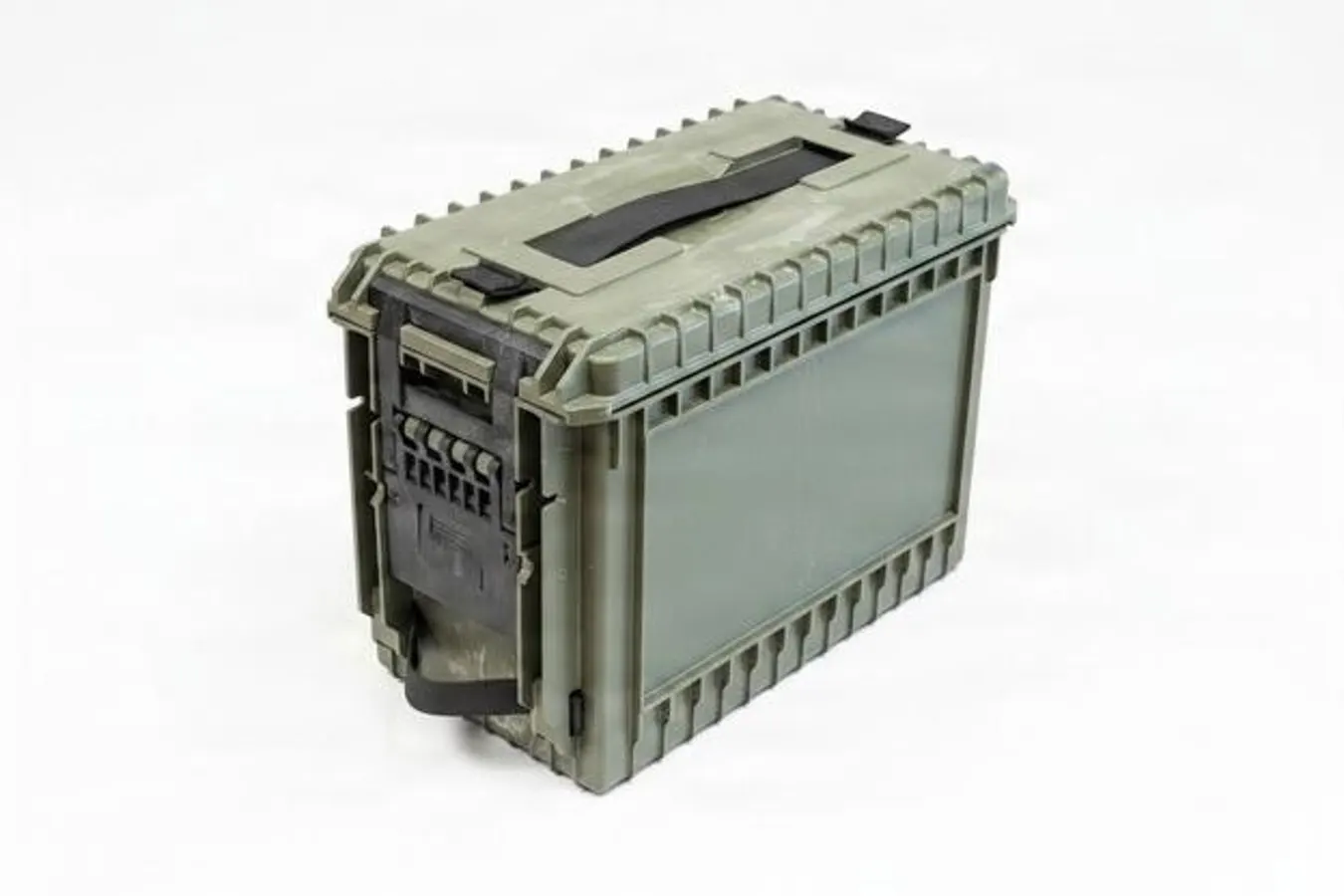

The U.S. Army Combat Capabilities Development Command (DEVCOM) Armaments Center’s next-generation lightweight packaging system, SixPAC, is built to modernize small‑caliber logistics and reduce weight, costs, and supply‑chain vulnerabilities.
Photo: Eric Kowal, Army
Since the days of World War II, the United States Army’s small arms ammunition has changed considerably. The service replaced the venerable .30-06 Springfield and .30 Carbine cartridges with the 5.56×45 NATO round during the Cold War, and the U.S. Army is now in the process of transitioning to the advanced 6.8x51mm common cartridge – also known as 2.77 Fury. The new round was developed to find a middle ground between the legacy 5.56x45mm and the heavier-hitting 7.62x51mm cartridges used by the U.S. military and its NATO allies. The hope for the Pentagon is that the new cartridge could eventually find a place along the other NATO standards.
Yet, even as there has been focus on developing improved cartridges since the Second World War, there has been little to no effort in advancing the way ammunition is packaged for distribution to the troops, at least until last month.
That is when U.S. Army Combat Capabilities Development Command Armament Center announced the introduction of a new polymer system that is the first major overhaul of small-caliber packaging, the first since the days of the “Greatest Generation.”
The Metal Ammo Box Has Met Its Match
The old metal ammunition boxes could arguably be one of the greatest military inventions of all time. Besides being effective at carrying ammunition, the sturdy metal boxes are widely used in the civilian world to hold tools, camping and outdoor gear, and other items.
Ammo boxes have been a stable product of army/navy surplus stores across the country for decades, but not all are technically “surplus” as there is no shortage of non-military knockoffs out there.
Yet, the old ammo boxes have finally met their match!
The polymer containers offer much of the strength but weigh just half of the legacy steel ammo boxes, which will reduce the load carried by soldiers in the field.
It is expected that more than 800 injection molders across the country will be capable of producing the crates, saving the Pentagon and taxpayers while also lowering the barrier to entry for new suppliers.
Grab a SixPAC
The new packaging, dubbed the “SixPAC” for its capacity to hold the 6.8mm cartridges, now features two lightweight polymer ammunition containers in a steel outer pack.
“After successful implementation with the cartridges, the system is planned for adaptation across multiple legacy small-caliber ammunition production lines,” the Army announced last week.
This change doesn’t run contrary to the old school thinking that if it isn’t broken, it shouldn’t be fixed. Rather, it was part of an effort to address supply chain vulnerabilities, rising costs and a need to prepare for tomorrow’s military operations in varied climates.
Those concerns led to the “reevaluation” of the legacy munitions packaging.
The new SixPAC offers a lighter tactical inner pack, which could increase the manufacturing base and further increase efficiency. The polymer system also removes wood entirely from the equation, as the old heavy metal ammo boxes were transported in wooden crates.
Those crates were manually assembled and were susceptible to mold during storage. By going with polymers, the process is simplified and there is also a reduced reliance on chemical treatments that were necessary with wood, which in turn lowers the environmental impacts.
The polymer inner pack enables easier transport. At the same time, the steel outer pack reduces the logistical footprint. That allows more containers and ammunition per pallet and has a notably larger supply base than its legacy wood counterpart.
“It’s a developing field, and polymers are unique — you can modify them, include additives that improve impact performance, stiffness or dimensional stability,” said Edward Lucas, a mechanical engineer and polymer designer at the Development Command Armament Center. “You can add more ingredients to the cauldron and your potion will come out different, trading some characteristics for others.”
Evolution of Ammunition Crates
Polymer is the latest in the evolution of ammunition crates. The earliest form of small arms ordnance storage was soft leather cartridge pouches or “belly boxes,” which began to be used in the 18th century to keep paper cartridges dry.
It was only with the widespread adoption of self-contained metallic cartridges using a metal base that there was a need for true ammunition boxes or crates. The earliest were simple wooden boxes that began to appear around the time of the American Civil War, around 1863.
By the end of the 19th century, militaries around the world adopted reinforced wooden boxes that featured internal sheet metal or zinc linings to fight off moisture. Wooden ammunition boxes are still widely used as a way to transport ammunition, but they could hardly be described as the most effective given the weight they add.
Expended ammunition .50 cal. casings are set in an ammo can after a M2A1 .50 cal. machine gun live-fire training exercise on Marine Corps Base Camp Lejeune, North Carolina, March 6, 2025.
(U.S. Marine Corps photo by Lance Cpl. Dominic Trujillo)
In September 1942, as the U.S. military was involved in World War II, the U.S. military officially adopted the hermetically sealed steel M2 ammunition can, which provided completely waterproof small-arms storage for the .50 caliber machine gun. It could hold linked .50 BMG belts for the heavy machine gun, but the same metal ammo box could carry upwards of 2,200 loose rounds of 9mm or 1,200 loose rounds of 5.56mm ammunition.
Although the famed ammo cans are likely to remain a favorite of civilians as nearly indestructible storage boxes, the future for the military may be with polymer crates.
















Leave a comment