


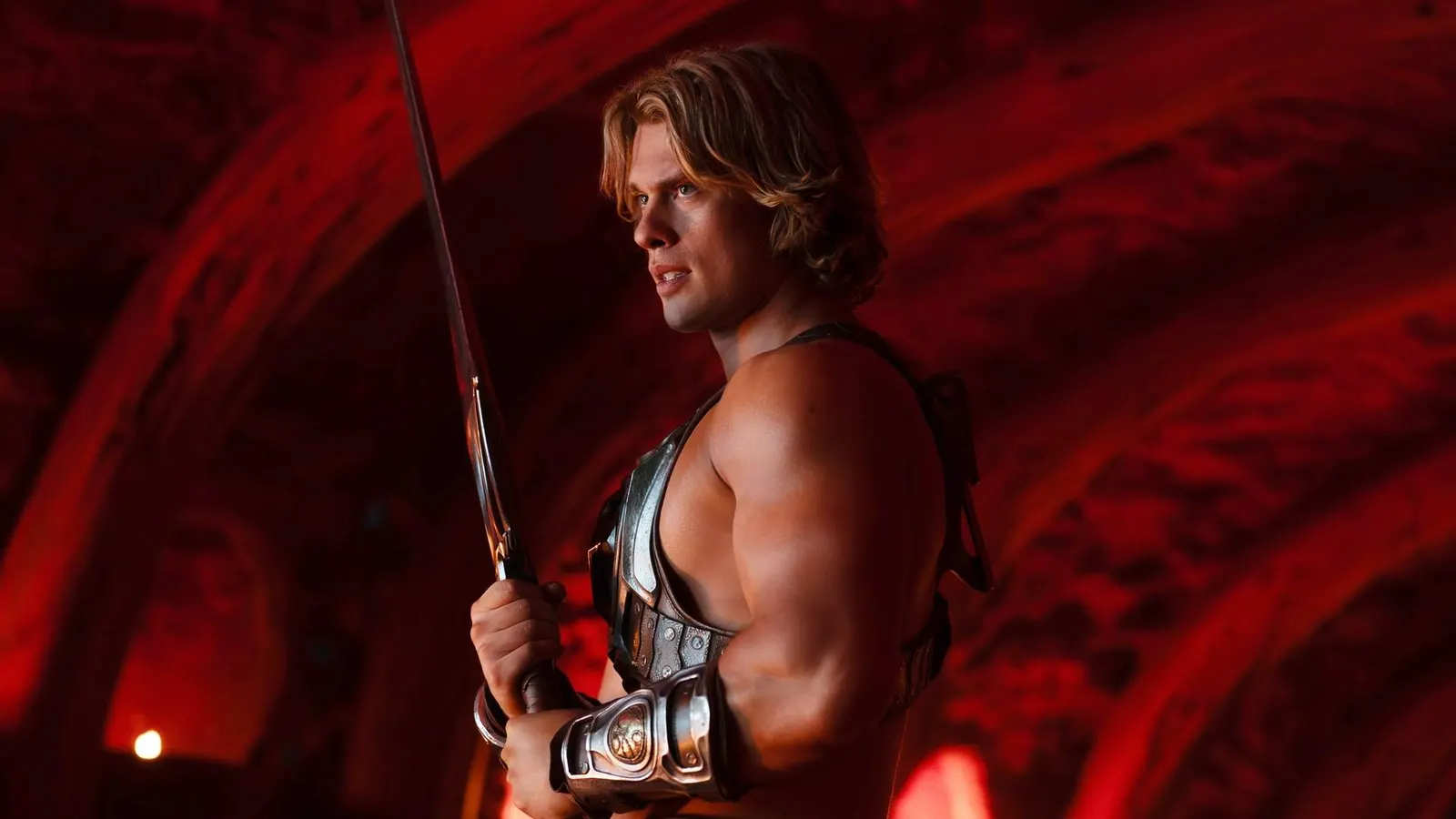

Nicholas Galitzine in “Masters of the Universe.”
Amazon MGM Studios
Despite the success of Mattel’s Masters of the Universe action figures, animated series and other franchise productions, He-Man appears to be heading toward a “He-Meh” opening at the box office.
That, of course, was not the case with the big-screen version of Mattel’s Barbie in 2023, which went on to make more than $1.4 billion at the worldwide box office against a $145 million production budget before marketing costs. On top of that, Barbie earned eight Oscar nominations including Best Picture, a rarity for a comedy.
Save for craft nominations like Best Visual Effects, no one is likely expecting major Oscar nominations for Masters of the Universe, and clearly that was never director Travis Knight’s intention. After all, the animated series from which the Mattel action figure line was drawn had a bouncy, feel-good atmosphere about it, and having screened the second live-action feature iteration of Masters of the Universe, the new movie nails that tone completely.
The film’s cast members, from Prince Adam He-Man actor Nicholas Galitzine to Man-At-Arms Duncan actor Idris Elba, are all-in when it comes to the film’s cartoonish vibe. Better yet, Jared Leto, who voices the film’s evil wizard Skeletor, turns in a whimsical performance that steals the show.
Better yet for Masters of the Universe, the He-Man origin tale has impressed most Rotten Tomatoes critics, earning a good but not great review score of 69% based on 154 reviews through Friday morning. In addition, audience reaction among RT users is stellar, with the film earning an 88% “fresh” Popcornmeter score based on 500-plus verified user ratings.
Best of all, though, is that Masters of the Universe, like Barbie, has something most films have, which is brand recognition. Beginning with Mattel’s Masters of the Universe toy line in 1982, the franchise quickly spawned the animated TV series in 1983 (which led to more spinoffs series and reboots), an animated feature in 1985 and the live-action feature film in 1987, as well as books, comics and video games.
The film also gave Mattel the opportunity to create more Masters of the Universe action figures based on the likenesses of Galitzine, Elba and Camila Mendes, who plays Prince Adam’s longtime friend, Teela. On top of that the iconic toymaker has issued reproductions of the classic figures and new versions from the original animated series.
Not surprisingly, there are Masters of the Universe-themed popcorn buckets to help market the film, too, including containers shaped like Castle Grayskull and Skeletor’s head. The drink containers are pretty crafty, too, including one that’s adorned with a He-Man action figure and another shaped like the muscular hero’s Sword of Power.
Despite all of the seeming momentum going for Masters of the Universe, marketing-wise, the film is projected for a soft opening in its opening weekend, but why?
‘Masters Of The Universe’ Is Projected To Earn $30 Million To $35 Million In Its First Weekend Frame
There’s no getting around it — the opening weekend projections for Masters of the Universe are weak.
On Tuesday, Deadline projected a $30 million domestic opening, while Variety pegged a slightly more favorable $33 million take in the film’s first Friday to Sunday frame. Even Box Office Pro, which generally casts a wider net in its projections, noted in mid-May that the film was tracking to make anywhere from $25 million to $35 million in its opening weekend debut.
However, the number that is sure to impale the He-Man movie’s ambitions of being a hit is the film’s production budget, which Variety reported is $200 million before its marketing spend.
Jared Leto in “Masters of the Universe.”
Amazon MGM Studios
Speaking of marketing, one of Masters of the Universe’s vital cogs — Jared Leto— has been largely missing when it comes to the promotion of the film. He didn’t attend the press junket, and his Instagram page, which has 11.4 million followers, has been radio silent with no mentions of Masters of the Universe or his turn as Skeletor. Instead, the page is largely devoted to his music career with his band, 30 Seconds to Mars.
Of course, given the actor’s controversial behavior offscreen — Vulture has a complete rundown of it and Variety in 2025 questioned how it could impact the then-unreleased TRON: Ares and Masters of the Universe — so it’s completely within reason that Amazon MGM Studios didn’t want his help in promoting the film. At the very least, Variety asked Amazon MGM for comment, but the studio declined.
Whatever the case may be, given the importance of Skeletor in Masters of the Universe lore and the lack of even one Instagram post by Leto to push the film can’t be anything but damaging to the film’s financial prospects.
Who Is ‘Masters Of The Universe’ Actually For?
While things could change and Masters of the Universe could over-perform over the weekend – after the boom in business Obsession and Backrooms experienced anything goes — executives at Amazon MGM Studios will have to confront what is sure to be a huge financial post-mortem examination to figure out what went wrong. Given the film’s tracking numbers, that post-mortem may be underway already.
One thing that can’t be blamed, though, is the Masters of the Universe IP, which has been around for 40 years. Clearly, there’s been enough of a fandom to sustain the Masters of the Universe brand for at least a couple of generations, so it only made sense to take a chance on a feature film. Translating that enthusiasm into a movie for the masses, however, is a different story.
In his analysis of what is sure to be a cruel weekend ahead for Masters of the Universe, Jordan Ruimy of World of Reel gave some thoughts on Tuesday as to why by asking a “basic but crucial question.”
Idris Elba, Nicholas Galitzine and Camila Mendes in “Masters of the Universe.”
Amazon MGM Studios
“Who is this movie actually for? Is it meant to appeal to kids, who have little to no connection to He-Man, or to adults who grew up with the toys and cartoon?” Ruimy asks in World of Reel. “It turns out most of the interest in Masters of the Universe seems to be coming from older male audiences who grew up with the franchise — but that demographic is not usually seen as a major driver of box-office success.”
The first part of that observation brings us back to the successes with the low-budget indie horror movies Obsession and Backrooms. Developing their respective followings on YouTube, Obsession director Curry Barker and Backrooms director Kane Parsons first achieved success on their YouTube channels and kept on delivering what their fans responded to on YouTube.
In short, they know their audiences, and luckily they each found producers who were willing to risk the finances ($750,000 for Barker to make Obsession, $10 million for Parsons to produce Backrooms) to prove their worth, and those investments have been rewarded handsomely.
The other factor to consider is that Barker and Parsons have delivered something new to moviegoers, while the big studios like Warner Bros. and Disney of late both hit the wall trying to push familiar IPs like Mortal Kombat II and Star Wars: The Mandalorian and Grogu to the masses.
The blistering successes of Obsession and Backrooms is a telling sign that moviegoers — at least Gen Z moviegoers of late — are sending a signal to Hollywood for the third time in the span of a month that they don’t like well-worn tires will present itself with the paltry opening of Masters of the Universe.
Does that mean there is no more room for popcorn movies featuring familiar faces, places and characters in pop culture? Of course not. But if the mother of all franchise films in 2026 — Avengers: Doomsday — has an opening akin to Star Wars: The Mandalorian and Grogu and Masters of the Universe, then the days of high-profile IP filmmaking that rests on the shoulders of audience nostalgia is doomed.












Leave a comment