


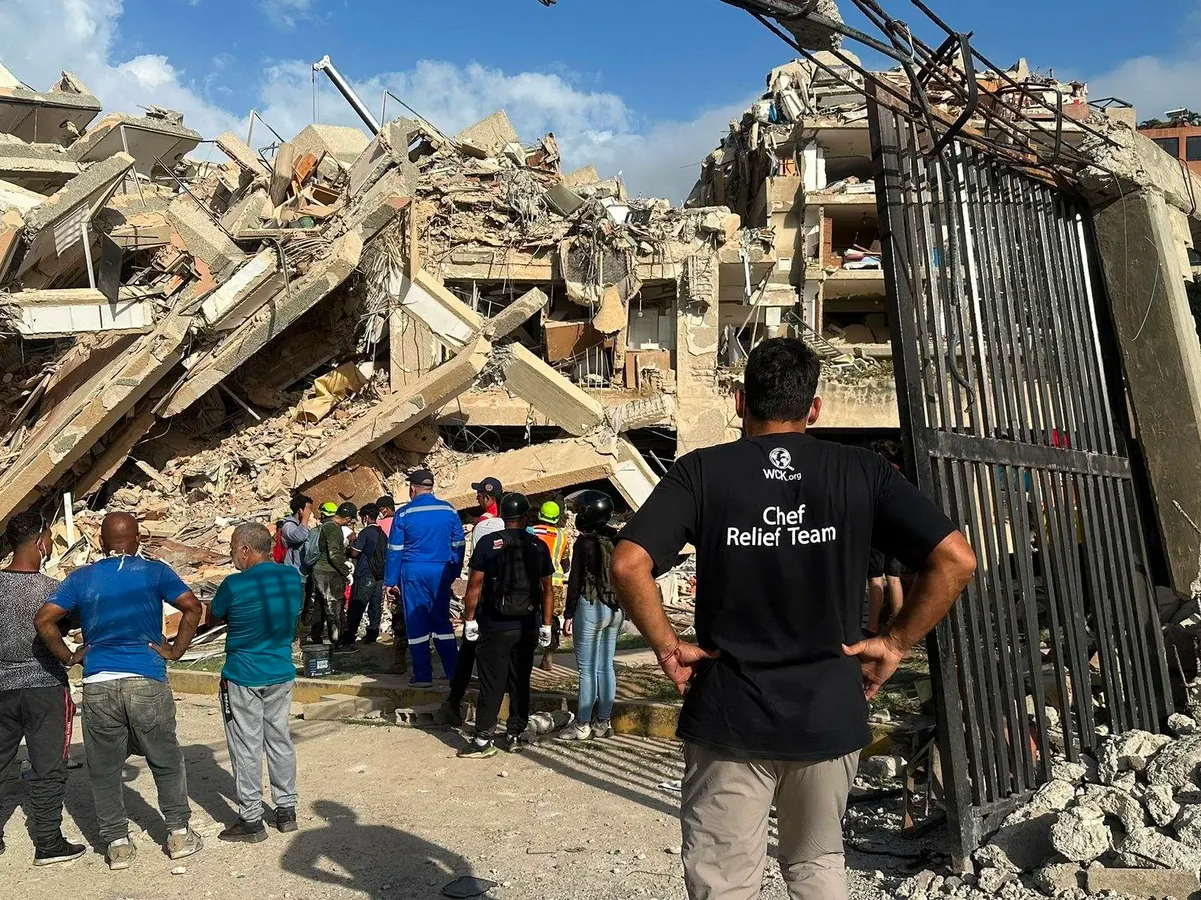

World Central Kitchen teams distribute meals to communities in Venezuela after two powerful earthquakes struck just 39 seconds apart in the northern state of La Guaira on June 24.
World Central Kitchen
In La Guaira, the coastal state north of Caracas that was among the areas hardest hit by Venezuela’s twin earthquakes on June 24, rescue crews pause their work several times a day. Bulldozers fall silent as someone calls into the rubble, hoping for a response from anyone still trapped beneath it.
For Olivier de Belleroche, World Central Kitchen’s culinary manager for Europe, known throughout the organization as Chef Oli, those moments are among the hardest.
“Everybody stops,” he says. “Somebody calls out, ‘If anyone is alive, knock three times. Scream.’ And then everybody falls completely silent.” For a few moments, everyone listens for any sign of life beneath the rubble.
Five days after the magnitude 7.2 and 7.5 earthquakes struck Venezuela, those pauses have become increasingly difficult. The chances of finding survivors are fading, but families continue to wait outside collapsed buildings as rescue crews press on with the search.
As of June 29, more than 1,700 people are confirmed dead, over 5,000 injured and nearly 16,000 displaced, while tens of thousands remain missing or unaccounted for. The United Nations estimates the disaster could ultimately affect as many as 6.76 million people.
Meeting An Urgent Need
As rescue crews continue searching for survivors, another urgent need has emerged.
Thousands of people who have lost their homes are sheltering in schools, parks, and makeshift camps. Rescue workers are working long shifts in intense heat, often without stopping to eat, while families spend their days beside collapsed buildings waiting for news of loved ones. With so many people displaced and daily life disrupted, access to food has become an immediate priority.
World Central Kitchen (WCK) has moved quickly to provide meals to those affected.
The nonprofit is working across Miranda, La Guaira, and Carabobo with 19 local restaurants and community partners to prepare and distribute fresh meals to displaced families, rescue workers, hospital staff, volunteers, and people sheltering on the streets.
A man waits in a makeshift tent at the Caraballeda relief center after the double earthquake destroyed his home in La Guaira. (Photo by Javier Campos/NurPhoto via Getty Images)
NurPhoto via Getty Images
Local Partners, Local Food
By the time the first international WCK team arrived, local restaurant partners and volunteers were already preparing ready-to-eat meals.
Within hours of the earthquakes, the organization activated the network it had built through previous humanitarian operations in Venezuela, including the migrant crisis and responses to Hurricanes Julia and Beryl.
“By the morning of the 25th, we were distributing sandwiches,” says de Belleroche, who has been leading the response on the ground.
Those existing partnerships, he says, allowed the organization to begin feeding people almost immediately and adapt as needs evolved by the hour.
The organization is now serving about 10,000 meals a day, ranging from hot meals to ready-to-eat foods including arepas, sandwiches, perros calientes, cachitos, carne guisada, meatballs in sauce, and boiled plantains, all prepared by local restaurant partners.
Among them is Rêverie, a contemporary seafood restaurant in Caracas, which prepared hot meals for local organizations to distribute to rescue crews. Madre Masa, a Caracas-based sourdough bakery, sent hot meals to families in the hard-hit coastal community of Boca de Aroa in Falcón state.
Hot meals delivered by WCK partner Rêverie.
World Central Kitchen
The response is also drawing support from outside Venezuela. Andrés has pledged $1 million through his Long Tables Fund, while Hard Rock International, through the Hard Rock Heals Foundation and Hard Rock Bet, has committed $60,000 to fund about 15,000 meals.
Hard Rock Cafe Caracas is also preparing and serving 1,000 fresh meals a day as a distribution partner.
WCK expects to scale up to between 20,000 and 30,000 meals a day as additional kitchens and food trucks come online, de Belleroche says.
The World Central Kitchen Model
At the heart of World Central Kitchen’s work is feeding people with food that feels familiar.
“When we go to a place, it’s not me cooking burgers,” de Belleroche says. “It’s me reaching out to local chefs, local restaurants. “They tell us what their community eats, and we help them cook more of it.”
That philosophy has defined the nonprofit since chef José Andrés founded it after the 2010 Haiti earthquake. Instead of relying on outside catering operations, World Central Kitchen works through local restaurants, suppliers, and volunteers, serving fresh meals while helping local economies recover.
Since its inception, it has served more than 600 million meals in disasters and humanitarian crises around the world, from the earthquakes in Turkey and Syria to the wars in Ukraine and Gaza and Hurricane Maria in Puerto Rico.
In Venezuela, that model is evolving as needs change. Restaurant partners in Caracas are cooking for nearby communities, food trucks are serving shelters and distribution sites, and a larger kitchen is being established near La Guaira to bring meal preparation closer to the communities most affected.
At José María Vargas Stadium, one of the largest shelters, the number of people rose from about 1,200 to 1,750 in a single day, forcing the nonprofit to send additional food quickly.
“We have a big team on the ground following all the needs that are continuously changing,” says de Belleroche.
Meals are going to first responders, displaced families, hospital workers, people waiting amidst the rubble for news of loved ones, and teams working at the morgue. At rescue sites, volunteers are distributing water and ice to crews working in the relentless heat.
“We don’t make a difference,” he says. “We feed everybody.”
World Central Kitchen has been delivering arepas prepared by its restaurant partner in Caracas. Arepas—a delicious, traditional Venezuelan cornmeal cake—are more than just food; they symbolize comfort, resilience, and home for Venezuelans during these difficult times.
World Central Kitchen
Food Is Hope
For de Belleroche, a meal is about far more than feeding people.
“Food is hope,” he says. “A meal is socializing. A meal is listening. A meal is giving some hope to people who are desperate in these moments.”
That same idea was echoed by Andrés in a recent post on X, where he shared a video of rescue worker Jeremy Vargas eating an arepa after a day helping clear debris in La Guaira. “One bite can mean a lot,” Andrés wrote. “It’s a moment to rest. It’s a message that somebody cares. In these hard times, a comforting meal can mean the world.”
De Belleroche says those moments of care often extend well beyond the food itself.
He recalls meeting a woman at a shelter in La Guaira who told him and a colleague she had lost two children and was still searching for two more.
“We had a lot of things to do, but we stopped what we were doing because it was more important to listen,” he says. “The comfort is sometimes more important than the food. People need somebody to listen to them.”
Those conversations are as much a part of the work as preparing and serving meals, he says. But with thousands of people still displaced and recovery only beginning, there is little sign the need will ease anytime soon.
For now, he expects the operation to continue for weeks, with no fixed end date.
“We know when we get there, but we never know when we go home,” he says. “I don’t think it’s going to be less than one month.”
As larger humanitarian organizations expand their operations, WCK expects its emergency role to gradually wind down. But the demand for food remains.
Already grappling with years of economic hardship, strained public services, and widespread humanitarian need, Venezuela now faces another enormous challenge in the wake of the earthquakes. For families who have lost homes, loved ones, and any sense of normalcy, a fresh meal cannot undo the devastation. But it can provide comfort, restore a measure of dignity, and remind people they have not been forgotten.













Leave a comment