


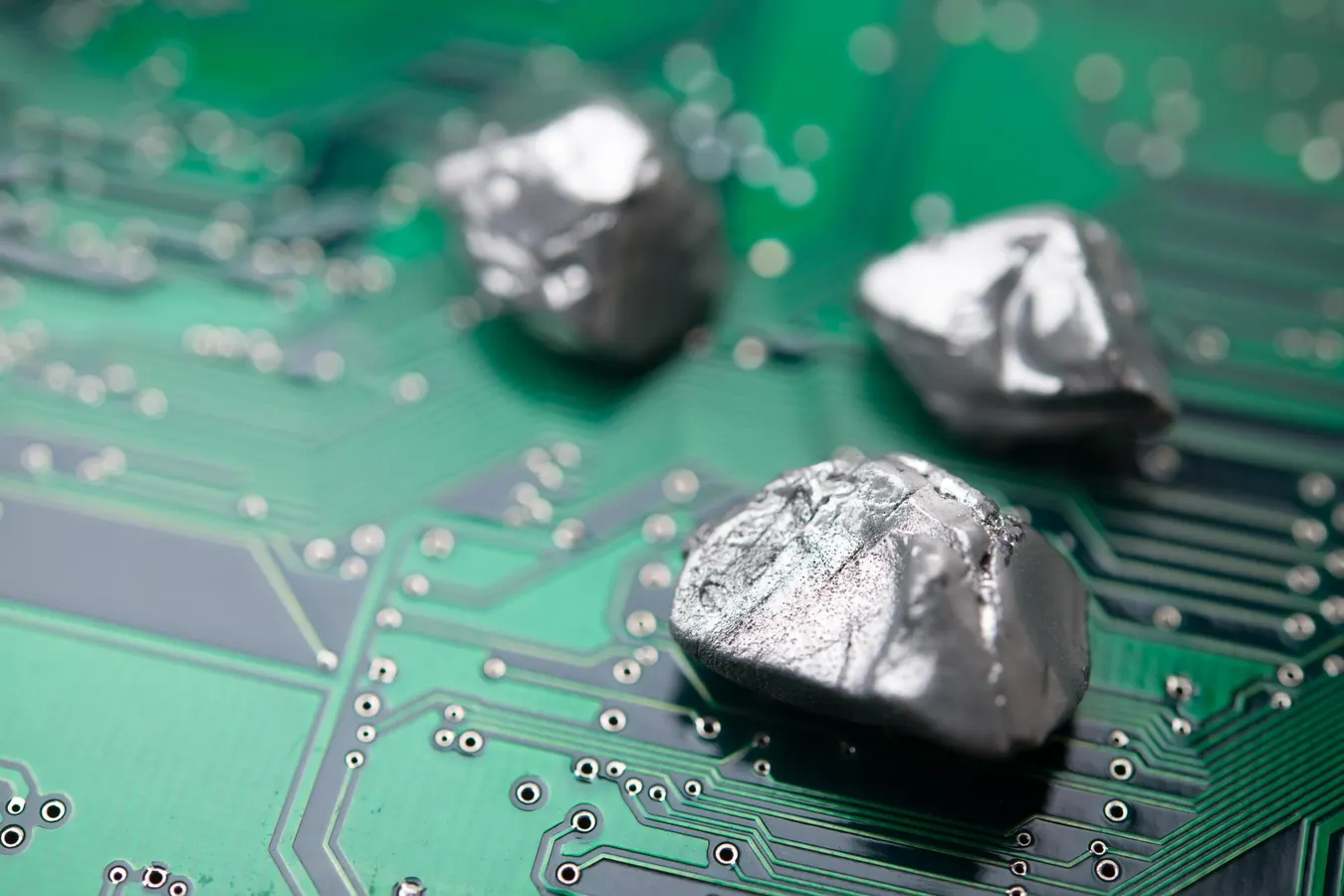

Mineral rare earth element on green electronic circuit board. Investors buying rare earth stocks are betting on a supply chain being rebuilt outside China.
getty
Most people have never heard of neodymium, but cars, phones, wind turbines and military equipment depend on it. It is one of 17 rare earth metals used in powerful magnets and other modern hardware. For decades, China has dominated refining and magnet production, leaving Western manufacturers vulnerable to supply disruptions. Now, the U.S., Europe and their allies are spending billions to build alternative mines, refineries and factories.
Why Invest In Rare Earth Stocks?
Most investors buying this group are betting on a supply chain being rebuilt outside China. China accounted for roughly 91% of key rare-earth refining in 2024 and over 90% of permanent-magnet production—the strategically vital midstream and downstream steps, rather than simply mining.
The vulnerability became tangible in April 2025, when Beijing put seven medium- and heavy-rare-earth products and related magnets behind export licenses. According to Reuters, global permanent-magnet exports fell to 1,238 tonnes in May, down 52.9% month over month and 74% year over year, the lowest monthly level in more than five years; shipments to the U.S. fell 93.3% year over year. Some auto-parts plants suspended output, and Suzuki paused Swift production in Japan.
Those supports don’t remove commodity risk, but they put a floor under it, and that changes the math for producers outside China. Demand is the other draw. Permanent magnets are used in EVs, drones, data center cooling, robotics and missiles. Few commodities have that many growing end markets, and the shift away from China is policy-driven, so it doesn’t depend on a single economic cycle.
5 Top Rare Earth Stocks To Buy For 2027
I write about funds and dividend stocks for a living and work with advisory clients. I’ve learned to be suspicious of any theme that gets crowded fast, and rare earths did. Plenty of names in this space are a press release and a drill hole. I started by cutting anything without a funded path to production by 2027 or 2028.
From there I weighed four things: whether the company is producing or has a funded path to production, government backing such as price floors and offtakes, how much of the chain it controls (mine, refinery, magnets) and balance sheet strength. Valuation mattered less than usual. Most of these companies aren’t profitable yet, so P/E ratios don’t tell you much. All figures below are as of early October.
| Company | Market Cap | Dividend Yield | P/E Ratio | Primary Sector Role |
| Lynas Rare Earths (LYC.AX / LYSDY) | ~$14.5 billion | None | ~65x | Largest separated producer outside China |
| MP Materials (MP) | ~$8.2 billion | None | N/M (loss) | U.S. mine-to-magnet producer |
| USA Rare Earth (USAR) | ~$5.1 billion | None | N/M (loss) | Magnet manufacturing, Brazil mine |
| Energy Fuels (UUUU) | ~$3.0 billion | None | N/M (loss) | Uranium miller turned rare earth refiner |
| Iluka Resources (ILU.AX) | ~$3.1 billion | N/M (H1 loss) | Australian refinery under construction |
1. Lynas Rare Earths (LYC.AX / LYSDY)
- Stock price: ~$13.77
- FY26 Revenue: $977.9 million
- FY26 Net Profit: $222.4 million
- Dividend Yield: None
- Cash on hand: ~A$1.2 billion
Lynas mines at Mount Weld in Western Australia and separates rare earth oxides in Malaysia. It’s the biggest producer of separated rare earths outside China.
Why LYSDY Stock Is A Top Rare Earth Choice
Lynas is the only company on this list that actually makes money at scale. For fiscal 2026, Lynas reported record revenue of $222.4 million, up from just $8 million a year earlier. It also produces separated dysprosium and terbium. Those heavy rare earths are where Western supply is tightest. Floor price agreements with Japanese and U.S. buyers make its revenue more predictable than most miners can manage. The shares have pulled back with the rest of the sector, which makes the entry price more reasonable than it was in the spring.
2. MP Materials (MP)
- Stock price: ~$46.09
- TTM Revenue: ~$416 million
- TTM Net Income: ~-$84 million
- Dividend Yield: None
- Beta: ~1.7
MP owns Mountain Pass in California, the only large-scale rare earth mine in the U.S. It is building out magnet plants in Texas.
Why MP Stock Is A Top Rare Earth Choice
MP has the strongest U.S. government backing of any company on this list. The 2025 Pentagon deal made the Defense Department its largest shareholder. It also set a $110 per kilogram price floor on NdPr, roughly twice the Chinese market price at the time. The operations are improving too.
Second-quarter revenue more than doubled year over year to about $108 million. The stock is down roughly 30% from its highs, which takes some of the froth out. It still isn’t cheap on a sales basis, so a measured position makes more sense than a big one.
3. USA Rare Earth (USAR)
- Stock price: ~$13.59
- TTM Revenue: ~$13.2 million
- TTM EPS: -$2.69
- Dividend Yield: None
- Beta: ~2.6
USA Rare Earth makes permanent magnets in Oklahoma. It recently bought the Serra Verde mine in Brazil and is developing the Round Top deposit in Texas.
Why USAR Stock Is A Top Rare Earth Choice
This is the highest-risk, highest-upside pick here. USAR has barely started generating revenue. What sets it apart is the cash: about $1.53 billion on the balance sheet as of June 30. That’s enough to fund a mine-to-magnet buildout without going back to shareholders right away. Buying Serra Verde gives it its own feedstock instead of waiting on Round Top, which isn’t slated until 2028. The shares trade near their 52-week low with a beta above 2.5, so keep any position small.
4. Energy Fuels (UUUU)
- Stock price: ~$12
- TTM Revenue: ~$106 million
- TTM EPS: Negative
- Dividend Yield: None
- Beta: ~1.6
Energy Fuels runs the White Mesa Mill in Utah, which processes both uranium and rare earths. It also owns a portfolio of mineral sands projects.
Why UUUU Stock Is A Top Rare Earth Choice
Energy Fuels gives you two themes in one stock, uranium and rare earths. Uranium sales are carrying the business while the rare earth side scales up. The company has agreed to acquire German magnet maker VAC for about $1.9 billion and is building a heavy rare earth circuit at White Mesa, with oxide output targeted for late 2027. That timing fits a 2027 thesis well. Deal integration is a real risk, but at around $3 billion in market cap you aren’t paying much for the rare earth upside.
5. Iluka Resources (ILU.AX)
- Stock price: ~$7.31
- H1 2026 Revenue: ~A$456 million
- H1 2026 EPS: -$0.056
- Dividend: 3¢ interim, fully franked
- Refinery capex: $1.7–1.8 billion
Iluka is an established Australian mineral sands producer, mainly zircon and titanium feedstocks. It is building the Eneabba rare earths refinery, Australia’s first fully integrated refinery for both light and heavy oxides.
Why ILU Stock Is A Top Rare Earth Choice
Iluka is the patient investor’s pick, and the only one on this list that pays you anything while you wait. The mineral sands business generates cash. Eneabba is backed by a $1.65 billion government loan and is about 60% built, with commissioning planned for 2027. A refinery reaching production in the year you’re investing for is a clear catalyst. The risk is the usual one for big builds: cost overruns or a slow ramp-up.
Key Drivers Reshaping Rare Earth Investing In 2027
Three forces matter most for this sector over the next year. Each one helps the stocks above in a different way.
Geopolitical Supply Chain Reshoring
Price floors, government offtakes and direct equity stakes now support several producers. As long as relations between Washington and Beijing stay tense, the policy support is likely to continue, and that steadies the revenue for companies that qualify for it.
Electric Vehicle And Permanent Magnet Demand
Non-Chinese magnet capacity is still small compared with demand, so companies that make magnets themselves, not just oxides, should be able to sell at better prices.
Defense And Aerospace Requirements
Fighter jets, guided munitions and radar systems all depend on rare earths. Defense buyers care more about secure supply than low cost, so they’re willing to pay above-market prices. That makes them some of the most dependable customers in the sector.
Risks Of Investing In Rare Earth Stocks
Prices swing hard. NdPr prices nearly doubled over the past year, and they can fall just as fast if China decides to flood the market. Building rare earth capacity is also expensive and slow. Separation is complicated chemistry, every deposit behaves differently, and refineries often run over budget and behind schedule. Most of these companies aren’t profitable, and some will likely issue more shares to fund expansion. Policy support helps, but it can be changed or reversed. These stocks have also traded heavily on headlines, so expect big moves in both directions. Keep position sizes modest.















Leave a comment