


ESSENTIALS
Firm Name: A Parallel Architecture
Principals: Eric Barth, Ryan Burke
Headquarters: Austin, Texas
Accolades: Forbes Architecture’s “America’s Best-in-State Residential Architects,” 2025
House Name: Terrace Mountain Residence
Location: West Lake Hills, Texas
Area & Layout: 5,000 square feet; 3 BR, 4 BA
Architectural Photographers: Chase Daniel (chasedaniel.co), Joe Fletcher (joefletcher.com )
Is it possible for a house to feel anchored to the ground, and at the same time, float above it?
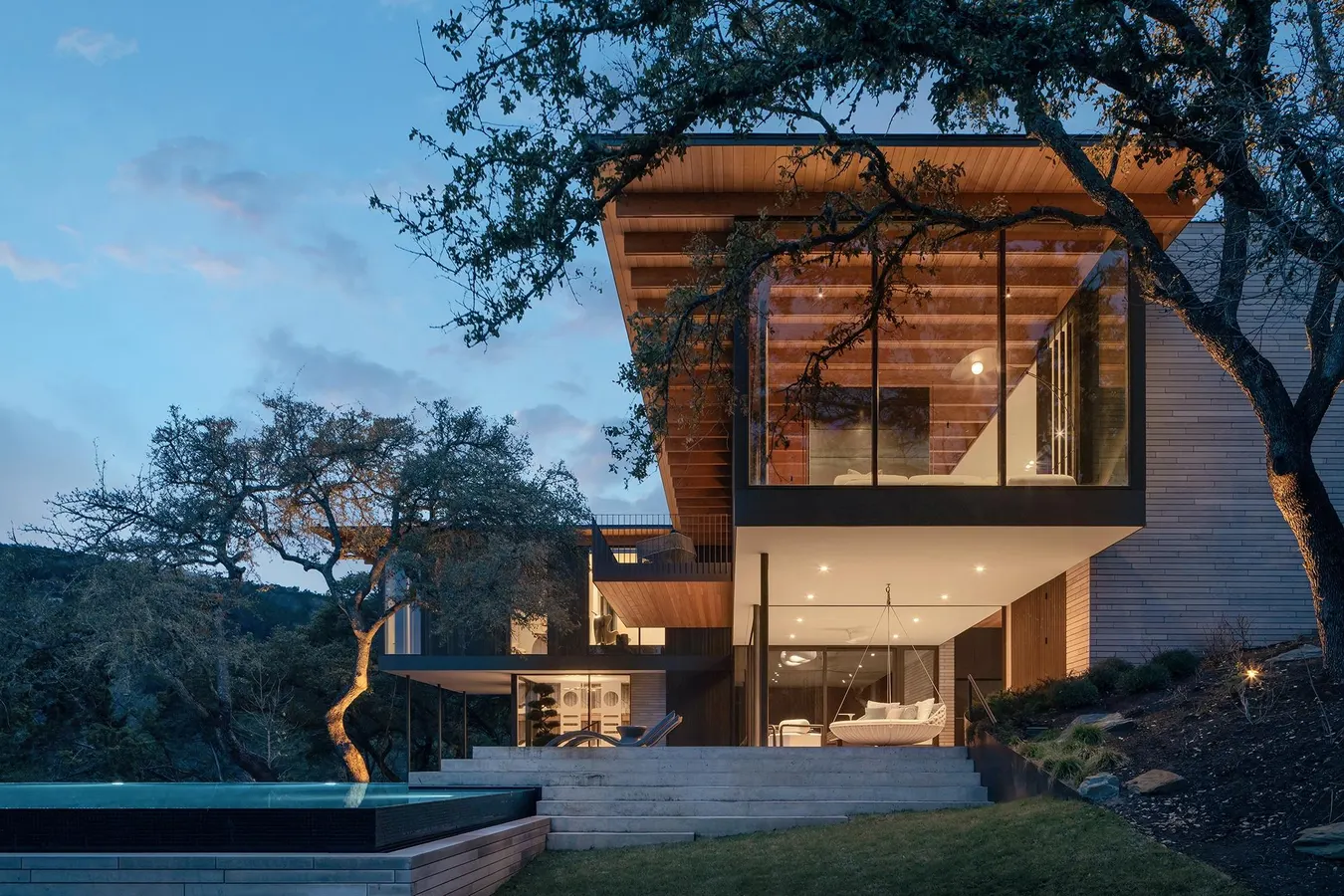
Set on a limestone bluff overlooking the Austin skyline, the Terrace Mountain Residence by A Parallel Architecture achieves that contradictory feat. Its muscular stone-and-concrete base seems to sprout from the landscape, while the translucent, cantilevered second floor appears to tiptoe across it atop slender steel columns. The result is a thrilling marriage of solidity and evanescence that binds the residents to both their setting and their surroundings.
“We are increasingly interested in houses that feel deeply rooted in their terrain,” says Ryan Burke, a founding partner of the firm, whose brashly geometric compositions possess a consistent confidence and clarity. “Terrace Mountain is very much a Texas house, but it also belongs to a broader body of work concerned with craft, restraint, permanence, and the relationship between mass and lightness.”
The site was constrained by a number of factors, including the steep slope, mature trees, and seasonal water that emerged from the limestone and trickled through the property. Instead of rerouting the rivulet, the team at A Parallel Architecture incorporated it into the design, weaving it through a terraced sequence of water features that culminates in an infinity pool in back.
Clad in charred cedar, concrete and sawn limestone, the home’s intersecting volumes vault over an outdoor living space that’s shaded from the Texas sun by the living area above. The architects varied the floor planes and ceiling heights inside to help define spaces in lieu of walls, maintaining views of the panorama through expanses of floor-to-ceiling glass shaded by broad hemlock eaves. That wood extends inside, offering a warming counterpoint to the interior’s honed-basalt floors and monolithic blackened-steel chimney.
While a majority of the firm’s attention is focused on the Lone Star State, “we are pursuing select projects, particularly in the Mountain West and the Pacific Northwest, where terrain, climate, view and material durability align closely with the questions that drive our work,” Burke says. “The goal is not growth for its own sake. It is to keep taking on projects where architecture, interiors, landscape and construction can come together in a way that feels deeply rooted, carefully made and enduring.”
ABOVE: “The terrace garden softens the transition between the house and the steep limestone bluff, reinforcing the project’s connection to topography, water and native planting,” says Burke.
Chase Daniel
ABOVE: A bay at the end of the living room surrounds the residents in scenery and a view of the pool. A slender steel column supports the bay; the neighboring wall is fashioned from courses of sawn limestone, echoing the composition of the hillside underneath.
Joe Fletcher
ABOVE: A pedestrian bridge leads to the shaded front door, which is flanked by a cast-in-place concrete wall that helps define the entry and control views into the house.
Joe Fletcher
ABOVE: “The dining room is set within the glass pavilion, which is oriented toward the landscape and anchored by the expressed wood roof structure above,” says Burke. A gas fireplace is partially sunken in the floor, in the manner of a Japanese irori, and is vented through a blackened-steel chimney edged in glass.
Joe Fletcher
ABOVE: “The living room projects above the pool as a glass volume, giving the main floor a sense of lightness while the exposed hemlock roof, steel structure and limestone walls maintain a strong sense of shelter,” Burke says.
Chase Daniel
ABOVE: “The kitchen is integrated into the main living volume with a restrained palette of walnut, stone and steel,” Burke says. The cooktop is set into the countertop at left with controls mounted on the cabinet face in front. A lower ceiling plane helps define the space within the open plan.
Joe Fletcher
ABOVE: The two-story family room features a sunken conversation area that lowers occupants to garden level, enhancing the sense of connection to the landscape and instilling a sense of intimacy within the open plan.
Joe Fletcher
ABOVE: Another fireplace flanks the primary bedroom, separating it from an adjoining seating area. “Exposed steel and wood structure serve as both framework and finish, combining the warmth of timber with the precision of steel,” observes Burke.
Chase Daniel
ABOVE: “Seasonal water is collected and guided through the site,” Burke says, “moving from the hillside into a planted court, vessel, reflecting pond and pool—and ultimately back toward the natural creek below.”
Joe Fletcher
ABOVE: The glassed-in kitchen spans the outdoor living space below, which is accessible by a bridge crossing the water feature in front.
Joe Fletcher















Leave a comment