


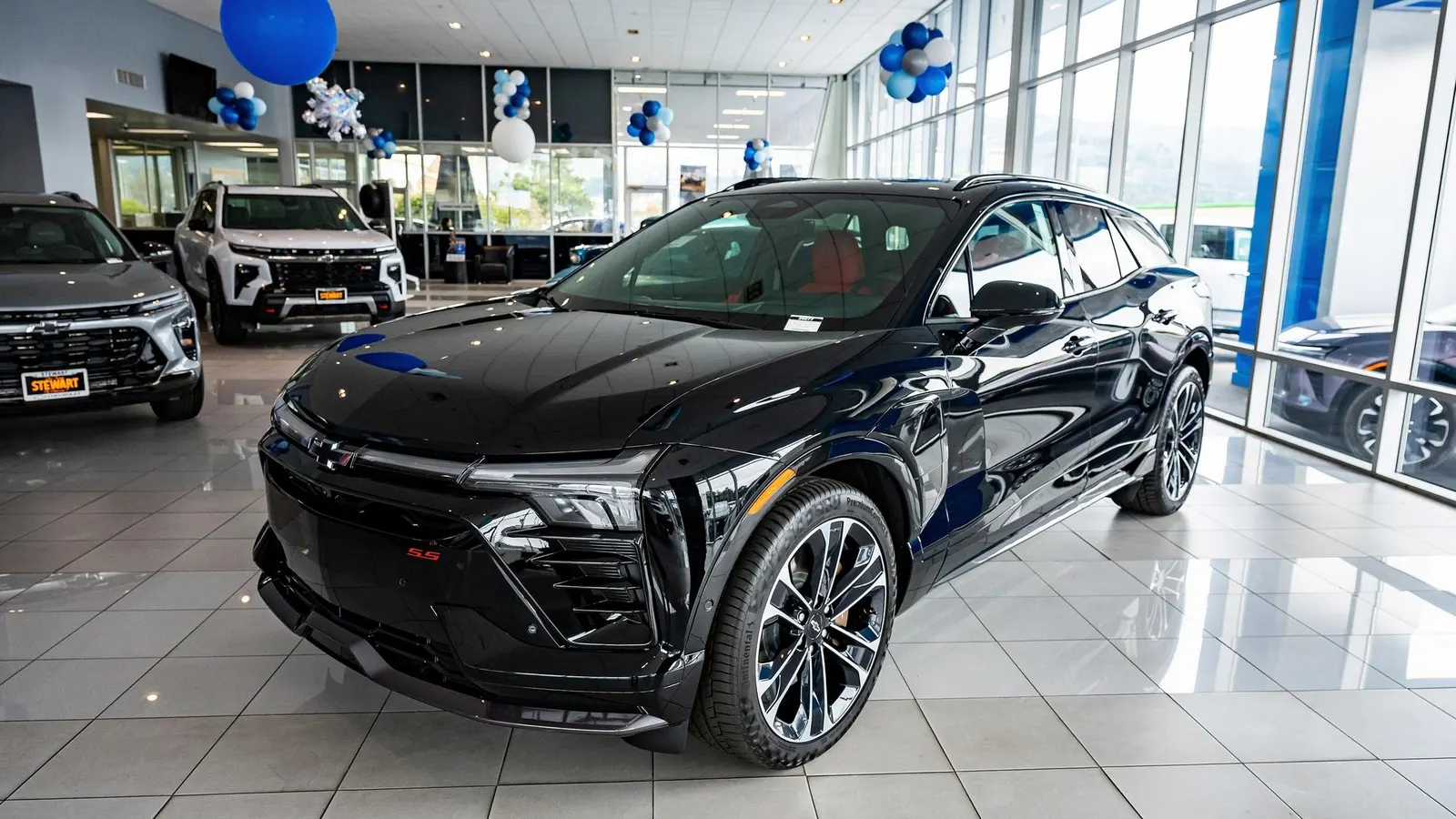
General Motors’ electric Chevrolet Blazer at a dealership in Colma, California.
© 2026 Bloomberg Finance LP
Sales of electric vehicles are booming worldwide, but have plunged in the U.S. since the Trump administration eliminated a $7,500 federal rebate last year. California, whose residents buy about a third of EVs sold in the country, hopes to rectify that with a new incentive it’s about to launch.
A state budget that went into effect on July 1 includes $135.5 million earmarked to defray some of the cost of battery-powered models. It provides first-time buyers of new electric cars and light trucks priced up to $50,000 with a $3,500 rebate–half covered by those state funds, with automakers providing the other half. The $50,000 price limit, however, is waived for EVs made by California-based companies such as Rivian and Lucid, whose cheapest models currently cost $58,000 and $71,000, respectively. Higher-priced models from Tesla, which left the Golden State for Texas in 2021, don’t qualify. Used EV purchases get a $1,750 discount.
“The premium for a new EV is still about $5,500 higher than for a [gasoline engine] model, so this doesn’t fill the entire gap, but it should help,” said Stephanie Valdez Streaty, director of Industry Insights for Cox Automotive. “The $1,750 for a used EV, given how many units are coming off lease and showing up there, might have a bigger impact.”
Sales of EVs so far this year are down at least 20% from the first half of 2025, according to Cox, a direct result of the end of the federal rebate last September. In the year’s first quarter, California, which wants to eliminate sales of gasoline-powered autos by 2035, saw the market share for EVs plunge from nearly a quarter of new vehicle sales a year ago to only 15.7% through March. That’s far below the state’s target of boosting EVs to 35% market share this year.
While the average transaction price for electric vehicles is higher than for gas cars, the number of affordable models is rising. General Motors has three EVs priced below $50,000, including the midsize electric Blazer SUV, compact Equinox crossover and Bolt hatchback, which is priced from less than $30,000. Toyota has two small crossovers, the bZ and C-HR models, that start under $40,000, while Hyundai’s popular Ioniq 5 hatchback is priced from $35,000. Ford’s Mach-E crossover starts at about $38,000, and lower-priced versions of Tesla’s Model 3 sedan and Model Y crossover will also qualify, though its angular Cybertruck won’t.
Two low-priced electric pickups, including a new $30,000 model from Ford and a utilitarian version from startup Slate, with a $25,000 base price, are to hit the market in 2027.
While California’s incentives sound good, Loren McDonald, CEO and chief analyst of industry researcher Chargeonomics, is skeptical they’ll make much difference.
“If automakers are already doing a $2,500 or $3,500 incentive because they want these things to move, this may not end up impacting buyers much,” he said. “For example, will Hyundai stack it and add another $1,750 on top of what it’s already doing? Or do automakers only add this on some models that aren’t selling so well and not others? It really depends on how this is applied.”
GM, Ford and Hyundai didn’t immediately respond to a request for comment. The program is to launch in the coming weeks, with details to be provided next month, said John Swanton, a spokesman for the California Air Resources Board.















Leave a comment