


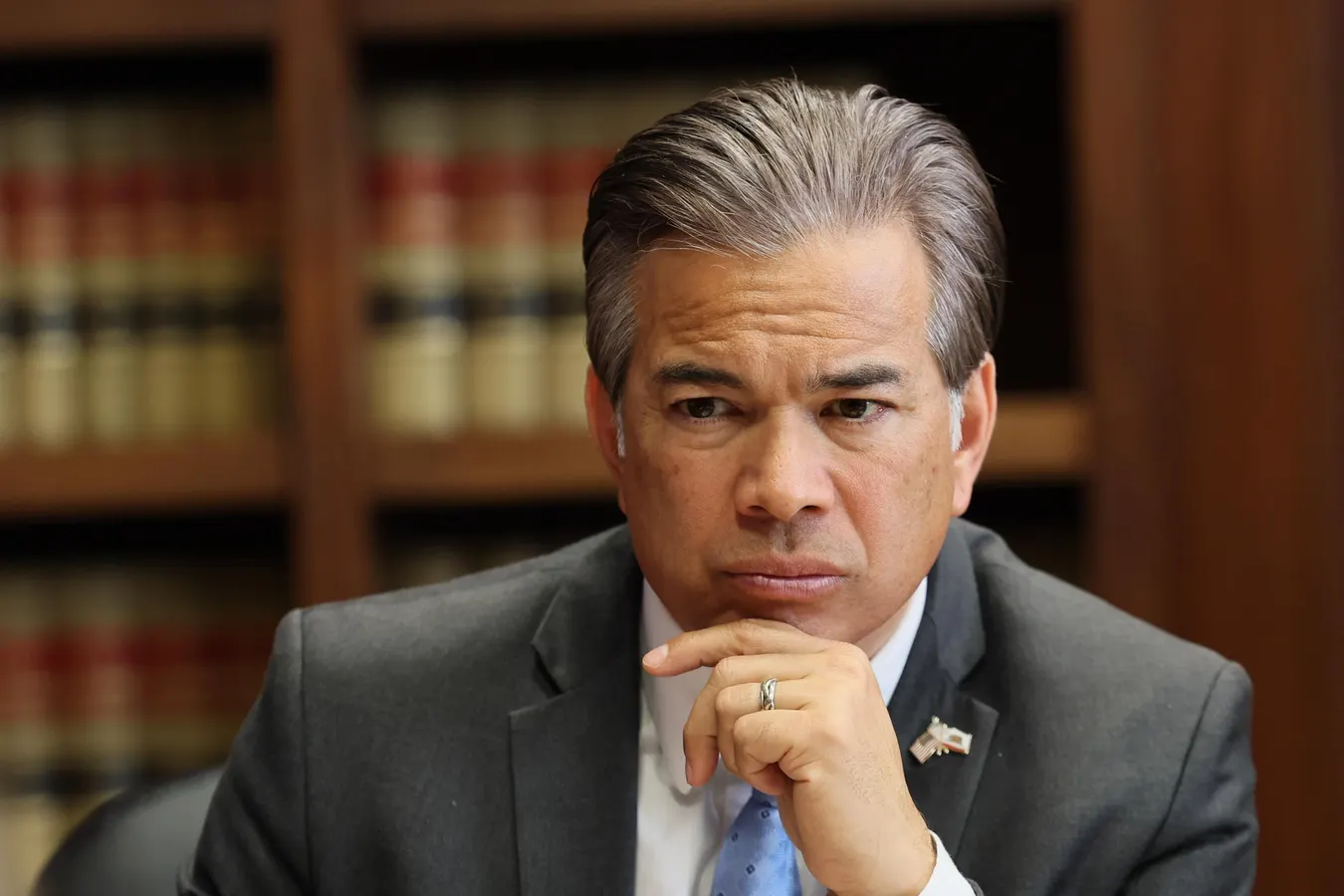

California Attorney General Rob Bonta is leading a 12-state coalition seeking to block the $110 billion combination of Paramount and Warner Bros. Discovery.
Los Angeles Times via Getty Images
David Ellison’s $110 billion Warner Bros. Discovery takeover has won every regulatory clearance required to close. But a coalition of 12 states has transformed what looked like a regulatory victory lap into a high-stakes legal standoff—one that could soon cost Paramount roughly $7 million a day and deepen an extraordinary confrontation between Hollywood and its home state.
In the first installment of a three-part series, we look at the genesis of the shocking lawsuit filed by a group of States with Democratic Attorneys General, led by California Attorney General Rob Bonta, seeking to derail the Paramount – Warner Bros. Discovery mega merger. After surmounting hurdle after hurdle, this “Blue States” lawsuit is the last roadblock standing in the way of a media merger that will transform the entertainment landscape.
By late August, Paramount Skydance had accomplished something that once looked improbable.
David Ellison and Paramount Skydance had (1) persuaded Warner Bros. Discovery (WBD) to abandon a deal with Netflix and won over WBD shareholders, (2) survived an eight-month investigation by the United States Department of Justice (DOJ) and (3) secured merger clearances across nearly 70 countries. European regulators signed off. Britain signed off. China, Canada, Brazil, Australia and a long list of other jurisdictions signed off. Mexico, the last outstanding regulatory clearance required under the merger agreement, gave its approval on August 14, 2026.
Yet Paramount still cannot buy Warner Bros. Discovery.
The obstacle is no longer Washington, Brussels or London. It is Sacramento.
On July 13, 2026, a coalition of 12 state attorneys general from Democratic-leaning States, led by California Attorney General Rob Bonta, sued in federal court to stop the $110 billion combination of Paramount and Warner Bros. Discovery, arguing, amongst other things, that joining two of Hollywood’s five major film distributors and two major cable-programming groups would substantially lessen competition. Paramount and WBD subsequently agreed not to close until five days after a decision on the merits of the States’ case or June 1, 2027, whichever comes first. A trial is scheduled to begin March 2, 2027.
That timetable is colliding with another date that has become increasingly important: September 30, 2026.
Under the merger agreement between Paramount and Warner Bros. Discovery, every day after September 30th that the transaction has not closed increases the cash consideration payable to WBD shareholders. Paramount describes the contractual mechanism as “Ticking Consideration.” At current share counts, the economic cost is roughly $7 million a day, or approximately $650 million for every 90 days of delay.
The result is an extraordinary inversion of the usual merger dynamic. Paramount has received every regulatory clearance that its contract requires, yet litigation by a minority of U.S. states could prevent it from closing for another six months or longer—and make the acquisition increasingly more expensive while it waits.
That pressure has already spilled far outside the courtroom. Settlement discussions between Ellison and Bonta have broken down amid accusations of leaks and bad faith. Paramount has asked the court to require the States and the Writers Guild of America, which brought a parallel challenge, to post a $1.88 billion bond.
Ellison has privately told senior executives that he is prepared to consider moving Paramount out of California if the dispute cannot be resolved, according to multiple press reports.
Paramount Skydance’s David Ellison displaced a signed Netflix deal in February 2026 with a $31 per share cash offer that included paying Warner Bros. Discovery’s $2.8 billion termination fee.
Variety via Getty Images
And on August 25, 2026, the confrontation took an even stranger turn: Iowa and Montana asked the U.S. Supreme Court for permission to sue California and the other 11 states directly, arguing that their antitrust action is an improperly politicized attempt by a small group of States to dictate national economic policy.
What began as a battle for Warner Bros. Discovery has become something larger: a fight over who gets to police consolidation in American media, how much power individual states should wield over nationally cleared mergers, and whether California can simultaneously defend Hollywood from consolidation, while at the same time prevent Hollywood from leaving its home state.
From Netflix to Paramount
Paramount’s path to acquire WBD began as an aggressive challenge to a transaction WBD had already struck with Netflix.
The decisive moment came in February 2026, when Paramount raised its proposal to $31 a share in cash. The offer included several unusually powerful protections for WBD: Paramount agreed to pay the $2.8 billion termination fee WBD owed Netflix, increased the regulatory termination fee to $7 billion and accelerated the ticking fee so that it would begin after September 30, 2026.
On February 26, 2026, WBD’s board determined that Paramount’s revised proposal constituted a “Company Superior Proposal” under the Netflix agreement. Netflix declined to match. On February 27, Paramount and WBD signed their definitive merger agreement.
The economics are enormous. Paramount is paying $31 a share for 100% of WBD, representing roughly $81 billion of equity value and $110 billion of enterprise value. Paramount says the combined company can eventually generate more than $6 billion of synergies. The financing includes approximately $47 billion of new equity backed by the Ellison family and RedBirdCapital Partners, alongside substantial debt financing.
WBD shareholders overwhelmingly approved the deal on April 23, 2026.
From there, the regulatory dominoes fell.
The Regulators Said Yes
In the United States, the Hart-Scott-Rodino waiting period had already expired on February 19, 2026, after Paramount certified substantial compliance with a Justice Department Second Request. More importantly, on June 12, 2026, the Justice Department’s Antitrust Division formally closed its investigation.
Its conclusion could hardly have been more different from Bonta’s.
After reviewing more than two million documents from more than 80 custodians, as well as data, executive testimony and third-party evidence, DOJ said the transaction was not likely to harm competition or American consumers in streaming video, linear television or the development, production and distribution of theatrical films.
Foreign regulators reached similar outcomes.
By July 22, 2026, Paramount had obtained competition clearances in the United States, Australia, Brazil, Canada, China, Kuwait, Montenegro, New Zealand, North Macedonia, Saudi Arabia, Serbia, South Africa, South Korea and Ukraine, as well as from the COMESA Competition Commission. The European Commission had also cleared the transaction. Foreign-investment approvals had been obtained in Australia, Germany, France, Spain, Slovenia, Belgium, Czechia, New Zealand, Italy and Romania.
The Justice Department’s Antitrust Division closed its eight-month investigation on June 12, 2026, finding no likely competitive harm in streaming, linear television or theatrical film.
AFP via Getty Images
Britain presented one of the more complicated reviews. The Competition and Markets Authority cleared the merger on August 6, 2026, while the U.K. government separately accepted legally binding commitments from Paramount addressing media-policy concerns. Those commitments include protections involving editorial independence and U.K. programming and generally remain effective for five years after closing; commitments concerning Channel 5 extend through the end of its current public-service broadcasting license in 2034.
Finally, Mexico cleared the transaction on August 14, 2026.
Paramount then declared that every regulatory clearance required under the merger agreement had been obtained after reviews spanning 68 countries.
That distinction matters. There are other regulatory proceedings associated with Paramount’s financing and ownership structure—including an FCC proceeding concerning indirect foreign investment in Paramount’s broadcast-license subsidiaries—but the FCC record indicates that this approval is not a condition to closing the WBD acquisition.
Thus, as of August 27, 2026, the central obstacle to consummation is not a missing merger clearance. It is litigation.
Bonta’s Case
California filed its lawsuit on July 13, 2026, in the Northern District of California, joined by Arizona, Colorado, Connecticut, Massachusetts, Minnesota, Nevada, New Jersey, New Mexico, New York, Oregon and Washington.
The complaint invokes Section 7 of the Clayton Act and focuses on three alleged markets.
The first is wide-release theatrical film distribution. The States contend that Paramount and Warner Bros. are two of only five major distributors and would hold approximately 27% of that market after combining.
The second is a narrower alleged market for anticipated top-grossing theatrical films. There, the States contend that the combined company would control more than 30% of the market, while Paramount-Warner, Disney, Universal and Sony collectively would account for more than 90%of the market.
The third is licensing basic cable television channels. Warner Bros. Discovery and Paramount are respectively major suppliers of cable networks; the States say the combined company would have approximately 27% of that market.
The theory is conventional horizontal-merger law applied to an unconventional industry.
Movie theaters sit at the center of the States’ case, which alleges that Paramount and Warner Bros. are two of only five major distributors of wide-release films.
UCG/Universal Images Group via Getty Images
Movie theaters, the States argue, benefit when Paramount and Warner Bros. compete for screens, release dates and exhibition terms. Cable and satellite distributors similarly benefit from having Paramount and WBD negotiate separately over channel carriage. Combining them would eliminate a negotiating alternative and potentially increase prices while reducing output and variety.
Paramount’s response attacks the premise that those historical categories accurately describe modern media competition.
That argument has powerful support from an unusual source: the Justice Department. DOJ’s June decision specifically found no likely competitive harm in theatrical films, streaming or linear television after its own extensive investigation. The department emphasized the dynamic nature of the entertainment business and questioned rigid reliance on historical market shares.
The States nevertheless scored an important early victory. U.S. District Judge Araceli Martínez-Olguín temporarily restrained closing the Paramount – WBD transaction, finding that the States had raised sufficiently serious competitive questions. Paramount and WBD then entered into a broader agreement: they will not close or integrate until five days after a merits decision or June 1, 2027, whichever comes first. If the States prevail at trial, the transaction remains blocked pending appeal.
The court has scheduled a 12-day trial, scheduled to begin on March 2, 2027, and end on March 19.
That means the lawsuit has already accomplished something economically significant even without a final judgment: it has likely pushed the transaction beyond September 30, 2026.
In the second installment of this series, we will examine the significant financial implications for Paramount if the Warner Bros. Discovery merger does not close by September 30th.










Leave a comment