


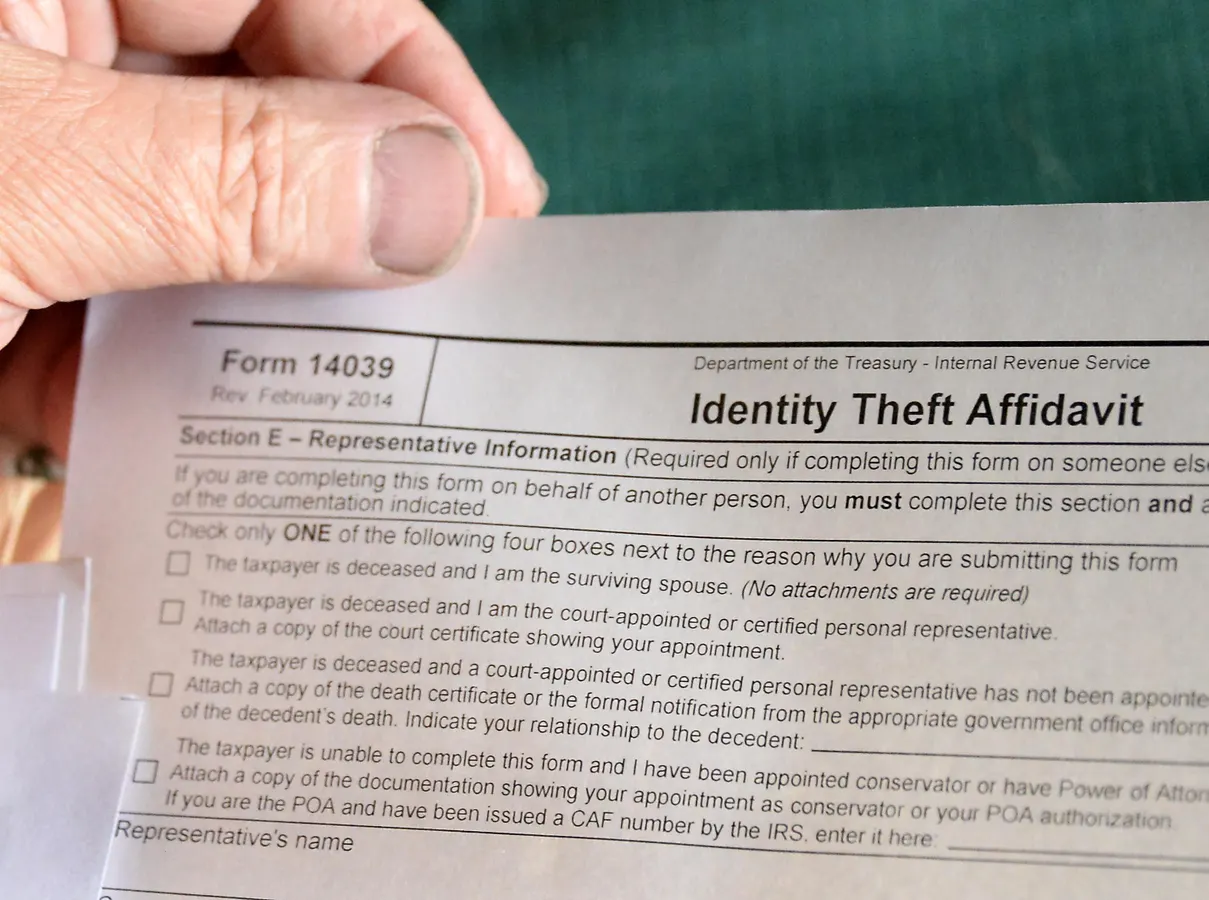

Ed Landing, a retired NYS geologist, and a victim of identity theft with an Identity Theft Affidavit as he tries to get back his stolen IRS federal tax return refund at his kitchen table Wednesday May 13, 2015 in Albany, NY. (Photo by John Carl D’Annibale/Albany Times Union via Getty Images)
Albany Times Union via Getty Ima
Carlos Ramon Obregon was killed at the age of 14 in a drive-by shooting in Los Angeles in 1977. However, 23 years later Carlos Ramon Obregon applied for a replacement Social Security card supplying his Social Security number, his date of birth and his parents’ names as supporting documentation. In 2012, he obtained a passport using Obregon’s birth certificate. For more than 20 years he collected numerous government benefits including Supplemental Security Income benefits, Medicaid benefits, SNAP benefits and Economic Impact Payments totaling approximately $284,000.
Of course, the real Carlos Ramon Obregon never obtained a passport or any government benefits, however, the identity thief who stole the deceased teenager’s identity managed to do so and recently the identity thief was sentenced to 61 months in federal prison after being found guilty of wire fraud, theft of government funds, aggravated identity theft and other related charges. At his trial, the real Obregon’s mother testified that her son died in 1977 and that she did not know the man claiming to be Carlos Ramon Obregon.
“Identity thieves who exploit the identities of deceased Americans cause real harm,” said Jonathan P. Kazmar, Special Agent in Charge of the U.S. Department of State’s Diplomatic Security Service (DSS) San Francisco Field Office. “In this case, the defendant assumed the identity of a deceased American teenager and used it for years to commit serious fraud. DSS will continue to work closely with our law enforcement partners to protect the integrity of U.S. travel and identity documents and to seek justice for victims of identity theft.”
In perhaps the most ironic aspect of a trial related to identity theft was that the identity of the convicted criminal remains unknown which is how he is referred to in the court documents – “unknown man.” Being unknown, however, will not keep him from serving his sentence.
Deceased Identity Theft
Not even the dead are immune from identity theft and this particular form of identity theft is on the rise. According to the consumer risk and fraud prevention firm ID Analytics 2.5 million deceased people are victims of identity theft each year. Until regulations were enacted in 2014, stealing the identity of recently deceased people was a simple matter with scammers merely checking out the latest obituaries and then going to a free available data bank called the Death Master File maintained by the Social Security Administration. Using the Death Master File, a scammer could obtain the deceased person’s Social Security number which would then be used along with information gained from the obituary to establish credit, make purchases or take out loans in the name of the deceased person. Since 2014 regulations have greatly limited the access to the Death Master File, but identity theft from the dead remains a serious problem because it is still easy for criminals to obtain Social Security numbers of dead people through various sources including data breaches. Income tax identity theft using the Social Security numbers of dead people is a popular scam with income tax identity thieves because the IRS may not be alerted that the victim of the identity theft has died and is not filing an income tax return.
The identities of deceased children are particularly attractive to identity thieves as a child’s Social Security number will generally have little, if any credit history attached to it. It is not uncommon, as was the case of the unknown person who stole the identity of Carlos Ramon Obregon, for the identity theft to continue for decades.
How to Prevent Deceased Identity Theft
- Limit the amount of personal information contained in any obituary;
- Notify the Social Security Administration about the death. Most often the funeral director will report deaths to the Social Security Administration, but to ensure that a death is reported in a timely manner, family members can report deaths directly to the Social Security Administration;
- Contact the major credit reporting bureaus, Experian, TransUnion and Equifax and notify them that the person is deceased and not to issue any further credit.
- All creditors, such as credit card companies of the deceased should also be notified of the death and accounts closed as soon as possible.
- Notify all financial institutions where the deceased had accounts of the death.
- Send a copy of the death certificate to the IRS.















Leave a comment