


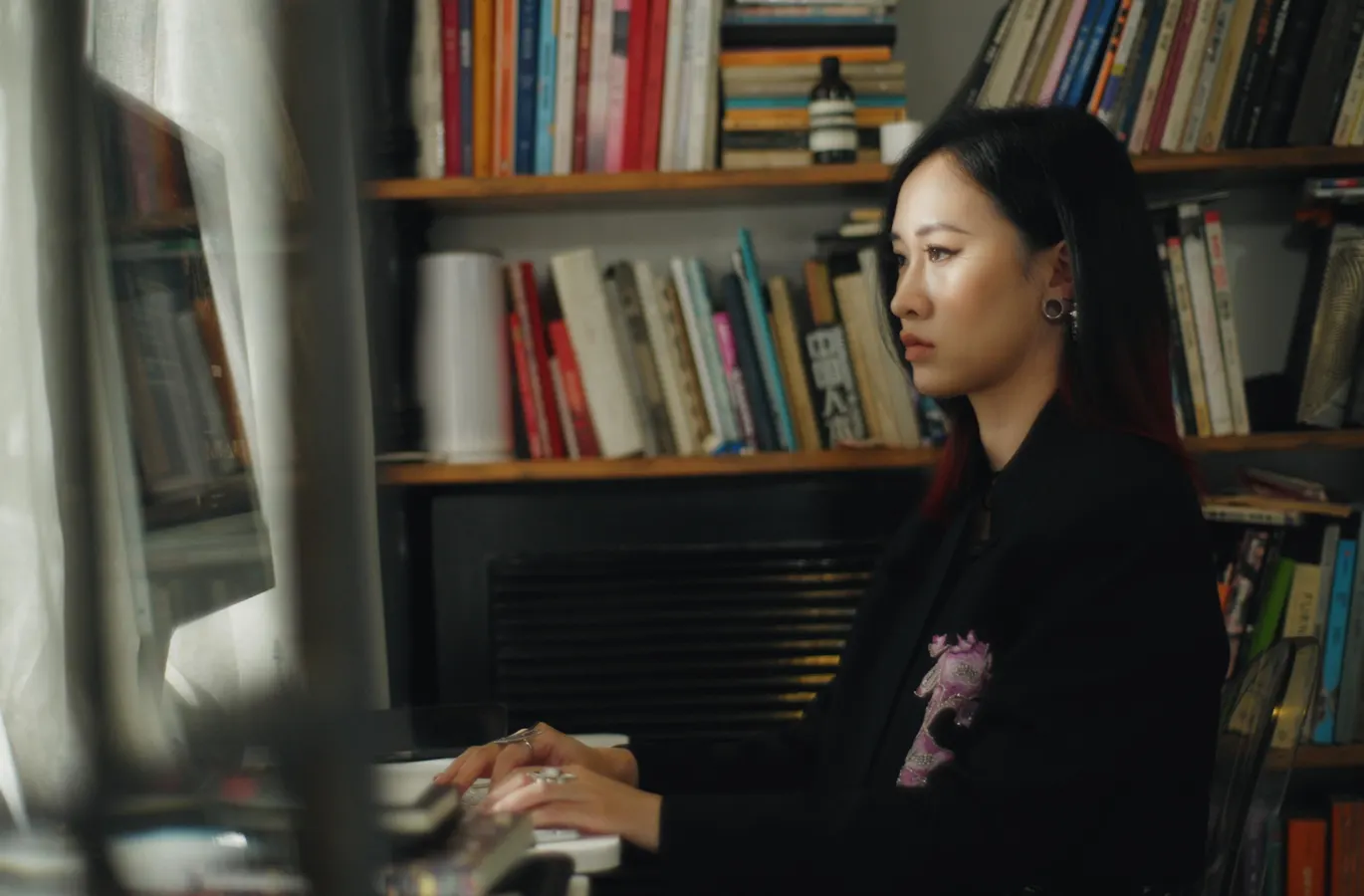

Junie Working in Her Workplace (Photo Credits: Zenith Chen and Yuxiao Yan.)
Courtesy of Junie Lau
When Junie Lau reaches back for the beginnings of Goldfish Mayhem, she does not start with artificial intelligence. She goes back to being 8 years old in Foshan, the city in Guangdong, China, where she grew up amid the cultural influence flowing between southern China and Hong Kong.
Her mother, then a finance director at a food company, took her to a martial arts school connected to her boss, Liang Weiyong, a fifth-generation inheritor of Choy-Li-Fuk Boxing. Lau remembers Chinese and international students training there, and the children joking that while the adults taught martial arts, the international students could teach them English.
More than two decades later, that memory has resurfaced in Goldfish Mayhem, the female-led kung fu comedy Lau is creating with Wonder Studios as part of its Beyond The Loop anthology. The film premieres on October 1. Even its geography is personal: Goldfish Street is based on a real street just downstairs from Lau’s childhood home.
In two video interviews in July and August, supplemented by written responses, Lau says the film combines memories of Foshan with perspectives accumulated after leaving it. Boarding school, London, Japan and the U.S. became fragments she could bring back into an imagined hometown.
From Foshan To Filmmaking
Born in 1994, Lau grew up in a family working largely in finance, banking and insurance. She was strong in mathematics, but drawing had been part of her life since early childhood, and she chose art at college. She studied fashion design before taking a master’s at the University of the Arts London in what was then called fashion media production, graduating in January 2020.
She returned to China that year, during the Covid-19 pandemic, into an industry with few openings for her.
Lau describes the difficulty of moving into directing then as the result of several overlapping factors. Gender was one of the main ones, she says, alongside professional networks, social structures, educational background, access to resources and the availability of industry opportunities. The pandemic had made the whole environment more uncertain.
Production design kept her close to directing while she developed her visual language and understanding of filmmaking. It placed her next to directors without making her one.
In 2022, she started experimenting with generative AI, when making images could still involve coding and far more technical friction than it does today. The attraction was not speed. The tools reduced the resources required to put an idea on screen.
“With AI, I realized that I could become the director,” she says.
Lau says AI may lower similar barriers for other women and filmmakers from different backgrounds.
For Lau, AI was not initially a technology story. It was an authorship story.
The Peter Gabriel Turning Point
Lau was working as a production designer in advertising, frustrated by the repetition of commercial work, when she came across the Peter Gabriel / Stability AI #DiffuseTogether competition. She had another commercial assignment in front of her. She chose the competition.
Lau created an AI-generated video for Gabriel’s song “The Court” and became one of two joint first-prize winners. Gabriel later released her version as the song’s official music video that September.
She remembers Gabriel announcing her name. She later worked on another music video for him.
“I think my life was kind of changed at that moment,” she says.
The competition provided external validation. AI had reduced the resources Lau needed to make work. Gabriel’s recognition changed how others saw her. Work with companies including OpenAI and Google followed, and her films and workshops began taking her into international festivals and creative communities.
AI had created a production route. Peter Gabriel helped turn it into a professional one.
Three Generations Of Women
Her film What If, Mother? was released on December 10, 2024, which Lau says was the same day OpenAI made Sora publicly available. She is part of OpenAI’s Sora Alpha artist community, whose members test models before wider release and provide creative feedback. For the film, she returned to a question she says had stayed with her for years: what might her mother’s life have looked like if Lau had never been born?
The idea grew from her own experience of family. Lau describes a pattern she sees in many traditional Asian families: children grow up assuming the people closest to them already know how they feel, so love is expressed through action rather than words.
That became more personal in Dear “Stranger”, an AI short film created for Google I/O 2025 using Flow. Lau collaborated with Google during Flow’s development, providing feedback from a filmmaker’s perspective.
The film grew from Lau’s regret about her grandmother, who played an important role in her childhood and later paid for her studies and living costs in the U.K. She died before Lau won the Peter Gabriel competition.
Lau says she never had the opportunity to tell her grandmother “I love you” in the way she later wished she had. That regret became part of Dear “Stranger”.
A similar reticence appears with her mother, who has watched interviews in which Lau discusses the work inspired by their relationship but has not sat down and talked it through with her. For Lau, that reflects a continuity between the relationship her mother had with her own mother and the one Lau now has with hers.
The women in Lau’s life are not simply biographical background. They have become part of the material from which she constructs her films.
Returning To Kung Fu And Comedy
Goldfish Mayhem takes that process into a brighter register.
Screenshots from Action Scenes in Goldfish Mayhem
Courtesy of Junie Lau
When Wonder Studios approached Lau, the discussion turned toward something less dark than the other projects around it. She began thinking about the Hong Kong comedies she watched with family and friends around Chinese New Year as a child, including the films of Stephen Chow, and about a comic tradition that, in her view, no longer occupies the cultural position it did when she was young.
Foshan brought another element: the city is closely associated with Chinese martial arts, and Lau felt relatively few kung fu films had placed a woman at the center.
Those influences came together in Goldfish Mayhem: a female protagonist, the kung fu heritage of her hometown, physical comedy and a fictionalized version of the city she remembers.
Lau is working with a kung fu supervisor and team to design the action. For some of the film’s fight and kung fu sequences, the production is using the movement-transfer capabilities of Seedance 2.5, which ByteDance released on July 31. Based on that production experience, Lau said in a written response that Seedance 2.5 performs better than 2.0 for this kind of action and movement work.
Lau is interested in the difference between the physical tension and weight of choreographed martial arts and movement generated through AI, which can escape the normal rules of physics. The creative problem is how to use both qualities.
Lau is less interested in making every movement perfectly realistic than in creating something surreal and dreamlike.
“When everyone could make pretty images, then the meaning behind it becomes unique,” she says.
As generated imagery improves, the filmmaker’s choices become more distinctive.
From Director To “Architect”
Lau is also thinking beyond fixed films, toward interactive, generative environments in which audiences can affect what happens.
She imagines a creator establishing the visual world, characters, relationships, conflicts and rules, while the experience changes depending on who enters it. In that model she is drawn to describing the filmmaker as an “architect”: rather than directing one fixed narrative, the creator designs the conditions from which many can emerge.
The technology is still developing, and audiences already understand conventional film. But Lau’s logic is consistent: if technology changes what a creator can make, the form need not remain fixed.
What Lasts After The AI Attention Moves On
Lau works with technologies defined by rapid releases and intense competition, yet her stated ambition is increasingly concerned with permanence. She has seen how quickly attention moves. A creator can attract millions of views and then disappear from the conversation almost immediately.
“The speed of we forget it is faster than we remember,” she says.
The Peter Gabriel competition changed the direction of her career, but recognition is no longer the endpoint. Her ambition is to create meaningful art that lasts. AI gave her another route into directing. What she does with that authorship is now the more consequential test.
AI opened the door. The work still has to give people a reason to remember who walked through it.













Leave a comment