


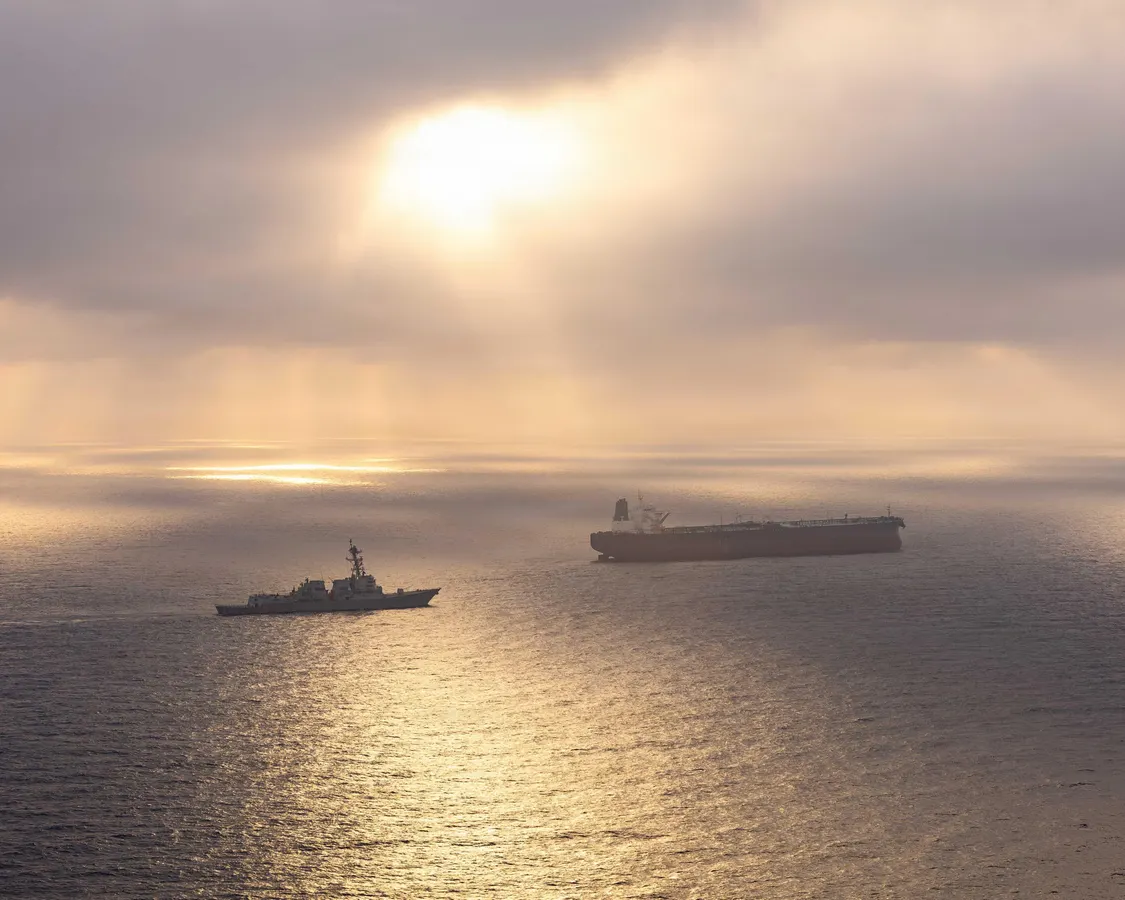

An Arleigh Burke-class guided-missile destroyer – USS Rafael Peralta – of the U.S. Navy’s 5th Fleet (right) next to an oil tanker in the Middle East. (File photo: U.S. Navy via Getty Images)
Getty Images
Global oil prices hit multi-week highs and neared the $100 per barrel mark on Monday, following an escalation of tensions between U.S. and Iran.
At the close of trading in London, the Brent front-month crude oil futures contract traded at $97.05, up 0.8% or $0.78 per barrel, threatening to hit the $100-level last seen late-July. The U.S. West Texas Intermediate front-month contract was also up 1.27% or $1.16 to $92.64 at 14:28 EDT.
That’s after the U.S. Central Command [“CENTCOM”] said on Saturday it had struck and destroyed three Iranian oil tankers “in response to attempted missile attacks on naval vessels.”
In a statement, it noted that a U.S. aircraft carrier and guided-missile destroyer successfully evaded multiple unprovoked Iranian attacks. No American personnel were harmed.
“Following Iran’s failed attacks, CENTCOM permanently disabled its crude oil carriers M/T Downy off the coast of Kharg Island and M/T Stark 1 near Jask. American forces also completely destroyed the unladen crude oil carrier M/T Kylo (also known as the “Noxen”) in the Gulf of Oman, striking the vessel in multiple critical locations to render it inoperable after the crew was directed to abandon ship,” CENTCOM added.
Subsequently, U.S. defence secretary Pete Hegseth issued his own threats at Iran, via social media noting: “It’s simple: if Iran shoots at US ships, we will destroy (and sink) their oil tankers.”
In response, while acknowledging the U.S. attacks, Iran’s top negotiator and parliament speaker Mohammad Bagher Ghalibaf warned of “a faster, heavier, and more painful response” on Sunday.
A translation of his statement on Iranian state media carried by the BBC and Associated Press, Ghalibaf read the U.S. must understand “before it is too late” that the “rules of the game have changed.”
A Near Permanent Crisis?
After a brief ceasefire, the clashes re-started late last July following U.S. raids on Iran, as both sides remain deadlocked in the war that’s past its six-month mark.
Iran is attempting to maintain its stranglehold on the key maritime artery of the Strait of Hormuz while the U.S. is continuing its counter-blockade of Iranian ports and attempting to ensure safe passage of maritime traffic.
A sense of a near-permanent crisis has engulfed the oil market as Washington and Tehran having repeatedly rejected each other’s proposals to end the war that began when the U.S. and Israel attacked Iran on February 28.
In a note to clients, investment bank Goldman Sachs said risk premiums associated with tension in the Middle East could drive oil prices to as high as $120 per barrel.
Meanwhile, analysts at ING said the continuing stalemate merits revisiting price forecasts. The bank’s optimistic case – in the event of a September agreement restoring Middle Eastern oil flows to pre-war levels by year-end – has Brent oil prices averaging $75 per barrel in the fourth quarter.
But ING’s pessimistic case – resulting from a potential escalation increasingly disrupting the Strait of Hormuz and bypassing routes leaving year-end flows near 50% of pre-war levels – has fourth quarter Brent oil prices rising to an average of $104 per barrel.
However, as the tensions continue to push oil prices up, regional efforts to maintain energy exports bypassing the strait by Saudi Arabia and United Arab Emirates, as well as U.S. navy’s heavy presence in the region are keeping a lid to some extent.
Just How Much Oil Is Getting Out?
Before the war nearly 20 million barrels per day of oil transited through the strait of Hormuz. After coming to a standstill at the height of the war, supplies partially resumed during the U.S.-Iran ceasefire.
But, since the strait was again shut in June and passage reverted to U.S. navy escorted corridors, estimates have ranged from about 5 to 8 million bpd leaving via the strait.
Data aggregators like Kpler and Lloyds List often report different visible crossings and oil shipping is also taking place with vessels switching their trackers off and going dark during the transit. The leaves the U.S. navy as the primary source of recorded transits.
Speaking to Fox News, U.S. energy secretary Chris Wright said the average volume of oil passing along the southern route of the strait of Hormuz closer to Oman’s coastline was 9 million bpd. He also reported up to another 5 million bpd transported by pipelines.
“Commercial organizations may not have access to all data on the situation in the strait. The U.S. navy ensures the passage of this flow. Why would we be lying?,” Wright added, dismissing the doubts about the figures expressed in some quarters.
At the beginning of last week, the energy secretary said 17 million barrels of oil passed through the strait on September 2 – the highest since the war began – as oil prices continued to creep upwards.
Disclaimer: The above commentary is meant to stimulate discussion based on the author’s opinion and analysis offered in a personal capacity. It is not solicitation, recommendation or investment advice to trade oil and gas stocks, futures, options or products. Oil and gas markets can be highly volatile and opinions in the sector may change instantaneously and without notice.















Leave a comment