


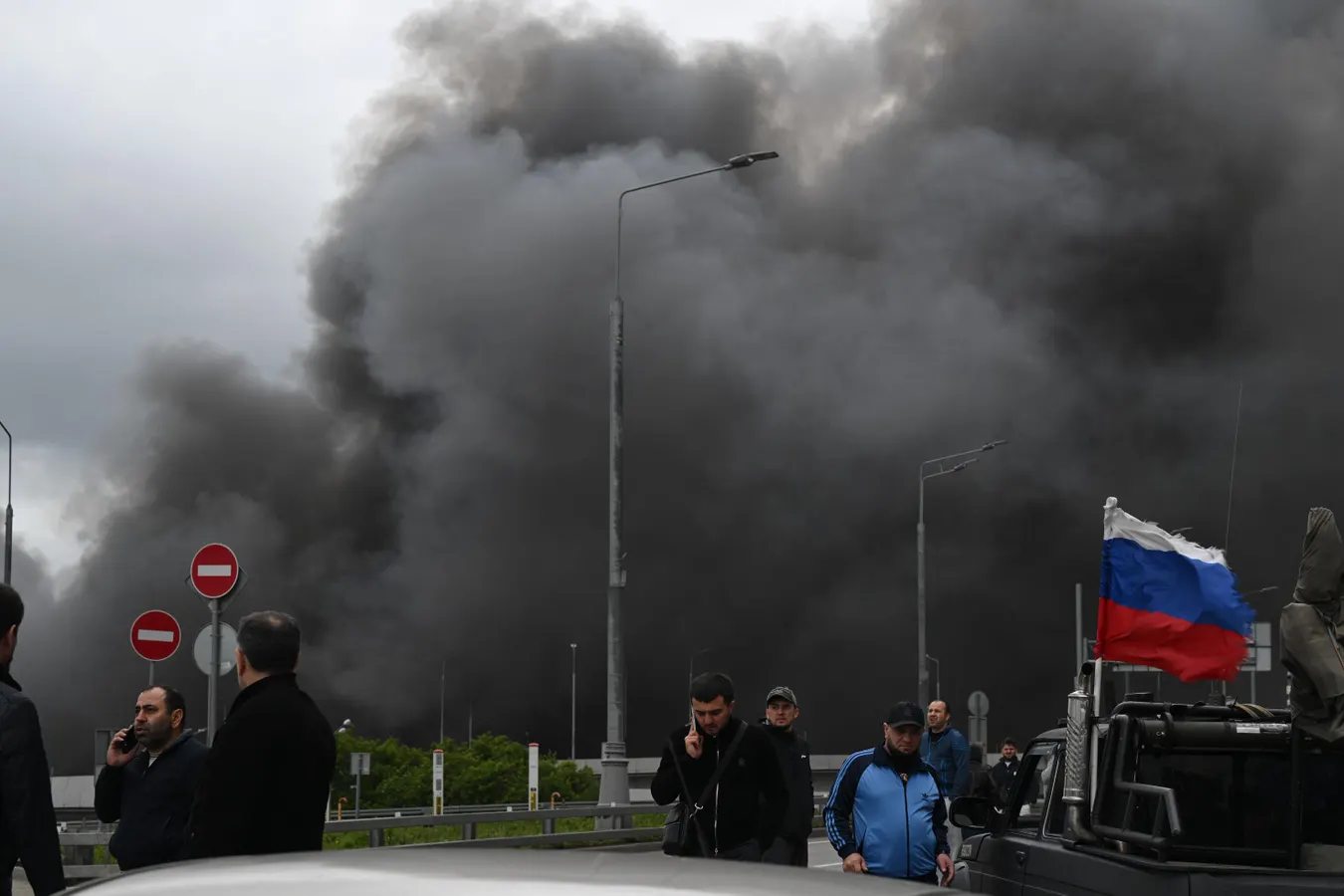

MOSCOW, RUSSIA – JUNE 18: Black smoke billows from the area of Gazprom Neftâs Moscow oil refinery, located on the southeastern outskirts of Moscow, on June 18, 2026, following what the Russian capitalâs mayor described as a âlarge-scaleâ drone attack by Ukraine. Moscow came under one of the largest Ukrainian drone attacks since the start of the war, with an oil refinery struck and around 200 drones intercepted on their approach to the Russian capital, Mayor Sergey Sobyanin said Thursday. (Photo by Sefa Karacan/Anadolu via Getty Images)
Anadolu via Getty Images
Russia faces an acute energy and fuel crisis following months of Ukrainian attacks on its refineries and other energy infrastructure. This has created long lines and economic slowdowns in Russia, forcing some regions to ration fuel. This crisis has spilled beyond Russian borders, helping to push diesel prices in the U.S. to over $6.00 a gallon, prompting President Donald Trump to publicly call on Zelensky and Ukraine to cease attacks on Russian refineries, the latest flashpoint in an increasingly strained U.S.-Ukraine relationship. Trump also called on Russia to stop attacking Ukraine’s energy infrastructure. On September 14, Trump claimed on social media that Kyiv and Moscow had agreed to a mutual halt on energy strikes; Ukrainian officials said they were not aware of any such deal, and Zelenskyy said he was “not sure” Russia would honor one.
In one sense, this is not new. The energy front has long been the key to the Russian invasion of Ukraine. Russia has systematically attempted to annihilate Ukraine’s capacity to generate electricity while simultaneously trying to use its energy dominance as leverage over Europe.
Strategically, Russia remains committed to halting its industrial and agricultural production, and breaking the spirit of its people.
Last winter, Russia repeatedly targeted energy facilities, including generation, transmission, and distribution facilities. More recently, Russian drones have focused on attacking smaller and more vulnerable Ukrainian power substations, in order to damage the network that distributes electricity even when major generating facilities remain operational. Attacks on transmission and distribution infrastructure could limit the ability to deliver electricity from functioning power plants to consumers and also disrupt the transmission of electricity from Ukraine’s nuclear power plants. By systematically degrading Ukraine’s energy system, Russia is also increasing the economic costs of maintaining the country’s energy resilience and sustaining the war.
In another sense, the strategy and results are novel. Ukraine has shifted from tactical strikes against key Russian energy arteries early in the war to a long-term, grinding, attritional strategy designed to wear down Russia’s refining capacity and deny the Kremlin an important source of revenue, while disrupting the logistics of the war machine and making the lives of ordinary Russians miserable. As Ukrainian strategy evolves, the global fuel markets feel pressure.
How is Ukraine changing its strategy for targeting Russia’s energy infrastructure?
Earlier this year, Ukraine’s Ministry of Defense announced that its primary goal was to deprive Russia of its economic resources to wage war, including targeting its shadow fleet and oil-and-gas revenues through its refineries and petroleum storage facilities. This prospect had long been unwelcome in both Washington and Brussels, as fears of increased prices and spurring inflation loomed large. Still, the embrace of this strategy is perfectly rational given the Ukrainian personnel shortages, insufficient anti-missile defenses, and difficulties in conducting conventional offensives and the state of Russia.
Russia has repeatedly faltered, to its adversaries’ advantage, after military humiliation in wars widely seen at home as avoidable and unpopular. In 1905, humiliation against Japan resulted in a barely suppressed revolution, while most infamously, in 1917, Russian incompetence facilitated the Bolsheviks’ seizure of power, which led to repeated famines, internal repression, and millions of people sent to the GULAG labor camps or executed. More recently, the Soviet Union lost the war in Afghanistan in the 1980s, and the First Chechen War of the 1990s ended in a humiliating cease-fire.
Russia’s already fragile economy, combined with President Vladimir Putin’s disproportionate reliance on particular ethnic minority and remote regions for manpower, combined with Russia’s unwillingness to fully mobilize the populations of Moscow or St. Petersburg suggests a fear of domestic instability. Putin is clearly avoiding antagonizing Russia’s major urban centers.
Ukraine is hoping to capitalize on these dynamics. It initially prioritized attacks on energy export infrastructure, including oil and refined product ports and terminals such as Ust-Luga, but shifted toward refineries, where damage could produce longer-lasting effects.
Attacks in June on refineries in Kapotnya, near Moscow, and in Tatarstan reduced their combined supply by about 600,000 bpd. Since then, Ukraine’s strategy has shifted to critical components such as pipelines and connections that keep plants offline longer, creating a greater financial burden. The September attack on the Ryazan oil refinery exemplifies this as sources reported that its CDU-6 unit, which processes approximately 8 million metric tons of crude annually, and CDU-4, which processes approximately 4 million tons annually, were shut down, at least temporarily.
The effectiveness of the attacks depends on whether Ukraine can continue causing damage faster than Russia can repair it. In August, Ukrainian President Volodymyr Zelenskyy announced that the country would continue its deep strikes into Russia, following its attacks on Tobolsk in Siberia. Ukraine has also implemented its long-range sanctions plan on Russian energy infrastructure such as its oil facilities.
TOPSHOT – Russian President Vladimir Putin addresses the crowd during a rally and a concert celebrating the 10th anniversary of Russia’s annexation of Crimea at Red Square in Moscow on March 18, 2024. (Photo by NATALIA KOLESNIKOVA / AFP) (Photo by NATALIA KOLESNIKOVA/AFP via Getty Images)
AFP via Getty Images
Global Markets Shortages Rescue Russia
Despite Russia’s precipitous decline in production by volume, the broader global energy market suffering from shortages due to the wars in the Middle East, has provided Russia with a windfall. The International Energy Agency (IEA) expects global oil supply to fall by 5.7 million bpd, or 6%, due to continued disruptions in the Middle East, while demand is expected to increase by 2.6 million bpd in 2027.
Russian oil and gas revenue was projected to rise 60% in July year-on-year, according to Reuters, driven by higher oil prices. Russia’s 2026 budget forecasts oil and gas revenue at 8.92 trillion rubles, slightly higher than the 8.48 trillion rubles collected in 2025. However, higher oil prices have not yet fully reversed the decline in Russia’s energy revenues.
Russian oil-and-gas revenue for January through July came in at 4.595 trillion rubles for the period — 16.8% lower year-on-year, though modestly above the government’s own 4.467 trillion ruble baseline projection. The relief was short-lived: according to Ukraine’s Foreign Intelligence Service, citing Russian Finance Ministry data, oil-and-gas revenue fell 16% year-on-year in August and was 55% lower than in July.
Russia’s Response
Many of these developments are beyond Russia’s and Ukraine’s control. The crisis in the Strait of Hormuz and the capture of Yemen’s West Coast by Iranian-backed Houthis have rescued the Russian economy. While the Kremlin didn’t engineer these developments, it can and most probably prolong and exacerbate them to its advantage.
In a testament to how international developments are obscuring the severity of Russia’s internal crisis, in July Alexander Novak, Russia’s deputy prime minister, said Russia would begin importing oil products to stabilize the domestic market. That is hardly reassuring for a country that once styled itself an energy superpower. Russia has since taken steps to maintain its domestic fuel market by restricting fuel exports and arranging imports from Belarus, Kazakhstan, and India.
On August 24th, Russian President Vladimir Putin authorized the Russian state to temporarily take control of critical infrastructure considered inadequately protected against Ukrainian drone attacks. The decree covered fuel, energy, industry, communications, transport, and logistics facilities. This is another step towards a Soviet-style state monopoly that Putin and his “Politburo” nostalgically cherish.
With winter looming, the energy war is likely to become a race over which side can better maintain its energy resilience. For Ukraine, that means protecting and repairing critical infrastructure under continued Russian attacks. This requires more anti-missile and anti-drone systems, both produced domestically and from the West. For Russia, it means maintaining fuel supplies and repairing refineries while Ukrainian strikes continue to disrupt its energy system. The question is whether rising global energy constraints and higher oil prices will let Russia offset some of these losses – and whether the West will let the Kremlin get away with it.













Leave a comment