


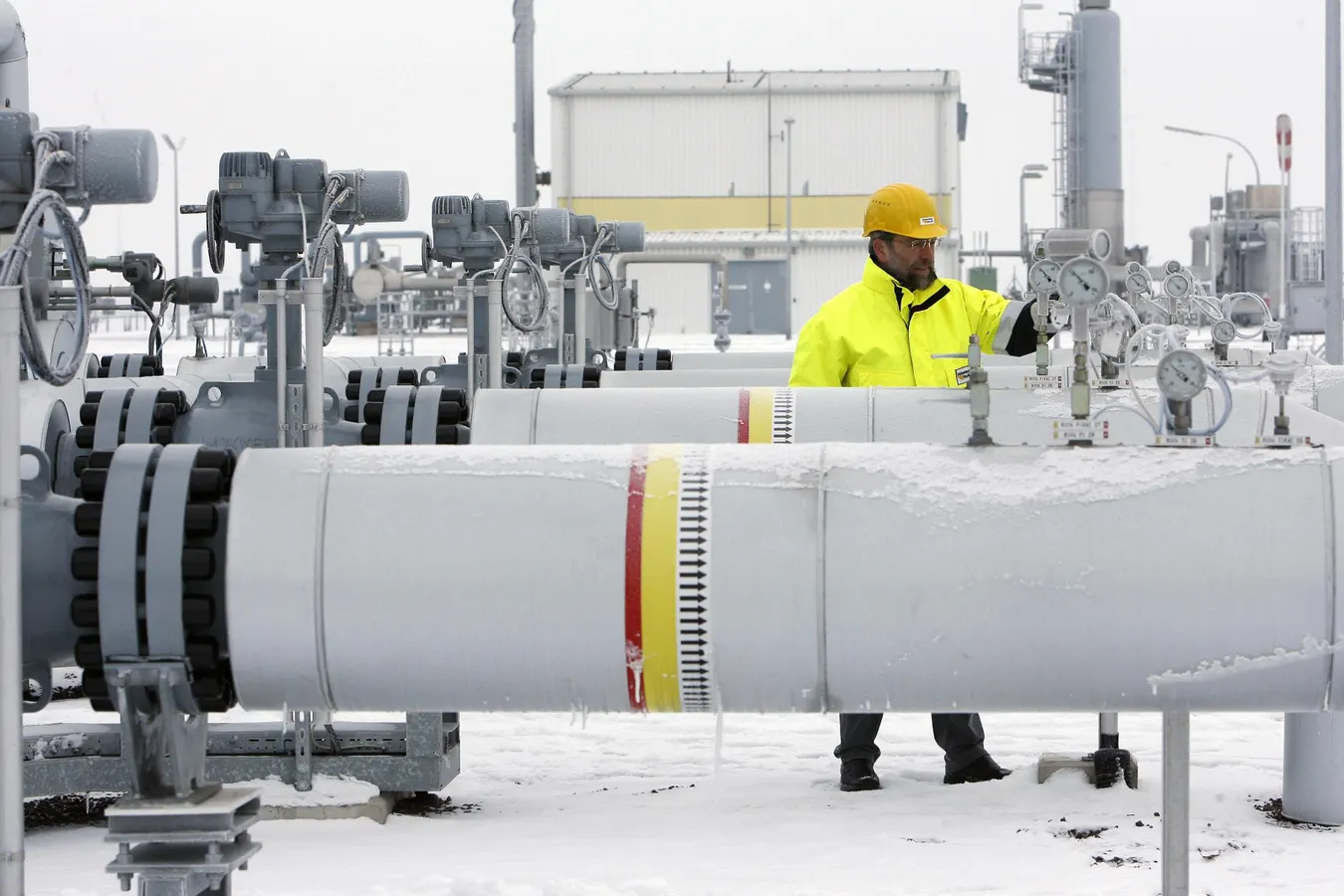

An employee controls the pressure gauge at a natural gas storing facility in Bad Leuchstaedt, Germany. (Photo: Jens Schlueter)
DDP/AFP via Getty Images
As winter approaches in the Northern Hemisphere, Europe is staring at alarming “decades low” natural gas storage levels and price spikes, according to various market commentators.
Nearly a fifth of world liquefied natural gas supply has been effectively removed from the market since the Iran War disrupted flows through the Strait of Hormuz in late February, and Qatar’s infrastructure was subsequently damaged. Europe’s lackluster response to the development is causing widespread market anxieties.
At Gastech – one of the energy industry’s largest global gatherings that concluded in Bangkok on 17 September – European natural gas storage was reported within a worryingly low capacity range of 65% to 69% full by various market commentators including Wood Mackenzie and Rystad Energy.
Rystad Energy – which projects Europe’s storage at around 67% full – said the continent is racing against the clock, well short of the five-year average of around 84%, with Germany particularly exposed at around 55%. Wood Mackenzie also observed European inventories to be their lowest for this time of year since 2009.
General market consensus is that with Europe and Asia competing for a shrinking pool of available cargoes, and low European gas storage levels – major European economies are now heading into the winter of 2026-27 in one of their weakest storage positions for this stage of the cycle in almost two decades.
David Lewis, principal European gas and LNG analyst at Wood Mackenzie, said: “The combination of Hormuz supply disruptions and below-average storage leaves Europe with very little room for error this winter.
“Storage normally acts as the market’s shock absorber, but with inventories at their lowest for this time of year and balances unlikely to normalise before 2028, the cost of a cold winter or a supply shock will be felt directly in prices.”
Potential Shutdowns, Elusive Targets And Price Spikes
Storage in Europe typically averages around 84%-85% around this time of the year. The revised ambition for the winter of 2026-27 is around 80%.
Among the major European economies, the U.K. could also be severely impacted alongside Germany. Sir Jim Ratcliffe, founder of petrochemical giant Ineos, told the BBC, that low gas storage levels in Europe posed a risk to the U.K. in the months ahead, and that he had lost confidence in the country.
“If we have a really sharp cold spell, then there is conceivably the possibility that we’ll run out of gas and have to switch industry off. Our storage is not full,” he said.
Another issue facing the U.K. is that it does not store large volumes of natural gas, typically relying instead on LNG and imports from Europe.
The policy has come under intense scrutiny following a decision by the U.K. Labour government in 2024 to hold back exploration licences in the North Sea on environmental grounds, a basin neighbouring Norway taps to export gas back to the U.K.
The country might also be in for a rude awakening on the LNG front, as the reopening of the inter-basin arbitrage could pull flexible Atlantic cargoes toward Asia just when the U.K, and other European importers need them the most.
A spokesperson for the U.K. government said Wednesday it was fully committed to “ensuring security of supply” as part of the wider energy mix without providing further details.
Meanwhile, a spokesperson for Germany’s state-owned energy company SEFE said it was working overtime to “increase its natural gas storage levels.” It currently accounts for a quarter the country’s storage by volume.
At Gastech, executives from energy majors Equinor and Shell said European natural gas stocks could reach 75% full by the first week of November but that an 80% target may prove elusive.
It implies that unless there is a mild winter in Europe, higher prices beckon given the European importers will have to compete with Asian buyers in a market with very little spare supply available.
According to data comparisons by S&P Global Energy, spot prices this year in Asia’s high growth markets over hover around $30 per million British thermal unit-levels, down from a pre-Iran War range of around $10 per mmBtu.
A scramble for cargoes between Europe and Asia could see this spiking to as high a range as $40-$45 per mmBtu in the event of a cold snap, according to many natural gas industry forecasters. That’s a chilly prospect for most of Europe’s policymakers.
Disclaimer: The above commentary is meant to stimulate discussion based on the author’s opinion and analysis offered in a personal capacity. It is not solicitation, recommendation or investment advice to trade oil stocks, futures, options or products. Oil markets can be highly volatile and opinions in the sector may change instantaneously and without notice.
















Leave a comment