


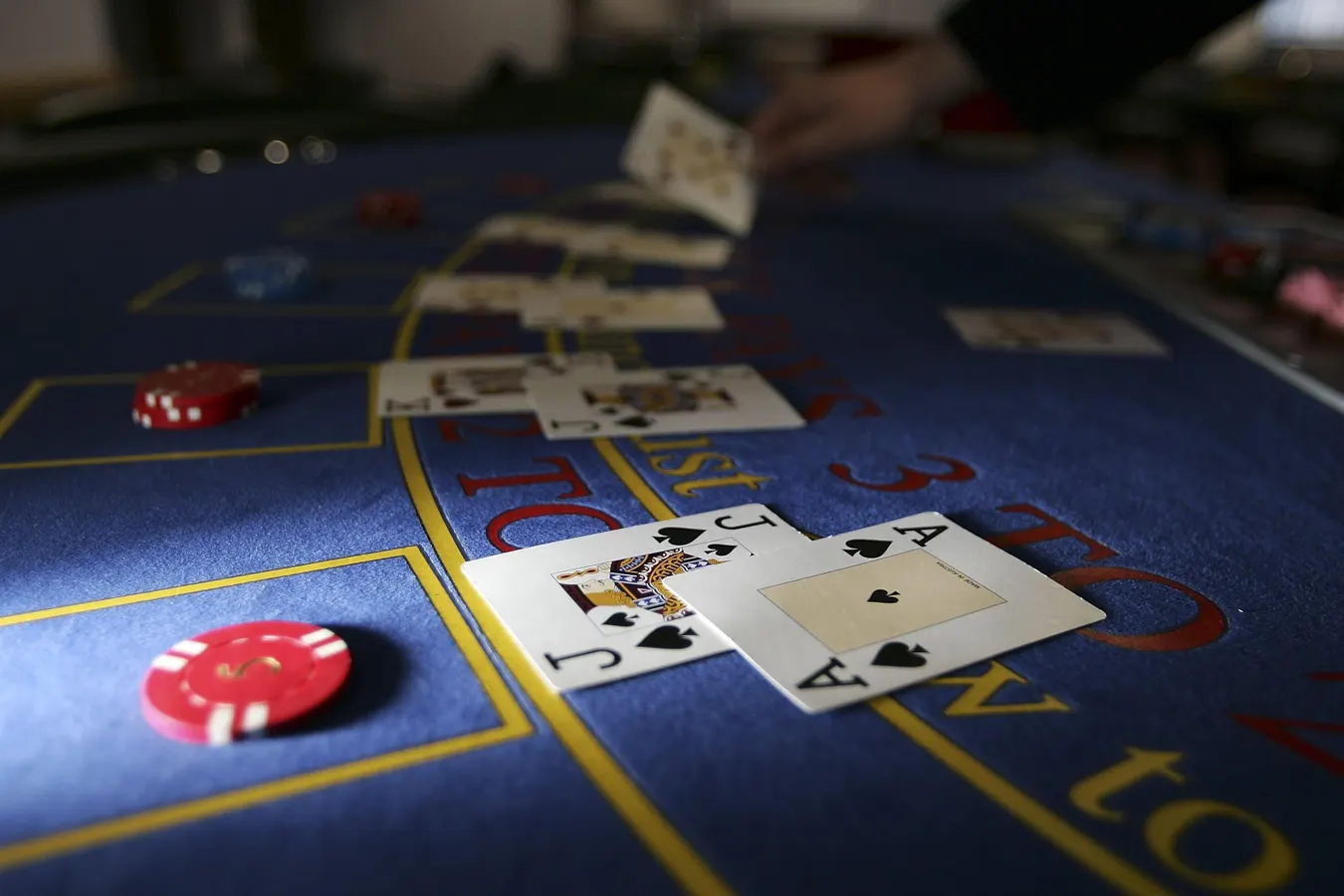

BLACKPOOL, UNITED KINGDOM – FEBRUARY 17: A croupier deals cards on a Black Jack table on February 17, 2006, Blackpool, England. Blackpool and The Fylde College has become the first educational establishment in Britain to offer training and qualifications in gaming. The gaming academy came into existence after changes in the Uk gaming laws and created a skills gap in the industry. Students are trained in every aspect in a casino form running card tables to servicing slot machines. (Photo Illustration by Christopher Furlong/Getty Images)
Getty Images
Knowledge is implicitly banned in casinos. They’re watching you as you gamble, and if they sense you’re counting cards, prepare to be dismissed from the casino.
No doubt a lucky streak of cards doesn’t get you in trouble, but if you’re seen as bringing an evident mathematical advantage into the casino, your time there will be limited. Said another way, casinos aren’t in the business of losing money. They always win.
Contrast what you’ve read with prediction market platforms. Opposite casinos, prediction markets quite simply are. There’s no ideological ax to grind, rather prediction markets are knowledge exchanges that produce information based on the aggregation of knowledge. The aggregation is the markets part of prediction markets.
As opposed to the proverbial “House” always winning in gambling, prediction market exchanges don’t win or lose based on the predictions patrons make. Instead, their prosperity is an effect of the creation of information itself: the more participants there are bringing their unique knowledge to a certain event or outcome, the more money they make via transaction fees charged on every trade.
Which means prediction market exchanges like Kalshi are rewarded the more that they improve understanding of what’s ahead. This could be about the cost of roses on the west coast in December, what the weather will be like on January 1st in Pasadena, and who will win the Rose Bowl in the early evening of the 1st.
It’s a long way of saying that while knowledge in Las Vegas will quickly render you persona non grata at the city’s casinos, at prediction market exchanges your individual knowledge is the ultimate virtue. That’s because the success of those information exchanges is an effect of the most knowledgeable minds routinely contributing to the exchanges through the purchase of contracts.
While with gambling you’re yet again expected to lose by design, prediction markets are designed to reward the most knowledgeable participant. See how contracts work on these exchanges.
Each one costs somewhere between 1 and 99 cents, which reflects the market’s estimated chance of a presumed outcome happening, or not. If your prediction is correct, you’re paid out $1, while you’re paid nothing if you’re incorrect.
Knowledge isn’t just the friend of the individual buying a contract, it’s also the friend of the information exchange. With prediction markets, incentives are explicitly aligned.
Which is why it’s so puzzling that U.S. courts and politicians continue to place prediction market exchanges like Kalshi in the same boat as casinos. They couldn’t be more opposite, and for obvious reasons. See above.
At the same time, remember yet again that while casinos view individual knowledge in the way that a bat theoretically views bright light, prediction markets are improved the more that the most knowledgeable minds are matching their knowledge on the exchanges with money. The latter amounts to the production of wealth (yes, information is wealth), while the former amounts to the consumption of wealth based on information’s subsumption.
Which is why courts and politicians would be wise to substantively distinguish between what extinguishes wealth and what creates it. Prediction markets are not gambling dens, simply because prediction markets are an expression of knowledge that casinos suffocate.
















Leave a comment