


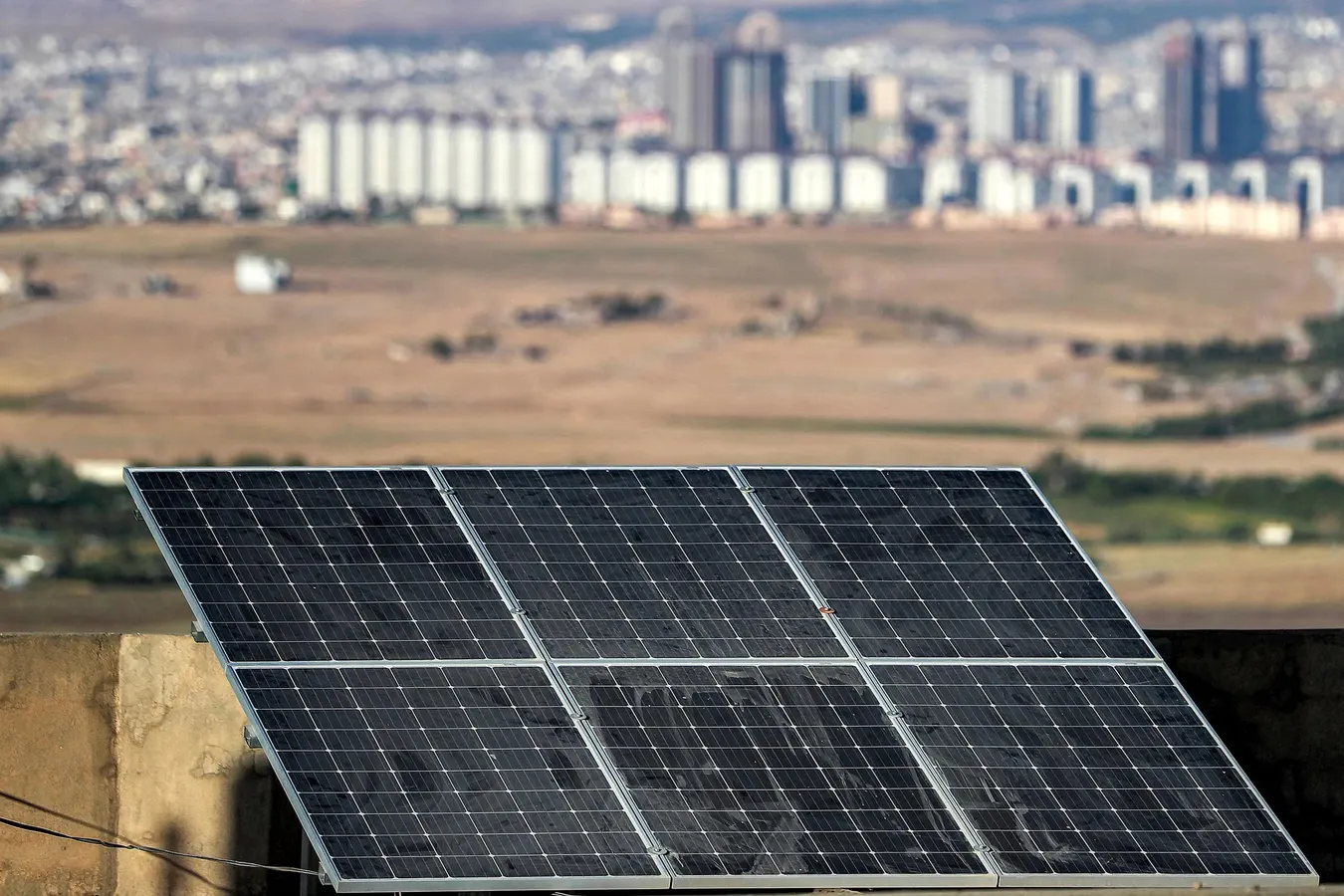

Solar panels installed atop the roof of a house in the Hazer Merd village near Sulaymaniyah in northern Iraq’s autonomous Kurdish region are pictured on September 19, 2023. Despite its vast oil wealth, Iraq struggles to provide enough electricity to its 43 million people after decades of conflict and sanctions, as well as rampant corruption and crumbling infrastructure. And even though it is blessed with more sunshine than most other countries, it has proved difficult to wean Iraq’s economy off fossil fuels – one of the themes of the upcoming climate COP28 talks in Dubai. (Photo by Ahmad AL-RUBAYE / AFP) (Photo by AHMAD AL-RUBAYE/AFP via Getty Images)
AFP via Getty Images
On long nights or hot days, life for many depends on private diesel generators. For decades, private diesel generators have filled the gaps left by Iraq’s unreliable electricity grid. The same holds in much of the Middle East outside the Gulf states. It’s also true in the Global South writ large. In extreme cases, a single large generator keeps the lights on in over 200 homes. Electrification for such communities can carry massive per-household capital costs, whereas microgrids can scale investments more easily.
Few places illustrate the problem better than Iraqi Kurdistan.
For centuries, the people of what is now Iraqi Kurdistan found shelter in the mountains from both invaders and the taxing powers of centralized governments. The saying goes that the Kurds’ only friend is the mountains in a region hostile to the idea of Kurdish unity. However, the mountains themselves are not friends of public utilities.
A photo of the Erbil citadel shows the various electrical wires running to the site in the Summer of 2010 during the author’s trip.
Joseph Hammond
I saw these challenges first-hand during a trip to Kurdistan in 2010, when I was covering the first U.S. withdrawal from Iraq. In the early evening, en route to Erbil, my shared taxi swerved off the road toward a simple house whose large floodlight, unlike its neighbors drenched in rolling blackout darkness, suggested it had power—more than that, it was a backwoods bodega whose running meat locker sold cold beverages to motorists in the know.
I noticed a similar disconnect the next morning when I visited the historic citadel at the heart of Erbil, the Kurdish capital. Locals hold that the old fortress was once an Assyrian ziggurat, and it is widely recognized as one of the world’s longest continuously inhabited places. History doesn’t keep the lights on, and when I visited, residents complained about electricity issues (and the odd snake). Elsewhere power lines snaked across buildings and above every available pole. Fifteen years later, this is a challenge which has yet to be solved even in the Citadel, which has been the focus of international restoration efforts.
Another approach may better serve Kurdistan’s rural communities by helping themselves wean off generator use. Running transmission infrastructure over mountains to a settlement of a few dozen families can make little economic sense. In the context of the current war in the Middle East, Kurdistan has been struck dozens of times in Iranian attacks – something that may give planners pause.
“Rather than expanding the grid in Northern Iraq, some of the most innovative solutions may involve alternative energy such as solar panels. A solar array and battery bank change the cost-effectiveness calculation,” said Eyup Kerem, President of the Iraqi Turks Culture and Aid Association, “It will also add much needed resiliency to the grid.”
The village of Kulak is a short drive from Erbil. However, its approach to electrification has been entirely novel. This off-grid village serves 32 homes, and its electricity comes from almost 200 solar panels. The panels cling to homes, schools, mosques, and even hospitals, eliminating the need for generators. Solar-powered irrigation and regenerative-agriculture training also connect energy access with broader rural development.
Kulak village and its prominent solar panels.
Dr Ruwayda Mustafah
The project, part of the Rwanga Foundation’s wider clean-energy work, reflects founder Idris Nechirvan Barzani’s broader vision of advancing sustainable development through integrated projects. Projects that don’t just provide reliable energy but environmental protection, education, agricultural resilience and community development — to the hardest to reach citizens. As part of this strategy, solar power is not just improving living conditions but, strengthening the long-term resilience of rural communities.
The foundation’s work includes similar solar projects in Gri Bie and Qamish, with plans to reach other communities. Together, these initiatives position Rwanga as an organization seeking to expand practical clean-energy solutions across the Kurdistan Region and elsewhere. They focus on rural areas where conventional electrification strategies have struggled to be profitable.
“The project reflects a wider principle of ensuring that development reaches communities often left behind by conventional infrastructure. Reliable electricity is not a luxury,” said Ruwayda Mustafah, a board member of the Rwanga Foundation, “It allows a child to study after dark, a farmer to irrigate their land and a family to build a future in their own village.”
There is no denying Iraq’s solar potential. Baghdad is targeting 12 gigawatts of solar capacity by 2030. That timetable may prove to be ambitious but, with several large projects in development. The 1 GW TotalEnergies project in Basra is among the biggest, while Karbala is slated to host a separate 300 MW solar park. Together, these projects mark a positive shift in a country long dependent on oil and gas for power generation. In the Iraqi context a single gigawatt can power 350,000 homes.
“Iraq receives some of the strongest sunlight in the Middle East. Annual solar irradiation ranges from roughly 1,550 to more than 2,100 kilowatt-hours per square meter,” said Ghaith Ghaffari, a Ministry of Health official,” Much of that is concentrated in the lower plains of central and southern Iraq, but even the mountainous get ample sunshine. The potential is there but uptake has been slow.”
Distributed generation such as solar villages and microgrids more generally have been highlighted by the International Energy Agency as a solution to Iraq’s historic energy woes.
In areas where the generator economy dominates, residents often pay twice. Once for government electricity and again for generator amperage when grids fail.
“Even in medical facilities with solar panels installed the uptake has been slow. A solar transition would also have respiratory health benefits for the population of Iraq,” said Gaffari.
Solar also saves residents time; one of the hidden costs of generators. During my own visit to the region, I was invited to stay in a friend’s home. The apartment had an automatic generator system that kicked on when the grid failed. However, not everyone did. From the 8th floor during a blackout, it could take up to 20 minutes or so for the community to flicker back to life. That delay represents one of the less obvious costs of unreliable electricity. Other costs include fuel purchases, battery replacement, noise, and pollution.
Kurdistan includes hundreds of isolated, rural communities, so any solution will take time to spread.
“In Kulak, we have shown how clean, locally generated power can transform daily life and support education and livelihoods. This initiative can be replicated across Iraq and around the world wherever communities need sustainable energy,” Mustafah said.
Given the decades of challenges, communities are taking the issue of sustainable electrification into their own hands. The growl of a diesel generator has long signalled a power outage. A quieter future may be the clearest sign that the system is finally working. Solar power (plus battery storage) can provide the “final-mile solution” for communities that have gone without reliable electricity for far too long.














Leave a comment