


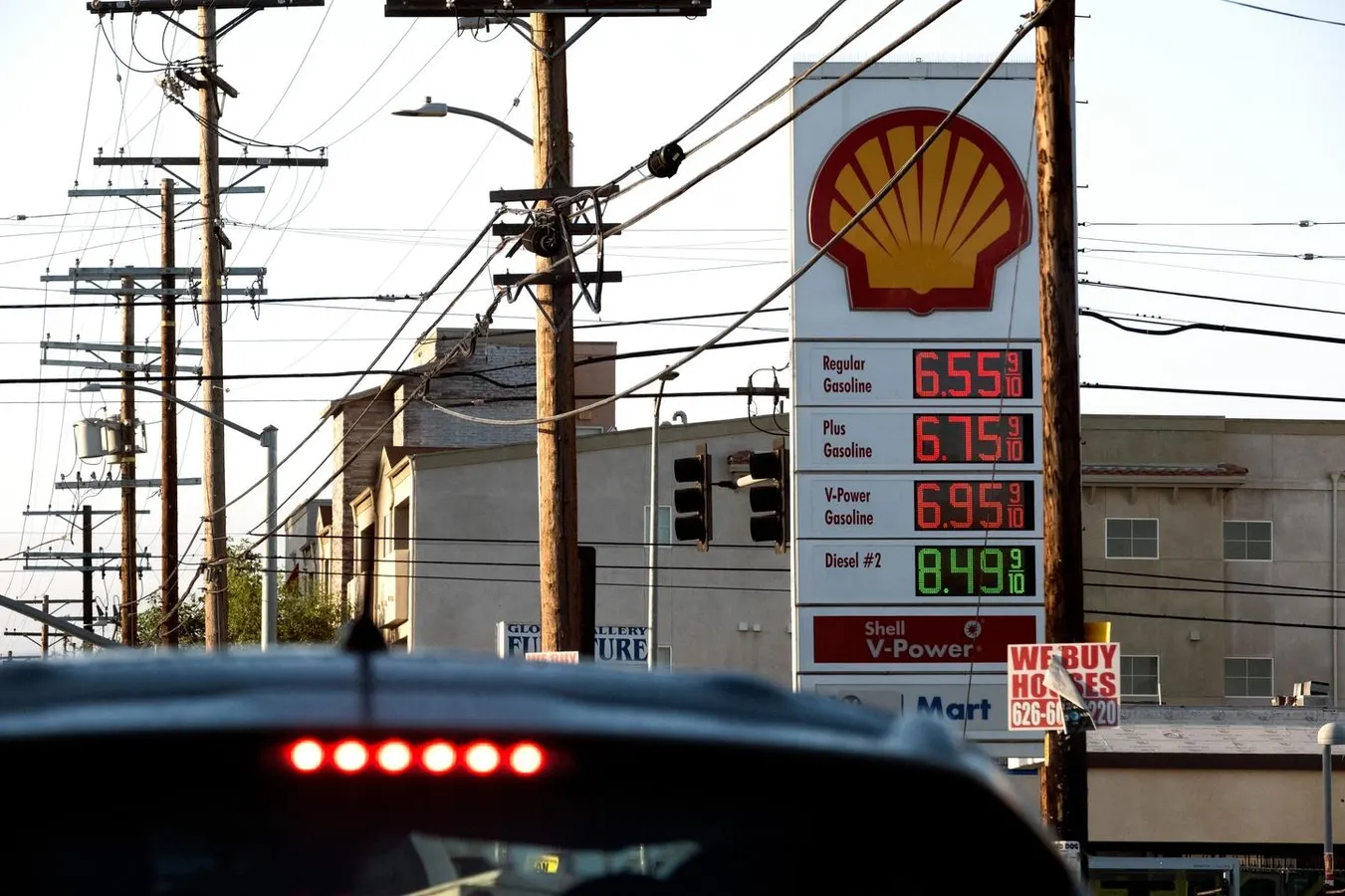

Gas and Diesel prices are posted on a Shell gas station in the San Fernando Valley section of Los Angeles on Thursday, October. 1, 2026. (AP Photo/Richard Vogel)
Copyright 2026 The Associated Press. All rights reserved.
On Sunday, October 11, President Donald Trump announced that “there is an ENERGY CEASEFIRE in the War between Russia and Ukraine,” saying both sides had agreed. Ukrainian President Volodymyr Zelenskiy called it “news for me,” but said Ukraine would halt attacks on Russian oil refineries if Moscow stopped striking Ukraine’s energy infrastructure. Moscow has not confirmed it, and Zelenskiy reported Russian strikes on Kyiv and Kharkiv power plants that evening. The proof, of course, will be in the pudding.
Energy is front and center in the U.S.-Russia-Ukraine triangle. Trump’s October 9 agreement with Russian President Vladimir Putin to release diesel into global markets marks a striking reversal of American policy toward Moscow, but it offers little relief from the diesel deficit and broader energy crisis American and international businesses and consumers now face. In announcing the deal, Trump said Russia would immediately supply more than 300,000 metric tons of diesel, followed by additional shipments in November and beyond. The administration has temporarily relaxed sanctions to facilitate these fuel shipments. Commercial terms remain unclear, including how much Russia will be paid, how much fuel will reach American buyers directly, and whether Washington has offered the Kremlin any other inducements.
In September, Trump began calling on Ukraine to end strikes on Russian oil refineries, essentially blaming Kyiv for global diesel price hikes. Kyiv’s attacks on Russian refineries have certainly contributed to the situation, but Iranian strikes on Gulf oil and refining infrastructure, regulatory constraints on refineries in Europe and the U.S., and the security crisis in the Strait of Hormuz are an even larger part of the worldwide picture.
The Math of the Deal
Can this arrangement materially reduce prices? The arithmetic should temper expectations.
The initial 300,000 metric tons equal roughly 2.25 million barrels of diesel. According to the U.S. Energy Information Administration, American consumption of distillate fuel oil (mostly diesel, plus heating oil) averaged 3.91 million barrels per day in 2025. The initial transfer, therefore, equals roughly 0.6 days of domestic distillate consumption. Even if the additional announced shipments of 500,000 metric tons and 1 million metric tons arrive as promised, the combined 1.8 million metric tons would equal about 13.5 million barrels, or only about 3.5 days of U.S. consumption. That is without looking at global shortfalls.
According to the September 2026 Oil Market Report from the International Energy Agency (IEA), combined diesel and gasoil exports from Russia and the Gulf were 1.6 million barrels per day lower in August than in February. Even if Russia delivers the full 4.8 million metric tons announced, equivalent to roughly 36 million barrels, that would equal only about 23 days of the lost export volume.
These comparisons are not forecasts of actual deliveries and do not account for exports, inventories, or regional distribution constraints. Promised deliveries may not lower prices quickly. Diesel is needed now, stocks are low, and fuel will not instantly reach the pump.
Shipments measured in mere days of national consumption, which may not entirely end up in the U.S., will not deliver sustained price relief in a world market disrupted by the war in the Middle East.
The logistics of delivery have not been announced. Ambiguity is not the only obstacle. Hours after the deal went public, Ukraine struck the strategic NZNP Rostovsky oil products export terminal in Rostov-on-Don.
Why Are Diesel Prices So High?
The underlying problem is not simply a shortage of crude oil, nor is it confined to diesel. It is the availability of refined petroleum products, diesel included, amid massive disruptions to global energy supply chains and refining capacity. This crisis is a preview of what the future may look like if the U.S., Europe, and the West’s East Asian allies, do not control the aggressors in Moscow and Tehran, and the Houthis in Yemen.
Before Ukraine’s long-range drone campaign reached its current intensity, Russia was a pillar of the global diesel market. It had 32 major refineries and roughly 6.5 million barrels per day of installed refining capacity, ranking third worldwide in refined-product output behind the U.S. and China. It exported about half of its diesel and gasoil output, some 0.8 to 1 million barrels per day (b/d) by sea (Kpler put the 2025 average at 817,000 b/d).
Since then, Kyiv’s strikes, which in the first eight months of 2026 hit a Russian refinery on average once every three days, have upended that position. Refinery throughput fell to 3.8 million b/d in June, its lowest in over twenty years and about 30% below a year earlier, and diesel output dropped by nearly 30%. Moscow responded with a diesel export ban on July 8, and seaborne diesel and gasoil exports fell to roughly 150,000 b/d in August and 144,000 b/d in September, a collapse of about 80% from their 2025 average. This loss compounded the shock from the Iran war, which began in late February 2026.
In February, Gulf producers exported refined products and liquefied petroleum gas (LPG) at rates exceeding 6 million b/d, including net diesel and gasoil exports of roughly 1.4 to 1.5 million b/d. Constrained transit through the Strait of Hormuz, which normally carries roughly one-fifth of the world’s oil shipments, cut Gulf refined product and LPG exports by nearly 60%, or 3.7 million b/d, and net diesel and gas-oil exports to about 390,000 b/d in August, just over a quarter of the prewar level.
Currently, Gulf crude flows have largely recovered through pipeline bypasses and U.S. naval escorts, while refined-product shipments remain severely constrained. Together, the Gulf and Russia supplied nearly 45% of seaborne diesel trade in February. By August, their combined exports were 1.6 million b/d lower, with roughly two-thirds of that gap attributable to the Gulf and one-third to Ukrainian strikes on Russia, based on analysis of IEA data. The result has been record Atlantic Basin refining margins, diesel refining crack spreads above $100 per barrel in September and U.S. diesel prices above $200 per barrel in early September. Disruption in the Gulf and pressure on Russian refining have combined to leave Western diesel markets severely undersupplied.
As noted earlier, Trump has repeatedly sought to shift responsibility for rising energy costs to Ukraine, blaming it for attacking the Russian energy infrastructure. The Russian refinery outages matter. Yet attributing the broader crisis to Kyiv obscures the fact that disruption around Hormuz is a major driver of the present shock. Blaming Ukraine does not restore supply chains, reopen damaged infrastructure, or add refining capacity. Nor will buying Russian diesel resolve the conditions that raised fuel prices.
A policy response that mistakes a contributing factor for the central problem risks delivering limited economic relief while imposing substantial strategic costs.
Making the Deal Work
If the administration believes accommodating Moscow is necessary to advance negotiations over its war in Ukraine, it should tie any such accommodation to a clearly defined diplomatic objective. Purchasing Russian diesel without revenue safeguards risks giving the Kremlin precisely what sanctions were designed to restrict: revenue and hard currency. The U.S. should consider placing payments into escrow, with disbursements controlled by American authorities or a designated third party and restricted to verified humanitarian purposes.
Such an arrangement is imperfect and would not eliminate the underlying problem of money fungibility: Russia could redirect domestic funds previously allocated to humanitarian or civilian needs toward military expenditure. Nevertheless, a controlled payment structure would impose greater transparency and conditions than an unrestricted commercial transaction and would establish a measurable connection between economic concessions and diplomatic progress.
The absence of clear terms makes this distinction important. Without transparency, neither American businesses nor the public can assess the agreement’s true cost. If Moscow receives hard-currency earnings while Washington gets only a marginal increase in fuel availability, the cost-benefit balance would be hard to justify as an instrument of energy security or diplomacy.
How to Get Cheaper Diesel
Refining bottlenecks in the U.S. and elsewhere are well-known. A more durable response to the diesel crisis would address the structural constraints on American refining. The U.S. produces substantial crude, but more oil does not automatically mean more diesel. Refinery configurations, investment costs, permitting requirements, and the availability of suitable crude grades limit the volume and types of products refiners can supply.
Instead of relying on the Kremlin, policymakers should pursue regulatory liberalization that makes new refining capacity commercially viable and lets existing American facilities expand or improve their output to handle heavy crude. Importing and refining heavy crude from Canada could help mend recently frayed relations, and Venezuela’s heavy crude could also be part of this strategy. This is a longer-term undertaking, not a quick fix for today’s prices. Yet additional domestic capacity would improve resilience against future disruptions rather than leaving American consumers dependent on improvised arrangements with foreign governments.
The central issue is consistency. Washington cannot credibly seek to constrain Russian resources for the war in Ukraine while relaxing those constraints without transparent conditions or a demonstrable strategic return. The diesel agreement and the “energy ceasefire” between Moscow and Kyiv, if successful, may add fuel to international markets, but the scale is unlikely to change the price environment before the midterms in November.
This diesel deal is not a hard bargain, nor does it come from The Art of the Deal playbook. If the U.S. is willing to trade sanctions leverage for limited and temporary relief, Moscow gains revenue while Washington risks weakening the coherence of its own policy. Energy security requires investment, capacity, and a consistent strategy, not merely another deal with the Kremlin.
















Leave a comment