


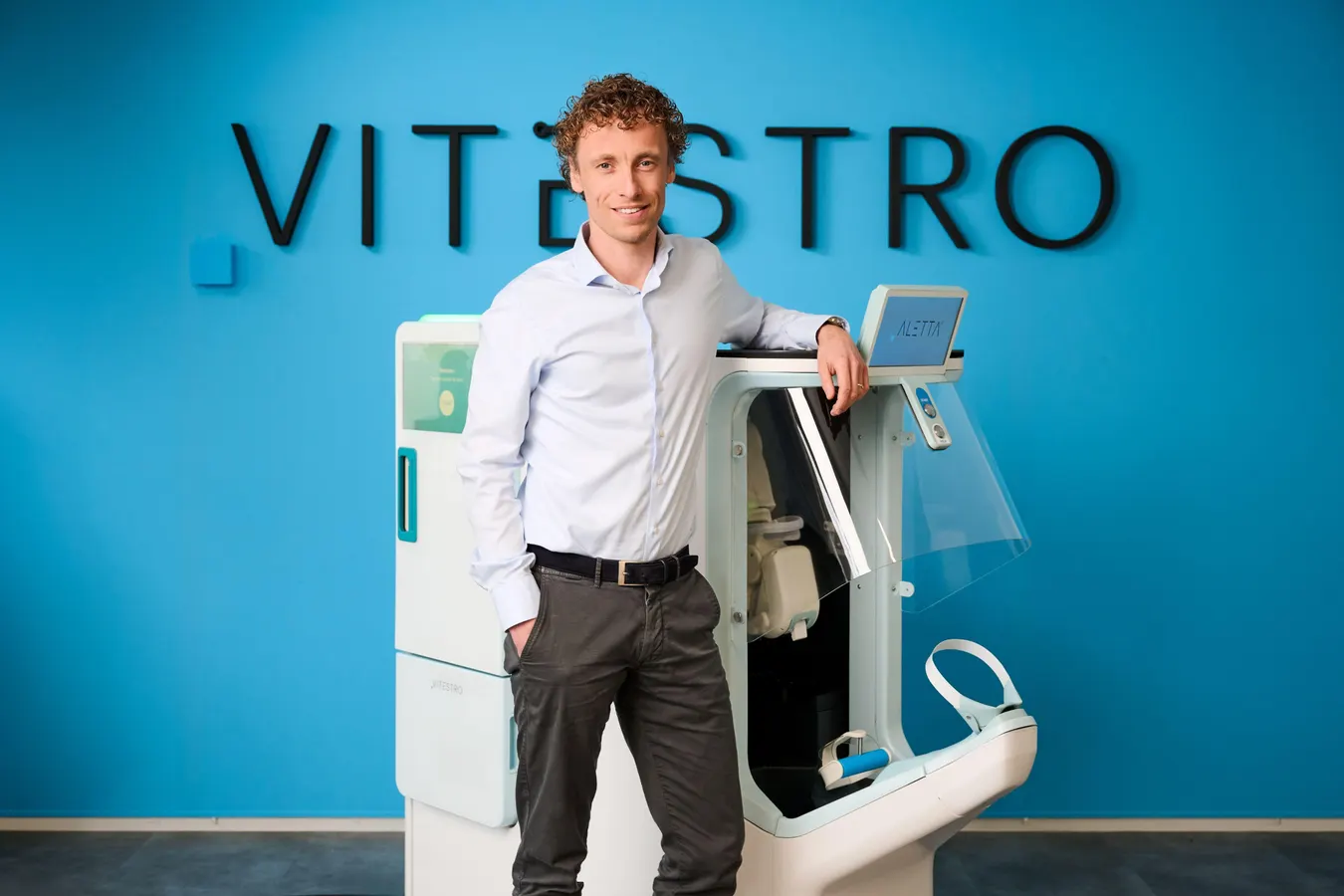
This week’s edition of InnovationRx looks at Vitestro’s newly authorized robot, Italy’s $10 billion pharma family, this year’s Covid-19 vaccines and more. To get it in your inbox, subscribe here.
Vitestro cofounder and CEO Toon Overbeeke
Vitestro
Would you sign up to have your blood drawn by a robot rather than a person?
Last week, a Utrecht, Netherlands-based startup called Vitestro got FDA authorization to deploy a robot that uses AI and advanced imaging to find your veins, guide a needle into them and collect blood samples. Named Aletta, the robot was inspired by cofounder and CEO Toon Overbeeke’s experience seeing how hard it was for a friend’s father to get his blood drawn due to chemotherapy’s impact on his veins.
This has been a nearly decade-long journey. “Clinically this has never been done before,” Overbeeke tells Forbes. “Aletta makes the decision to do an invasive procedure….Getting that designed in a safe manner was critically important.”
Overbeeke, a former Bain consultant, launched the company in 2017 with Brian Joseph, who had previously cofounded a software firm that was acquired by Amazon. They’ve now raised a total of $110 million, including $70 million last March from investors that include the venture capital arm of Labcorp, the $27 billion (market cap) clinical laboratory behemoth; health systems Mayo Clinic and Sutter Health; and robotics pioneer Fred Moll, who cofounded Intuitive Surgical and now invests in robotics startups. Aletta was cleared for commercial use in Europe in August 2024.
Blood draws are one of the most common invasive procedures in healthcare, with roughly 1 billion of them done each year in the United States alone. They’re crucial for tracking key health markers like cholesterol (a risk factor for heart attacks and strokes) and glucose (an indicator for diabetes). Yet like so many other basic areas of medicine, the labs that perform them have faced staffing shortages. While Vitestro’s robot requires a human supervisor trained in blood drawing, the company says that one person could oversee up to three robots at a time.
For now, the robot has only been approved in outpatient settings, and Overbeeke says the company will begin with outpatient centers at hospitals that do a large volume of blood draws. In a key study, Vitestro found that Aletta completed blood draws on its first stick 94.5% of the time, and worked well in patients who were obese, elderly and whose veins–like Overbeeke’s friend’s father–were difficult to access.
“My concern was that people would be afraid, but the opposite turned out to be true,” Overbeeke says. “It is preferred by many, many patients because of the consistency.”
Italy’s $10 Billion Pharma Family Makes A U.S. Power Move
Angelini Pharma’s Sergio Marullo di Condojanni
Angelini Pharma
For more than 100 years, the billionaire Angelini family had been content to run a largely European business empire from their headquarters in Rome: pharmaceuticals like the Italian equivalent of Tylenol and the antidepressant trazodone, as well as a robotics business, wineries (of course) and a joint venture with Procter & Gamble to sell Pampers and other consumer products in their native Italy.
But after former banker and law professor Sergio Marullo di Condojanni married Thea Paola Angelini, now the family’s fourth-generation controlling shareholder, in 2017, the two began plotting a major expansion of Angelini Pharma, its drug business. By 2024, they’d set their sights on the largest and most innovative pharmaceutical market in the world.
“What was clear from the beginning is that the U.S., in the pharmaceutical space, is mandatory,” Marullo di Condojanni, 48, tells Forbes.
Last November, Marullo di Condojanni zeroed in on Coral Gables, Florida-based Catalyst Pharmaceuticals, a biotech focused on rare diseases that was then publicly traded. During a meeting with its CEO Rich Daly at the swanky Chancery Rosewood hotel on London’s Grosvenor Square, which had once been the U.S. embassy, Marullo di Condojanni turned on the charm. “He’s very Italian—dressed to the nines,” Daly says. The two bonded over their approach to drug development, and the way that their companies—one in the U.S. working on rare neurological and neuromuscular diseases, the one outside the U.S. looking at brain disorders like epilepsy and depression—could fit together.
In May, with the help of Blackstone and Italy’s CDP Equity, Angelini Pharma agreed to pay $4.1 billion in cash to buy Catalyst, a premium to its market cap at the time. The deal, which closed in July, catapulted the Italian firm into the United States and the rare-disease market.
While Angelini is little known in the United States, it has a long and storied history in Italy. With $1.5 billion in revenue before the Catalyst deal, Angelini Pharma is the largest piece of the Angelini family’s broader group, Angelini Industries, which rang up total revenue last year of some $2.5 billion. Forbes estimates that Thea Paola Angelini and family are worth some $10 billion.
Covid-19 Vaccines Approved
The FDA approved this year’s Covid-19 vaccines for adults aged 65 and older and those who have health conditions that could raise the risk of serious illness. The approval clears the way for the vaccine manufacturers–notably Moderna and Pfizer, which make the two most common of them–to begin shipping to pharmacies and doctors’ offices. People who are not formally eligible may still be able to be vaccinated, though some could face logistical hassles. Last year, Walgreens and CVS allowed people to self-attest that they met the criteria. Insurers typically cover vaccines in full, and trade group AHIP has previously said that it would do so through 2027.
What We’re Reading
The FDA’s approval of Revolution Medicine’s innovative pancreatic cancer drug could usher in a new era of treatment.
Children in a faith healing sect in Idaho keep dying. Yet the state maintains its exemption to child endangerment laws for those who believe that life and death must be left to God’s divine will.
Colossal billionaire Ben Lamm spun out Astromech, at a valuation of $3.8 billion, to build AI models that can forecast evolutionary change.
The Department of Justice steps up its crackdown on Medicare “upcoding,” in which healthcare providers submit improper diagnosis codes to insurers.
Novartis halted CAR-T cell therapy clinical trials after three deaths. Bristol Myers Squibb also put its CAR-T programs on hold for safety review.
















Leave a comment