


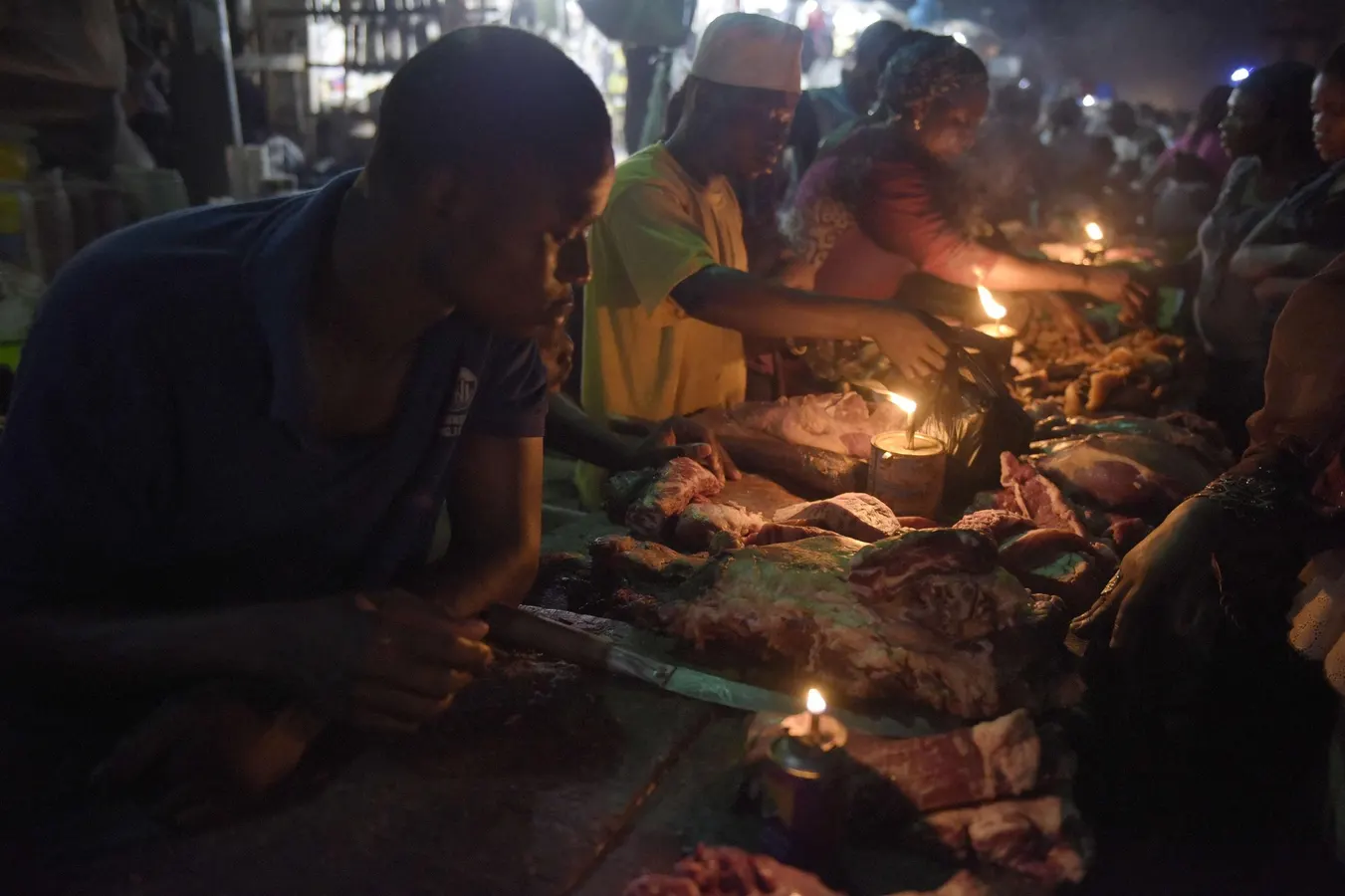

TO GO WITH AFP STORY BY MARIANNE BARRIAUX Vendors sell meat at the Oshodi night market in Lagos, late on June 6, 2015, lighting their stall with a fuel lamp in absence of electricity. AFP PHOTO / PIUS UTOMI EKPEI (Photo credit should read PIUS UTOMI EKPEI/AFP via Getty Images)
AFP via Getty Images
The lights in Lagos, Nigeria, go out between 30 and 60 times a month. When power does flow, it lasts perhaps six to eight hours a day—enough to charge a phone, but not nearly enough to run a factory. It is the same story in Nairobi, Lusaka, and Dakar— cities that are technically electrified.
At a moment when artificial intelligence, advanced manufacturing, and the clean-energy transition are rewriting the global economic order, Africa’s commercial hubs risk getting left behind again—not because they lack wires, but because the electrons flowing through those networks are unreliable, untracked, and leaking.
That is the argument Bim Adisa has been making to utilities, investors, and anyone who will listen. Adisa is the founder and CEO of Beacon Power Services, a Nigerian-based firm that builds data and software solutions for African power grids. His pitch is equal parts engineering lecture and economic manifesto: the path to a more stable, prosperous world runs through the transformer stations of sub-Saharan Africa, and the technology to fix them already exists.
“No economy grows without electricity. It’s fundamental to industrialization, and in the 21st century, to digitization. Africa missed the last industrial revolution. Now we’re having another one, underpinned by electricity. It’s really critical that we fix the electricity problem now,” Adisa told me in a virtual interview.
The common narrative around African electrification fixates on the roughly 600 million people who have no access to electricity at all. That number is real—and damning. But just as important is that somewhere between 500 and 600 million Africans do have grid connections, yet those networks fail them daily.
One-third of all electricity generated across the continent is simply unaccounted for: lost to theft, leakage, aging infrastructure, and the absence of any reliable metering between the power plant and the consumer. For utilities already operating on thin margins, that missing third is financially catastrophic.
Consider Lagos: Between 1990 and today, the city’s population grew from roughly 6 million to 22 million people. The grid did not come close to keeping pace. Infrastructure that was never designed to serve 22 million people now tries to do so, without the data to understand where demand is coming from, where power is going, or why transformers keep blowing. The result is a city of immense economic energy that cannot reliably run a conveyor belt.
“You won’t find many people in Lagos who don’t have access to electricity,” Adisa says. “What they suffer is the challenge of consistent supply—steady, 24/7 power, with no voltage fluctuations. Because of that, you can’t run a factory when the power goes out 30 times a day.”
Data First, Then Light
A man holds a placard reading “No electricity! No industries!! No jobs!!! Provide electricity, revive industries, provide decent jobs” during a demonstration to protest against the 45 percent raise of electricity prices on February 8, 2016 in Lagos. / AFP / PIUS UTOMI EKPEI (Photo credit should read PIUS UTOMI EKPEI/AFP via Getty Images)
AFP via Getty Images
Adisa’s framework for fixing the grid rests on two foundations: data and visibility. They sound simple. In practice, neither exists in most African cities today.
What’s needed is a “digital twin of the grid”—a precise, dynamic map of every asset from generation sources to consumers. That means using AI and drones to identify transformers, substations, and medium-voltage lines from aerial imagery. Field teams must then physically verify and photograph each asset, attaching ratings, installation dates, and connection data.
Think of it, Adisa suggests, the way Google Maps was assembled before satellites could do the work: cars driving every street, cataloging every corner. Beacon Power Services does the same thing for power infrastructure, deploying thousands of workers to comb neighborhoods block by block.
In Ghana, it mapped and physically verified 4.6 million buildings across every major city in roughly 24 months. In large cities, the process typically takes about 12 months. The result is an accurate topology of the grid—a true accounting of where electricity comes from, where it goes, and where it disappears.
Providing “visibility” into the network is next. Meters must be installed not just where the customers are but at every node: transmission stations, injection substations, feeders, transformers. By tracking the flow of electricity at every junction between generation and consumer, the system can pinpoint in real time where an outage has occurred, how much power is leaking and where, and how demand is distributed across the network.
“If you live in neighborhood X and demand is usually 100 but today it’s 140,” Adisa explains, “the system can tell you: if you don’t switch something here, that transformer is going to blow. You can preempt outages before they happen.”
The technology is fuel-source agnostic, able to track electrons whether they originate from a coal plant, a gas turbine, or rooftop solar panels — a feature that becomes increasingly important as renewables penetrate African grids. The system can also redirect electrons to where they are needed.
Promises Have Been Made Before
This aerial view shows the Lekki-Ikoyi link bridge in Lagos on November 29, 2024. (Photo by OLYMPIA DE MAISMONT / AFP) (Photo by OLYMPIA DE MAISMONT/AFP via Getty Images)
AFP via Getty Images
I’ve written countless stories about African electrification. The arguments for why it matters—poverty reduction, economic growth, reduced migration pressure—are not new. And yet the lights still go out in Lagos. Skeptics have reason to ask whether anything will ever change.
Critics of private-sector approaches to African infrastructure point to a consistent set of obstacles: governance failures, weak regulatory oversight, currency risk, and the difficulty of building consistent revenue from utilities that are themselves broke. If a third of the electricity a utility generates goes unpaid, there is no obvious pool of capital to fund modernization.
Adisa does not dismiss these concerns. “The utilities are living from hand to mouth,” he acknowledges. “They’re trying to survive every single month, making it difficult to take a long-term view.” The barriers, in his telling, are financing and capacity-building—not the technology, which already exists and works.
Africa has long attracted capital from multinationals: Coca-Cola has operated profitably on the continent for more than a century, and major technology companies have been expanding their African footprints for years. The World Bank and development finance institutions have deepened their commitments to energy infrastructure.
Adisa says the key is to build centralized grids so as to first modernize the major cities, as was done in Europe and the United States. Africa has been prioritizing rural access while the grid in its major cities corrodes. Industrialization generates tax revenue, private-sector growth, and employment, which reduces migration.
“It’s in everybody’s interest for Africa to develop,” Adisa says. “If Africa industrializes and becomes self-sustaining, the global economy benefits too.”
The technology to stabilize Africa’s grids is not waiting to be invented. It exists, it has been deployed, and it works. What is missing is the data foundation—the granular, verified, continuously updated picture of where electricity actually goes. London and New York didn’t wait for a better idea. Neither should Lagos.
Reliable power in Africa’s commercial hubs does not just keep the lights on. It keeps the world economy from leaving an entire continent behind.
















Leave a comment