


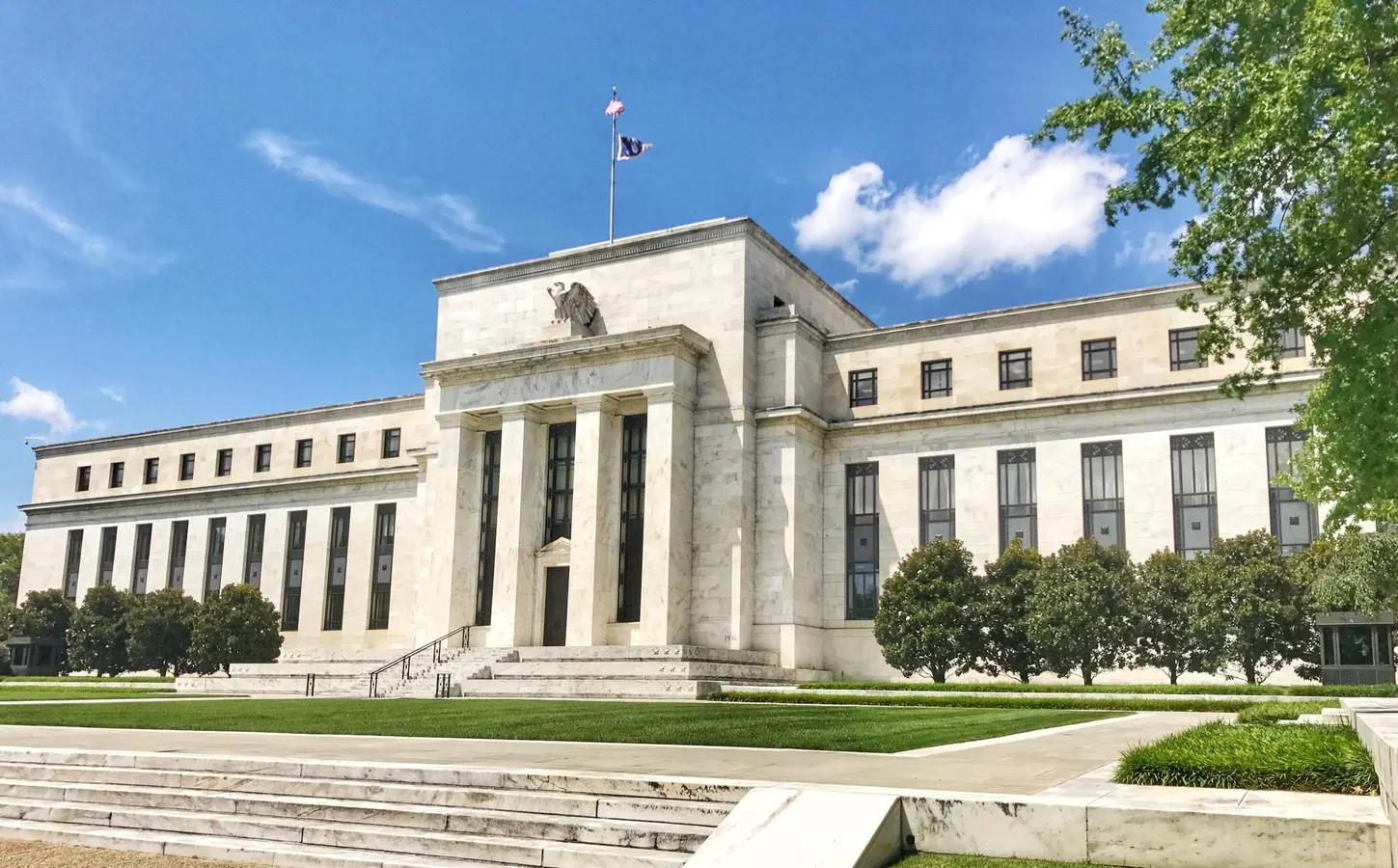

Facade of the Marriner S Eccles building of the United States Federal Reserve, on a bright and sunny day in Washington, DC, United States, July 24, 2017. (Photo by Smith Collection/Gado/Getty Images)
Getty Images
The Federal Reserve doesn’t “print money” to “monetize” the debt of the U.S. Treasury. The view presumes that a creation of the federal government could fund that same government.
If Treasury were reliant on the Fed’s so-called “printing press” to remain upright, then Treasury would have no debt. That’s because no one buys Treasury income streams, rather careful investors buy U.S. Treasury income streams for what they can be exchanged for: think real resources including trucks, tractors, buildings, computers, paper clips, copy paper, and most important of all, labor.
To which some will ask how – if it isn’t and hasn’t been printing – the Fed has built up such a sizable collection of interest-bearing assets since 2008. For all that time the Fed has been paying banks interest on their reserves, only to exchange those reserves for credible, interest-bearing assets. Savings for savings.
The obvious question from this is why banks would ever rent money to keep it at the Fed. Furthermore, no bank ever sidelines money that could be generating returns, so why the Fed as the proverbial warehouse? In the answer we can see why so many (or perhaps so few) were against the bailouts in 2008. The banks saved were gun shy, which meant the Fed was a safe place to get a risk-free return on monies in their control.
From this, is it any surprise that “private credit” and other more risk-focused forms of lending got their wings? With banks some of whom stared death in the face pulling back on all but the safest of safe lending (the low rates were paradoxically a sign of difficult bank lending conditions), riskier lending or “systemic risk” simply found a new address, far away from gun-shy banks and regulators still haunted by what had happened.
Back to the Fed’s balance sheet, why don’t other central banks such as Argentina’s Banco Central de la Republica Argentina have large balance sheets? See above. Governments prone to “printing” or persistent devaluation (yes, devaluation is the ONLY inflation) have very little debt. Markets for money are ruthless, the power of compounding is overwhelming, which means printing is the path to very little debt issuance.
The U.S. is obviously different. Its banks are and have been loaded up with voluminous amounts of dollars that are an effect of real production, which means the Fed was and is paying interest for real savings. Balance sheet expansion was the matching of savings with savings. Which is the point.
Not only has the Fed not been printing, its ability to expand its balance sheet was and is an effect of it buying income streams that are heavily demanded, and that would be heavily demanded even if the Fed weren’t a buyer. Put another way, absent the Fed as buyer there would still have been size buying of these Treasury income streams.
This isn’t meant to excuse the Fed substituting itself for the marketplace on the matter of it liquefying positions of widely held and credible assets, but it is to say that the offramp from all this buying arguably isn’t as fraught as so many believe. Precisely because the Fed was buying what the rest of the marketplace would have purchased absent the Fed, the disposal of those same assets won’t be as difficult as is assumed.
In truth, it’s what trading desks at Goldman Sachs and other institutions do all the time, as in expertly and quietly selling off big positions. If the Fed’s balance sheet is the problem, and the latter is probably overstated, the size of its balance sheet is the tell that there will be a big market for what it disposes of.
















Leave a comment