


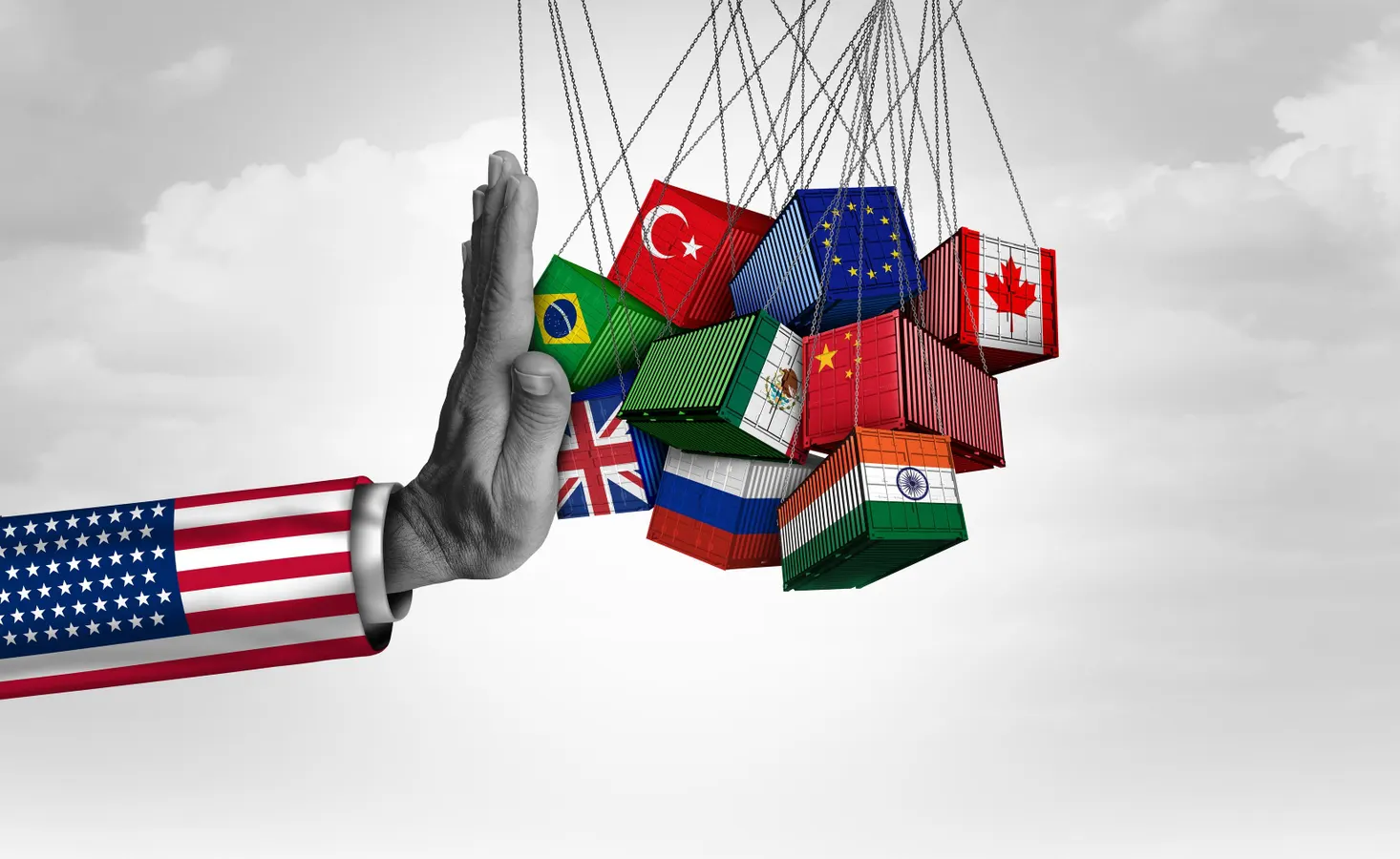

US Trade Barrier Tarrif as American Economic Protectionism and rade Isolation or USA government Protectionist Policy as import taxes or Tariffs in imports.
getty
The United States and Canada are in an economic war that could upend the international order. That will depend on how Canadian Prime Minister Mark Carney responds to the moment—and the courage of allies who have likewise tired of US bullying.
After trade talks crumbled on August 21, the US placed tariffs on $20 billion worth of Canadian goods, and Canada responded in kind. “You’re at war when you get attacked. We got attacked,” said Mr. Carney, explaining his decision during a press conference on August 23. He has some leverage: Canada exported $157.5 billion worth of fossil fuels and $3.3 billion worth of electricity to the United States in 2025. Redirecting that elsewhere isn’t easy, but the short-term impact on a number of US states would also be devastating.
Canada isn’t the first country to get attacked. Previously, US President Donald Trump threatened NATO allies with tariffs in his bid to seize Greenland. He imposed tariffs on Brazil for its prosecution of former President Jair Bolsonaro, who, like Trump, tried to overturn the results of a fair election. India and South Africa have also been targeted, and Spain has been threatened.
What can middle powers do when a superpower attempts to use economic dependence as a weapon? Mr. Carney gave an answer at the 2026 World Economic Forum in Davos: “The middle powers must act together because if we’re not at the table, we’re on the menu,” he said.
While Mr. Carney has put those words into action, this new conflict suggests that he must go further. Middle powers need a syndicate that will make us too big to bully, too diversified to isolate and too economically powerful to ignore. We need alliances that seek to foster interdependence without dependence. Put simply, we need to build a bigger TABLE: a Trade Alliance for Building Leverage Equitably.
Why the US Has Leverage
Middle power dependence on the United States runs deep. It’s not merely a legacy of the Cold War or NATO’s traditional reliance on US military capabilities. The key is that economic power has become concentrated among a few US corporations that control AI, cloud computing, semiconductors, digital platforms and capital markets.
As of this writing, fifteen of the world’s twenty most valuable companies are located in the United States. They include NVIDIA, Apple, Alphabet, Microsoft, Amazon, SpaceX and Meta. Their combined value exceeds the GDP of China and is often neck-and-neck with the GDP of the United States itself. The remaining five companies—Taiwan’s TSMC, Saudi Aramco, South Korea’s Samsung and SK Hynix, and the Netherlands’ ASML—depend either on investments in US AI, security guarantees from the US or both.
This concentration of wealth and innovation force unpalatable decisions onto middle powers. Our pension funds increasingly depend on the fortunes of US tech. Our businesses cannot avoid spending with US cloud providers, advertising platforms, SaaS companies and now LLMs. Most important of all, our startups and scale-ups increasingly depend on acquisition by US companies to deliver returns on investment.
We All Bear the Cost
Frustratingly, middle powers reinforce this lobsided status quo, making themselves more vulnerable to coercion. To run with Mr. Carney’s analogy, we prepare an excellent menu of innovations and talent, and then place it on the table for superpowers to devour.
In Canada, for instance, our universities educate world-class talent; our governments support groundbreaking research; and our venture investors finance promising startups. Then comes the scale-up gap. Just when a company needs hundreds of millions of dollars to compete globally, domestic capital becomes scarce. A US company arrives with an irresistible acquisition offer. The founders and intellectual property migrate south. The headquarters and future tax revenues often follow. Thus, the middle power taxpayer subsidizes US dominance in technology.
Financial institutions often reinforce this outflow of value. Pension funds, for instance, control hundreds of billions of dollars of patient capital and allocate much of it abroad. The $793.3 billion Canada Pension Plan has 48% of its holdings in US assets and just 12% in Canadian assets, according to its latest report. In fairness, their fiduciary responsibility is to maximize risk-adjusted returns, not conduct industrial policy. But this fuels a vicious circle. We starve our scale-ups of growth capital, watch them sell to foreign giants and then complain that we have too few domestic companies in which to invest.
In theory, a middle power could choose to stop subsidizing superpowers. In practice, this is nearly impossible for a middle power to do unless it has partners.
A Seat at the TABLE
Tit-for-tat tariffs will not correct an uneven relationship in which middle powers invest in making themselves dependent on a superpower. To break the cycle, we need a syndicate of middle powers that, combined, can rival the clout of the US and China. As stated, I’m calling this organization TABLE: Trade Alliance for Building Leverage Equitably.
TABLE must align around several things, starting with its investment strategy. Middle power investors, from seed funds to pension funds, need incentives to back companies within the TABLE ranks. The incentives, perhaps in the form of matching investments from a TABLE Innovation Fund, would help scale-ups compete with US tech giants.
As a trade alliance, TABLE must set up physical and digital value chains that are immune to coercion. In particular, the alliance needs its own data centers, AI models, critical minerals and energy sources. Canada, a fossil energy superpower vying to lead in next-gen clean energy, would be critical here. Other potential members offer complementary strengths: Australian rare earths, Brazilian agribusiness, UK AI, German manufacturing and Singaporean trade networks.
The last component is cooperation in emerging technologies. The opportunity is vast in industries where leadership remains in flux: artificial intelligence, robotics, advanced manufacturing, biotechnology, quantum computing, critical minerals, clean energy and fusion. These industries could produce hundreds of middle-power companies able to innovate and deliver returns without selling to US tech.
The purpose of TABLE is to produce a virtuous cycle in which talent, IP and capital remain and grow within the syndicate. That is the best protection we can muster against coercion.
Interdependence Without Dependence
Washington’s pointless scrap with Canada may ultimately do the latter a favor. No middle power remains under the illusion that economic integration with the US produces fair, respectful or consistent political relations any longer. Mr. Carney and like-minded allies have a chance to establish a bloc that fosters economic interdependence without dependence.
TABLE would be a serious deterrent to any superpower. Individually, middle powers cannot win a trade war with the US, China or the next would-be hegemon. Together, however, they can engage with superpowers as an equal. And maybe they can fill the leadership vacuums in climate change, AI safety and pandemic preparedness.
My message to Canada and its fellow middle powers is simple: Take yourself off the menu. Get a seat at the TABLE. Don’t allow a would-be king to control your future.















Leave a comment