


Topline
Michael Selig, chairman of the Commodity Futures Trading Commission, told CNBC on Tuesday that his agency’s case against the Winklevoss twins’ crypto exchange Gemini was an act of political “lawfare,” going against a competing allegation that the brothers had targeted the agency by lobbying against Brian Quintenz’s bid for the top CFTC job after he refused to promise them the outcome they wanted.
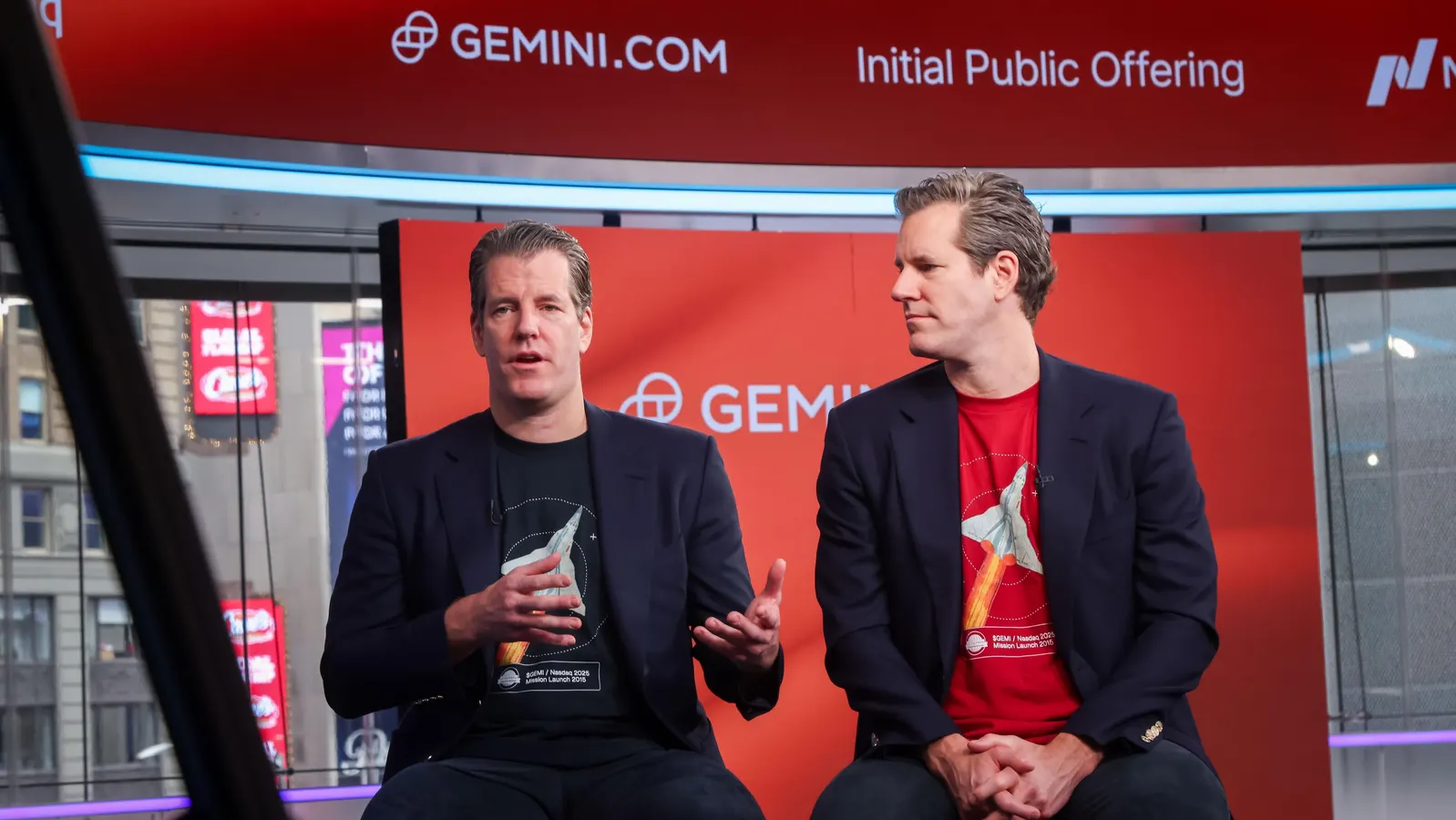
Tyler Winklevoss, chief executive officer and co-founder of Gemini Space Station Inc., left, and Cameron Winklevoss, president and co-founder of Gemini Space Station Inc., right, during the company’s initial public offering on Friday, Sept. 12, 2025. Photographer: Michael Nagle/Bloomberg
© 2025 Bloomberg Finance LP
Key Facts
Selig, who was nominated in October and assumed the role in December, said the Biden administration “weaponized the federal agencies against the crypto industry” and “politically targeted people like the Winklevoss twins.”
Selig was nominated to the position after Trump pulled Quintenz’s nomination to lead the CFTC in September 2025, following Quintenz’s accusation that the Winklevoss twins lobbied to block him over his refusal to take their side in the Gemini case.
Selig’s remarks were the agency’s first public comment since it asked a federal judge in New York last week to vacate a $5 million penalty and a permanent injunction that paved the way for harsher penalties for future false statements to regulators.
The order was implemented in the final weeks of the Biden administration, and the case originated in 2022 over statements Gemini allegedly made to the CFTC in 2017 while seeking approval for a bitcoin futures product.
Selig declined to litigate the merits, saying only that “to the extent the agency was used to politically target folks, we’re reversing that, and we’re starting fresh.”
Though the $5 million has already been paid and cannot be recovered, the permanent injunction and other forward-looking restrictions would lift if the judge grants the motion.
Gemini declined to comment.
Crucial Quote
“Cultural reform (in the CFTC), which includes rectifying what happened to us, should be the highest priority. I’d like to understand your thoughts on this and how you plan to align with President Trump and the administration’s mandate to end the lawfare and make amends for it,” Tyler Winklevoss had sent Brian Quintenz, according to screenshots shared by Quintenz in an X post on Sept. 10. “I believe these texts make it clear what they were after from me, and what I refused to promise. It’s my understanding that after this exchange they contacted the President and asked that my confirmation be paused for reasons other than what is reflected in these texts,” Quintenz wrote in the X post where he shared the screenshots.
Key Background
The CFTC’s rescue arrives at a precarious moment for the exchange it once pursued. Gemini Space Station went public in September 2025, but the stock has since collapsed roughly 84% from its debut, bottoming at an all-time low of $3.91 in March against a $28 price at its initial public offering. The financials underneath that slide are stark, as net losses widened to $585 million in 2025 from $158 million the year prior, even as revenue rose 26% to $179 million. In February, the company cut nearly 30% of its workforce, exited its Europe and Australia operations, and lost its chief operating, financial and legal officers in quick succession—then absorbed a shareholder class action accusing it of misleading investors in its IPO marketing about both its growth prospects and an “abrupt corporate pivot” to prediction markets that followed. The twins have recast Gemini from a crypto exchange to “a markets company,” staking its future on prediction markets—the same category Trump’s CFTC has moved aggressively to protect. President Donald Trump’s first choice to run the CFTC was Quintenz, but he withdrew the nomination in late September 2025 without stating a reason, after months of Senate delay and opposition to Quintenz’s nomination for reasons including that his board seat on prediction market Kalshi, which the CFTC regulates, presented a conflict of interest.
Forbes Valuation
The Winklevoss twins, Cameron and Tyler, first entered public view as Olympic rowers and as the Harvard classmates who accused Mark Zuckerberg of stealing their idea for Facebook. The dispute was settled in 2008 with the twins receiving $65 million in cash and stock. In 2013, they spent roughly $11 million of the settlement money on bitcoin, and they have famously never sold. That early, stubbornly held wager—not their businesses—is the bedrock of their wealth, which Forbes estimates is around $2.5 billion each. In 2014, they parlayed their crypto credibility into crypto exchange Gemini, though the company has fallen behind in market share and profitability.
Tangent
The optics did not end with the personnel switch. Tyler Winklevoss now sits on the CFTC’s Innovation Advisory Committee, appointed by Selig in January 2026. The twins were also among the larger individual crypto donors to Trump’s 2024 campaign, and a New York Times investigation in May reported that CFTC career officials who raised concerns about crypto businesses tied to the Trump family, including a Gemini-affiliated prediction market, were pushed out. The White House has denied any conflict of interest.















Leave a comment