


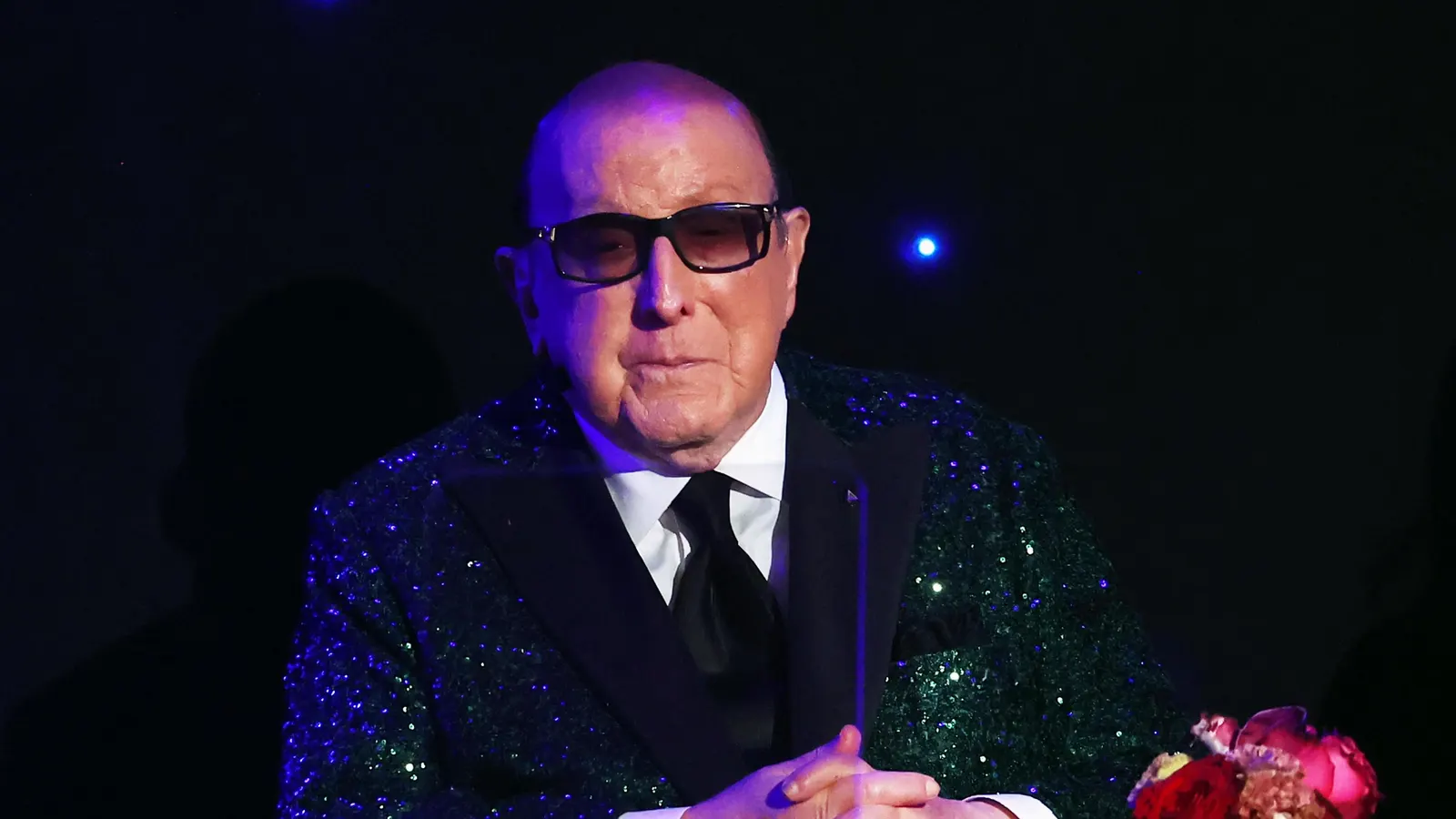

LOS ANGELES, CALIFORNIA – JANUARY 31: Clive Davis speaks onstage during the 68th GRAMMY Awards Pre-GRAMMY Gala & GRAMMY Salute to Industry Icons Honoring Avery Lipman & Monte Lipman on January 31, 2026 in Los Angeles, California. (Photo by Leon Bennett/Getty Images for The Recording Academy)
Getty Images for The Recording Academy
There are music executives. There are industry legends. And then there was Clive Davis.
The news of his death at 94 feels less like the loss of a record executive and more like the closing chord of an era—one that didn’t just witness the evolution of American music, but helped shape its direction. For more than six decades, Davis didn’t simply respond to culture as it changed; he moved in step with what it was becoming.
Before algorithms learned to predict taste, before streaming data could forecast a hit, and before social media could manufacture stardom in real time, Davis operated on something far less visible and far more decisive: instinct. An ear tuned not only to what worked, but to what was about to matter. He didn’t just hear records—he heard where music was going.
Across a career that spanned generations, that instinct carried him through rock, singer-songwriters, R&B, hip-hop and global pop. Each era sounded different. Each shift felt like a rupture. Yet Davis remained a constant presence through all of it—one of the rare figures who didn’t just witness the soundtrack of modern America, but helped conduct its evolution.
LOS ANGELES, CA – FEBRUARY 11: Host Clive Davis speaks onstage at the Pre-GRAMMY Gala and Salute to Industry Icons Honoring Debra Lee at The Beverly Hilton on February 11, 2017 in Los Angeles, California. (Photo by Kevork Djansezian/Getty Images)
Getty Images
Clive Davis Shaped Who Became Mainstream Music
The standard story about Clive Davis is that he had an extraordinary ear for talent. That’s true. But the deeper story is that he consistently identified the genres that would soon define popular culture—and positioned major labels to meet them at scale.
Rock Became The Future
When Clive Davis served as president of Columbia Records from 1967 to 1973, rock was still viewed inside the corporate music world as a volatile youth movement rather than a serious commercial engine. Davis saw something larger.
He backed artists like Santana and Janis Joplin at a time when the industry was still learning how to translate counterculture into commerce. Under his leadership, Columbia became one of the first major labels to fully embrace rock as both an artistic force and a scalable business category.
Rock was no longer peripheral. It was becoming the center of American music—and Davis helped build the bridge that carried it there.
The Singer-Songwriter Revolution
As the 1970s unfolded, audiences gravitated toward artists whose music felt personal, vulnerable, and direct. Singer-songwriters like Bruce Springsteen and Billy Joel helped define that shift.
During his tenure at Columbia Records, Davis signed and supported both artists, recognizing early that this movement wasn’t stylistic—it was structural. Popular music was shifting toward storytelling and emotional realism. Ultimately, he helped bring that intimacy into the mainstream without losing its core identity.
Pop And R&B Entered Their Global Era
By the 1980s and beyond, crossover appeal had become one of the music industry’s most valuable currencies. Through the founding of Arista Records in 1974—and later J Records in 2000—Clive Davis built and shaped a label system designed around artists who could move fluidly across audiences, genres and radio formats.
His approach helped position both labels as hit-making engines, prioritizing broad appeal and mainstream reach while still nurturing distinctive talent.
That included Barry Manilow, whose early breakthrough with “Mandy” helped shape the sound and commercial identity of adult contemporary pop, and later Alicia Keys, whose debut single “Fallin’” fused soul, piano-driven songwriting and mainstream pop appeal into a defining early-2000s crossover moment.
He also helped guide Kelly Clarkson after her breakthrough on American Idol, shaping her into a global pop-rock force. Across decades, his approach remained consistent: strong vocal identity, strong material and maximum cultural reach.
NEW YORK, NY – JANUARY 27: Host Clive Davis (L) and recording artist Alicia Keys attend the Clive Davis and Recording Academy Pre-GRAMMY Gala and GRAMMY Salute to Industry Icons Honoring Jay-Z on January 27, 2018 in New York City. (Photo by Kevin Mazur/Getty Images for NARAS)
Getty Images for NARAS
How Clive Davis Made Black Music Central To Pop
Hip-hop and urban music moved from the margins to the center of popular culture in the 1990s, becoming one of the defining forces in global music.
Clive Davis recognized that shift early and positioned his companies—especially Arista Records—within its orbit. Rather than treating hip-hop and contemporary R&B as niche or peripheral, he brought them into the mainstream commercial pipeline, working closely with artists and producers reshaping the sound of pop.
A key turning point was his role in the rise of Bad Boy Records. In 1994, while heading Arista, Davis entered a 50/50 joint venture with Sean “Puffy” Combs, providing essential financial backing and nationwide distribution at a formative stage for the label. That partnership helped drive Bad Boy’s breakout success, with artists like The Notorious B.I.G. establishing East Coast rap as both a cultural force and a commercial powerhouse.
American music executive and producer Clive Davis and American musician and producer Sean ‘P Diddy’ or ‘Puff Daddy’ Combs meet regarding the release of Puff Daddy ‘No Way Out” album on February 28, 1997 at at undisclosed location in New York City, New York. (Photo By Larry Busacca/Getty Images)
Getty Images
The era also included TLC’s crossover dominance, blending R&B, pop and hip-hop sensibility into a radio-defining sound, and Lauryn Hill’s emergence with the Fugees and later The Miseducation of Lauryn Hill. Davis would later describe that album’s Grammy success as a watershed moment that signaled the Recording Academy’s broader acceptance of hip-hop and rap.
Rather than standing apart from these movements, Davis helped channel them through the industry’s center—shifting hip-hop and urban contemporary music from parallel currents into the defining language of pop.
Whitney Houston: The Ultimate Clive Davis Collaboration
If there is one artist who best embodies Clive Davis’ philosophy, it is Whitney Houston.
Not because she was manufactured, but because she represented the ideal alignment of talent and vision. Davis recognized her early and understood that her voice had the potential to transcend genre, geography and audience segmentation.
Rather than placing her in a single category, he built a crossover strategy around her, selecting material that showcased both vocal power and emotional accessibility. Songs like “Saving All My Love for You,” “How Will I Know” and “Greatest Love of All” were not just hits—they were part of a deliberate framework for global stardom.
Essentially, Houston’s voice was the instrument; Davis built the platform that allowed it to reach the world.
Whitney Houston and Clive Davis attend a party circa 1989. (Photo by Lester Cohen)
Lester Cohen
Why Clive Davis Became The Definitive Music Mogul
The music industry once revolved around executives like Ahmet Ertegun, Berry Gordy, David Geffen, and Clive Davis. They weren’t just executives—they were cultural architects who could translate instinct into mainstream reality.
What made Davis distinct was not just his reach, but his repetition. Across decades, he consistently identified where music was heading before the industry fully understood it—and built systems to support that shift.
Today, that kind of influence is dispersed across algorithms, platforms, and data systems. Discovery is faster, but no longer centralized. Which is why Davis feels singular in hindsight. He operated in a world where individual conviction could still move culture at scale—and did so repeatedly over more than half a century.
Can someone like Clive Davis exist anymore?
Maybe not.
And that absence is what makes his legacy feel so extraordinary.
The Final Note: Clive Davis And His Legacy
Clive Davis spent more than six decades shaping the soundtrack of American life. Across genres and generations, he consistently recognized not only talent, but cultural direction. He helped bring rock into the mainstream, elevated singer-songwriters, expanded R&B and hip-hop’s commercial reach, and played a defining role in shaping modern pop’s global architecture.
The industry he helped build now operates on entirely different systems—faster, more fragmented, and increasingly algorithm-driven.
Which is why his influence stands apart.
And in doing so, he became something the music business may never see again—a singular architect of the modern musical era.
Legends leave catalogs. Icons leave eras. Clive Davis left both.
















Leave a comment