


Governments Are Taking AI Into Their Own Hands
On June 12, the U.S. government suspended foreign access to Anthropic’s two most capable AI models under export control authority. For the millions of international users and institutions building systems on models owned by American companies, the message was immediate and clear: in the AI era, systems you do not control can be taken away. The race to control AI compute has become impossible to ignore, and governments are concluding that markets alone cannot be left to decide the outcomes.

WASHINGTON, DC – JULY 23: U.S. President Donald Trump speaks during the “Winning the AI Race” summit hosted by All‑In Podcast and Hill & Valley Forum at the Andrew W. Mellon Auditorium on July 23, 2025 in Washington, DC. Trump signed executive orders related to his Artificial Intelligence Action Plan during the event. (Photo by Chip Somodevilla/Getty Images)
Getty Images
Dominance and Its Limits
The U.S. and China together account for roughly 90% of global AI compute performance, per a 2025 analysis of 500 supercomputers (U.S.: 75%, China 15%). Each country has advanced industrial policy in the face of a competitive challenge seen as existential, spanning economic dominance, scientific leadership, and military capability. But physical constraints in both geographies are more severe than the headline narratives suggest, and industrial policy in both is straining to respond.
A new tier of countries is designing policy to fill the gaps that the dominant players can’t. The largest of these gaps is sovereignty. Every government handling sensitive data, from defense systems to financial infrastructure, faces the same question: can it afford to process that data on systems it does not own, governed by laws it did not write, subject to the legal reach of a foreign power?
The next phase of compute geography will be more plural. Understanding these pathways will help clarify how the AI race could evolve.
Why Industrial Policy for AI Matters
AI capability has expanded from a technology investment category to an organizing principle of national strategy. The stakes are measurable. According to one estimate, U.S. GDP growth would have collapsed to near zero in the first half of 2025 without massive data center investment. On the battlefield, AI is reshaping wins and losses, from drone targeting to logistics to signals intelligence, rewriting military advantage in real time. It is accelerating scientific discovery at a pace no prior technology has matched, and restructuring trade as AI capability increasingly determines how products are designed, manufactured, and consumed.
All of these uses are physically constrained by energy availability. A nation that cannot power its compute infrastructure cannot compete, which is why energy abundance and AI dominance are now inseparable strategic objectives.
Compute is a distinctive policy objective because delivery requires simultaneous execution across five domains that answer to entirely different legal frameworks: chips governed by trade and export law; power by energy regulation; land by zoning and permitting; water by environmental law; and community consent, which can’t be legislated and is therefore hardest to secure. This complexity is why markets alone cannot move at the speed and scale that strategic competition now requires. Industrial policy is needed to coordinate it.
China’s 15th Five-Year Plan, approved in 2026, reflects this logic directly, mentioning AI 52 times. AI forms the organizing principle of China’s modernization agenda through 2030, with the AI+ Initiative linking it to science, industry, culture, public services, and governance, paired with a three-part buildout of computing power, algorithms, and data.
The U.S. AI Action Plan, released in 2025, frames AI leadership as a national security imperative, treating the compute stack, chips, data centers, power, and export standards as strategic infrastructure on par with defense procurement. American industrial policy is also distinctively market-driven, deploying equity stakes, procurement contracts, and export controls across the full value chain, from critical minerals and energy production to frontier AI models, rather than through central planning or public control.
Given these plans and each country’s compute share, the race to shape global AI architecture has been reasonably understood as a contest between these two powers.
The U.S. Compute Ceiling Is Closer than It Appears
The U.S. holds approximately 75% of global AI compute performance, and many observers engage in handwringing about overinvestment relative to future demand. However, a more present concern is physical constraint on compute supply, particularly power and project siting. EPRI warns that data centers could consume 9% to 17% of U.S. electricity generation by 2030. In major hubs, the pressure is already visible: interconnection delays, grid bottlenecks, and land constraints are extending construction timelines by years. Community resistance is also a major factor. As of mid-2026, at least 69 local governments have enacted bans or moratoriums on new data center development, and community opposition had blocked more than $130 billion in projects in this year’s first quarter alone.
A primary constraint on U.S. leadership is becoming the ability to deliver new capacity quickly, partly a physical challenge of grid interconnection and equipment supply, and partly a question of social legitimacy that federal permitting reform alone cannot fully resolve. Addressing both is now a precondition for the rest of U.S. AI industrial policy to function.
China’s Gap Between Building and Delivering
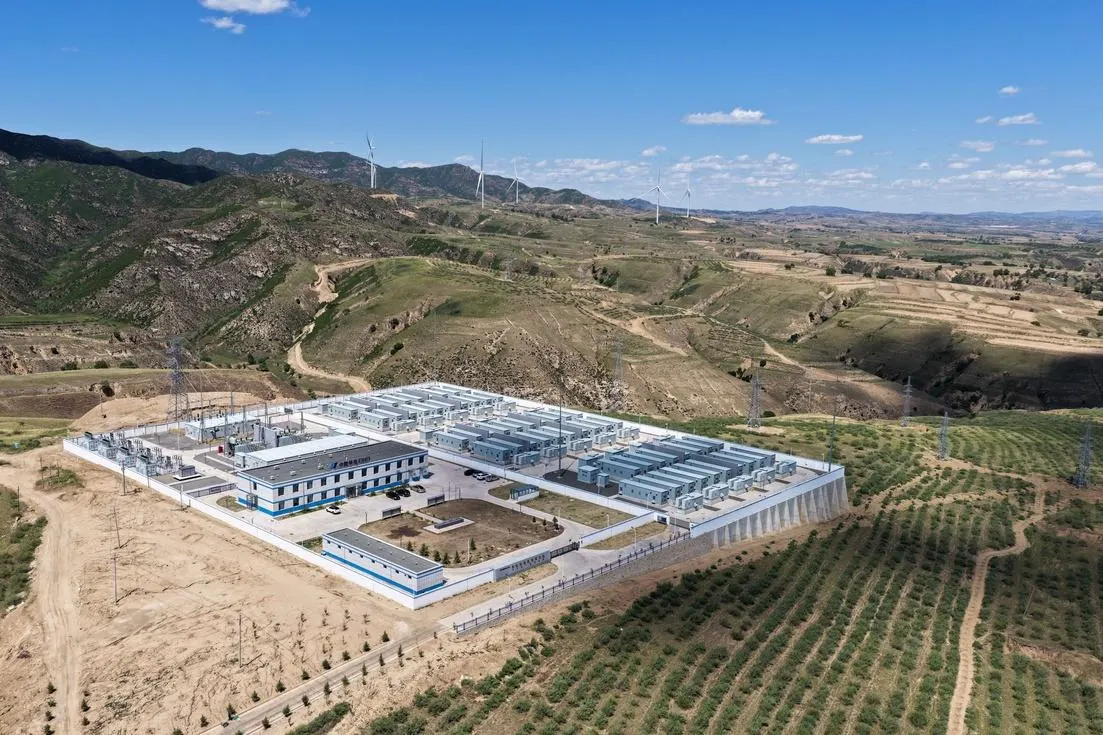
China faces a different version of the same problem. Its Eastern Data, Western Computing initiative relocated data center construction to the interior regions, like Inner Mongolia and the outer edge of the Gobi desert, with abundant solar and wind energy, cheap land, and cool, dry climates. This strategy processes data in the resource-rich west and transmits it to the densely populated east. But it doesn’t solve for capacity mismatches. Western hubs sit thousands of miles from the urban centers with concentrated demand, and latency constraints mean many workloads cannot practically run there. Many facilities run at only 20% to 30% capacity.
An aerial drone photo taken on June 4, 2026 shows a wind-photovoltaic power storage station of Huadian Inner Mongolia New Energy Co., Ltd. as part of the Horinger data center cluster green energy supply demonstration project, in Hohhot, north China’s Inner Mongolia Autonomous Region. Leveraging its abundant wind and solar resources, Hohhot is driving the synergistic development of green energy and computing power. The city is now accelerating the construction of the Horinger data center cluster, one of China’s top ten of its kind, by integrating direct green power supply with a unified “source, grid, load and storage” system to fuel the high quality development of its local computing power industry. (Photo by Li Zhipeng/Xinhua via Getty Images)
Xinhua News Agency via Getty Images
Chinese industrial policy must now respond to physical limitations in the same way America’s must, but for different reasons. China has proven the state can build. Getting compute where it’s needed, in the right form and at the speed required, is a harder problem.
Sovereignty Drives a New Tier of AI Industrial Policy
The U.S. and China are not alone in designing industrial policy around their needs. A new tier of countries is doing the same, with the most consequential emerging strategies driven by sovereignty.
The EU and Canada, two close U.S. partners, formalized that conclusion within 48 hours of each other in early June 2026, a week before the White House order on export controls for new Anthropic models, recognizing that compute capability is too consequential to leave solely to foreign suppliers. The EU’s proposed Cloud and AI Development Act aims to triple European data center capacity within five to seven years, reducing dependence on U.S. hyperscalers, which currently control more than 70% of the EU cloud market. Canada’s AI for All strategy commits to a nationally-owned supercomputer with Canadian governance and data residency requirements, partly in response to exposure under the U.S. CLOUD Act, which can compel disclosure of data held by U.S.-headquartered providers regardless of where it is physically stored.
The Anthropic suspension made the stakes of sovereignty visceral. Days before the G7 summit in Évian, Canadian Prime Minister Carney framed the danger of over-reliance on a single foreign AI provider as a systemic risk, comparing it to the financial vulnerabilities that preceded 2008. The international frame for AI competition is widening. But, as Carney also acknowledged, no country is positioned to go it alone. At the summit, G7 leaders announced a new Critical Minerals Resilience and Production Alliance aimed at reducing dependence on China for the rare earths and materials that go into data center infrastructure.
The Limits of Sovereignty
No industrial strategy for compute can operate on fully sovereign terrain. The supply chains underpinning every framework here — chips, chipmaking equipment, rare earth minerals, and energy inputs — remain deeply interdependent across the countries competing most intensely.
The MATCH Act, a bipartisan bill introduced in U.S. Congress in 2026, illustrates the problem directly. It would require U.S. allies to align their export controls on advanced semiconductor manufacturing equipment with U.S. rules or face unilateral American penalties. In practice, it targets companies like ASML, the Dutch firm whose technology is essential to producing the world’s most advanced chips, and which derived roughly a third of its 2025 revenue from China. The Netherlands has formally objected. The episode reveals a central tension in compute industrial policy. Effective export controls require allies and partners to comply.
These dependencies run deeper than any single policy can resolve. U.S. export controls on advanced chips aim to constrain China’s AI capability, but China controls the rare earth minerals and critical materials used to make those same chips. Each country is simultaneously the other’s adversary and a critical node in its own supply chain. Industrial policy can direct investment and restrict trade, but it cannot easily redesign underlying geology or decades of specialized production.
Additionally, beneath these national policy frameworks and supply chain disputes lies an ungoverned layer that industrial strategy has yet to fully address: the shared physical infrastructure of the global digital economy — maritime chokepoints, subsea cables, critical material flows — that traverses international terrain no single country controls, and no single sovereign framework can fully secure.
Turning Exposure into Strategy
The global demand for compute won’t wait for these tensions to settle. Capital, talent, and infrastructure will find their paths as governments write legislation and commit public investment to meet the moment. The industrial policies taking shape worldwide vary widely in sophistication and ambition, each bringing different strengths, governance structures, and cultural imperatives to the challenge. Successful execution will be another matter entirely. Along the way, domestic imperatives will drive the geography of compute in new directions.
For decision makers trying to orient themselves, much of the AI race discussion reduces to three familiar frames: Is there a bubble? Who is winning the frontier model race? How does U.S.-China competition resolve? Each has limits the current moment is beginning to expose.
The bubble question assumes demand is the variable most worth watching. But as both the U.S. and China are discovering, binding constraints that are physical, jurisdictional, and social can threaten supply as it rises to meet demand.
The frontier model frame assumes whoever builds the most capable models wins. But the Anthropic suspension revealed that model capability and model access are different assets, and that governments without sovereign AI have no guarantee of either.
The great power frame assumes the game is bilateral. But sovereign compute strategies are now being written from Ottawa to Brussels and Riyadh to Kuala Lumpur, for reasons that are serious and unlikely to reverse.
What unites all three limitations is the same reality: AI is a competition over interconnected systems — energy, materials, infrastructure, governance, physical security — that will determine how countries compete and position themselves in the AI era. The decisions defining the next decade are being made in ministries and legislatures, just as they are in boardrooms and AI labs. Understanding those decisions and the national imperatives behind them is what turns unmanaged exposure into deliberate positioning.
















Leave a comment