


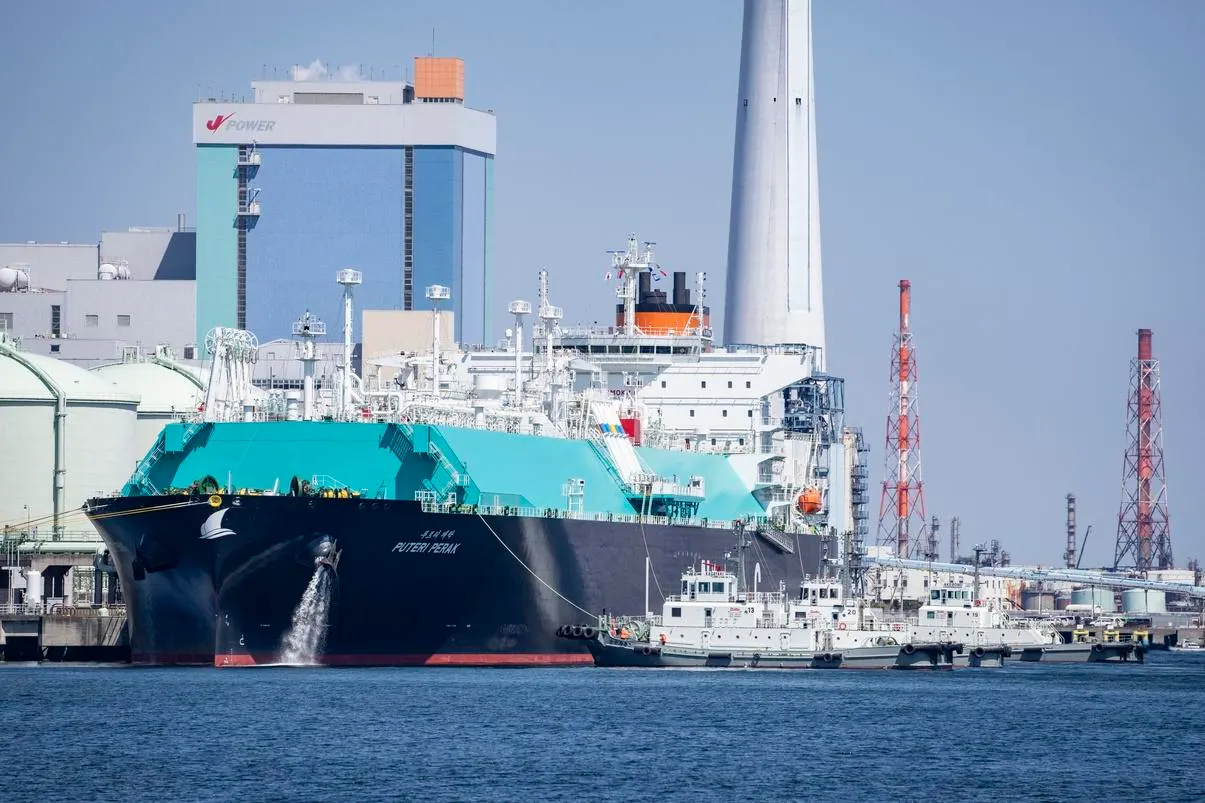

A tanker moored at a liquefied natural gas (LNG) terminal in Yokohama, Kanagawa prefecture, Japan on April 8, 2026. (Photo: Yuichi Yamazaki)
AFP via Getty Images
The hyperscale data center boom is being acutely felt in southeast Asia where it is cementing its place as a major demand driver of liquefied natural gas (LNG).
As the region’s leading economies, most notably Indonesia, Malaysia, Singapore and Thailand, expand their AI footprint, the realization that rising power demand cannot by serviced by renewables alone is amplifying the region’s exposure to LNG.
At Gastech – one of the energy industry’s largest global gatherings that concluded in Bangkok, Thailand on Thursday – a Wood Mackenzie report noted Southeast Asia’s data center pipeline is set to more than triple from 2.8 gigawatts today to 9.4 GW by 2035, with electricity demand from data centers growing from 17 terawatt-hours to 57 TWh over the same period.
While renewable and nuclear energy would be part of the mix, for many in southeast Asia combined-cycle gas turbines are currently the most viable power generation technology capable of meeting data centers’ 24/7 reliability requirements at scale.
Furthermore, grid-scale battery storage – which remains commercially immature across the region – is unlikely to gain traction until late into the next decade with LNG now at the heart of regional policymakers’ agenda.
Thailand’s minister of energy Akanat Promphan admitted as much at Gastech. His country currently has 9 million tons of LNG capacity and is expanding this to 27 million tons to “support regional energy needs.” He called for a “more secure, more resilient and accessible energy for everyone, while positioning Thailand as a regional partner for energy cooperation.”
That regional cooperation is desperately needed. According to S&P Global Energy data, practically of all Singapore’s grid runs on gas today. It implies that practically every new data centre taking power off the grid in the city-state translates near-directly into higher LNG offtake.
And with piped imports from Malaysia and Indonesia expected to cease by the early 2030s, Singapore’s LNG reliance is on course to reach a near-absolute 100% from 95% today.
Malaysia has 3.9 GW of data center capacity under development, with new regasification terminals being built to meet growing power demand. Thailand, where two-thirds of the grid is already gas-fired, is expected to see its LNG share of gas supply exceed 50% by 2035 as Gulf of Thailand production and Myanmar pipeline imports continue to fall, according to Wood Mackenzie.
With steady drops in domestic and piped gas supply for all three nations, LNG appears to be the only fuel option to support new gas-fired power plants. Much of it is being sourced via a rapidly growing U.S. to Asia LNG corridor.
Destination Southeast Asia, Origin U.S. of A
With Qatar’s LNG exports to the region disrupted by tensions in the Middle East and outages caused by attacks on its infrastructure during the early stages of the Iran War, U.S. – the world’s largest LNG exporter – has stepped in. The International Energy Agency expects U.S. LNG to account for a third of the global market by the end of the decade, up from a fifth as recently as 2024.
And Reuters data points to the U.S. heading for a record year having already exported just over 73 million metric tonnes of LNG from January through to July globally; a 23% increase on an annualized basis.
Much of this incremental volume is seen heading to high growth markets in Asia in general, and southeast Asia in particular.
Charlie Riedl, executive director of the center for LNG in the U.S., said: “Buyers in the region are looking for supply they can count on over the long term. U.S. LNG offers contract flexibility, destination freedom, and a supply base backed by the largest and most liquid natural gas market in the world.”
The client profile of southeast Asian importers and the proliferation of data centers offers U.S. exporters an attractive preposition.
Md Fadhlullah Omarali, principal analyst at Wood Mackenzie said: “What makes data centre demand interesting from an LNG perspective is the counterparty profile. These are large, creditworthy offtakers with power needs that remain stable regardless of economic cycles. That does change the risk of calculus for new supply into Southeast Asia.”
“Malaysia and Thailand are at a turning point. Data centre investment is growing quickly just as domestic gas output peaks and declines.” Omarali added. “New import infrastructure is being developed and the importer base is broadening. For LNG suppliers with volumes to place, this timing is important.”
Most of those at this point in time happen to be in the U.S., and are rapidly expanding their operations. But can they keep up pace with the demands of the region’s data center buildout? It seems both emerging opportunities as well as rising challenges await the U.S. LNG industry and its client base.
Build More, Build Fast
For the U.S. end, the near-term opportunity is straightforward, said Riedl of the Center for LNG. “The industry needs to continue expanding export capacity on a predictable timeline so U.S. LNG exporters can meet demand.”
“The medium-term question is whether infrastructure stateside keeps pace with the commitments our industry is being asked to make, and that comes down to permitting reform. Without it, the constraint on U.S. LNG is not resources or capital, it is the time it takes to build.”
The industrial solutions and engineering firms are relishing the opportunities offered by existing LNG market permutations from offshore to onshore infrastructure, from export terminals to importation facilities at the Asian end.
Commenting on the latter point, Peter Mackey, managing director at LNG technology and integration solutions provider GasEntec, said: “No one can dispute the data center buildout is becoming one of the more interesting forces in LNG demand. There’s a tendency to talk about this as an LNG story. It’s very much an infrastructure story.”
“The U.S. has plenty of gas to sell. What’s scarce is the capacity to land it fast enough for markets that don’t have years to build fixed terminals. In many cases, for instance, a FSRU [“Floating Storage and Regasification Unit”] can be delivered in a fraction of the time of an onshore terminal, and for a lot of Southeast Asian buyers, speed is critically important in the race to build local data center capacity. That’s the gap we are attempting to fill .”
There is a clear recognition of the challenge among U.S. export facility operators, added Christina Andersen, president of gas and LNG, Honeywell Technologies. “There are substantial opportunities to help developers and operators bring capacity online faster, more efficiently and with greater certainty.
“Our technology is used to pre-treat approximately 40% of the world’s LNG, and we provide liquefaction technology for around two-thirds of global LNG capacity. We are bringing that to the fore by supporting customers across the entire LNG value chain, from gas pre-treatment and liquefaction technologies to automation, digital solutions and ongoing operational support.”
Andersen forecast a growing market for capacity additions on both export and import infrastructure, but also said a meaningful drive “to optimize existing assets” will play a vital complementary role in ensuring LNG supply is available where demand for energy is the greatest.
Deals Keep Coming
As market progresses, the deals keep coming. Following the conclusion of Gastech, the event’s organizers dmgevents put the combined estimated value of industry memoranda of understanding, supply agreements and investment commitments in the region of $40 billion.
In there were two major regional announcements. The first one was GE Vernova and B.Grimm Power’s agreement for natural gas-turbine supply and long-term services, supporting new and existing power-generation capacity in Malaysia and Thailand.
The second one was PETRONAS, PTTEP and the Malaysia-Thailand Joint Authority’s formalization of a 35-year production-sharing contract and natural gas sales agreement in the Malaysia-Thailand Joint Development Area, delivering new natural gas supply to both countries.
As the U.S. LNG juggernaut rolls on, hyperscale data centers continue to proliferate across southeast Asia, and natural gas holds its place in the wider energy mix – the wider market could potentially expect more such big ticket deals over the near-term.
Disclaimer: The above commentary is meant to stimulate discussion based on the author’s opinion and analysis offered in a personal capacity. It is not solicitation, recommendation or investment advice to trade oil and gas stocks, futures, options or products. Oil and gas markets can be highly volatile and opinions in the sector may change instantaneously and without notice.















Leave a comment