


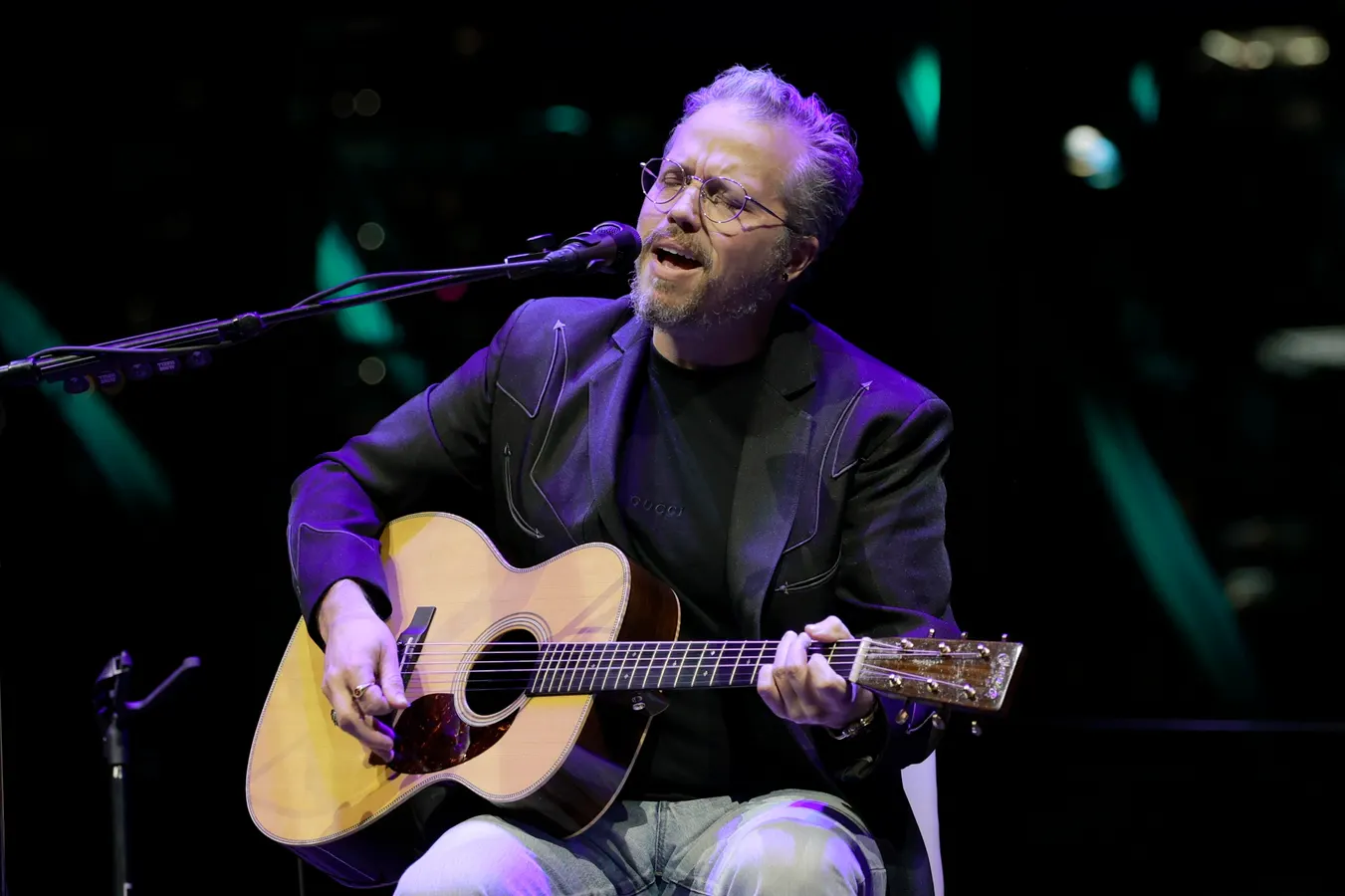

Jason Isbell performs on November 13, 2025 in Nashville, Tennessee. (Photo by Jason Kempin/Getty Images for the Country Music Hall of Fame and Museum)
Getty Images for the Country Music Hall of Fame and Museum
Forget suing music AI-platform Suno for copyright infringement, go after them for musical “identity theft” instead.
That’s what alternative country artist Jason Isbell and alternative rock artist-turned-professor David Lowery are trying to do, presenting an alternative approach to suing Suno from what seven other lawsuits are trying.
Indeed Suing Suno for song-snatching has become old hat, with yet another major label lawsuit filed just last week, piling up atop six others already seeking billions in copyright infringement damages.
Isbell and Lowery’s lawsuit theorizes that if Suno is too closely imitating the sound, style, likeness, or identity of a songwriter or recording artist, that’s a whole different thing than copyright infringement, which involves straight up copying of the music itself.
But is there a difference?
If a federal judge in Boston rules that Isbell and Lowery’s case looks and sounds too much like a copyright claim, it may get kicked out of court, due to the “preemption” clause of the U.S. Copyright Act.
What Does “Preemption” Mean?
“Preemption” is a legal term that brings a grin to defendants and chagrin to plaintiffs when judges rule that a federal law, like the U.S. Copyright Act, supersedes or entirely “preempts” state law claims, because the state claims are either federal claims in disguise or just sound too much like similar federal claims.
A federal judge can quickly kick a preempted case out of court.
Or “Dropkick Murphy” the case into Boston Harbor. The Celtic punk band shares its Massachusetts home turf with Suno, based in the heart of Harvard Square, not far from the Joseph Moakley Courthouse, overlooking the harbor. (To be read in a Boston accent.)
Singer Ken Casey (C) of Dropkick Murphys performs onstage during day 2 of Warped Tour at Shoreline Waterfront on July 27, 2025 in Long Beach, California. (Photo by Scott Dudelson/Getty Images)
Getty Images
Preemption will surely torpedo this lawsuit if the judge rules that the complaint is about nothing more than copyright infringement, like the other mainstream lawsuits from the major music companies.
“But this one may be a bit betwixt and between,” says Robert Shore, an intellectual property litigator at Raines Feldman Littrell.
“On the one hand, it’s not squarely the use of a particular song that they’re talking about in the complaint,” Shore says. “Suno will argue that the case is about derivative use of copyrighted materials that are incorporated in the AI songs Suno generates. That’s the argument that supports preemption.”
“On the other hand,” Shore says, “the plaintiffs have the argument that what’s really being used here is not the actual copyrighted music, but the voice, the style, the identity of specific artists not tied to any particular copyrighted work.”
Public records show that both Isbell and Lowery own copyrights on music that Suno apparently scraped from the Internet along with tens of millions of other songs. But they don’t want to sue for copyright infringement, perhaps for reasons discussed below.
The case was likely spearheaded by Lowery, former frontman of the ‘90s alternative rock band Cracker who has since become an artist rights advocate and is a professor of music business at the University of Georgia in Athens. Lowery declined to comment.
Lowery apparently parted ways with copyrights to his most famous work, the hit song “Low” from Cracker’s 1993 album Kerosene Hart. The music video credits the copyright to Virgin Records, the former label founded in 1972 by Richard Branson and now the namesake of a division of Universal Music Group. But Lowery appears to own copyrights in his cool 2025 album Fathers, Sons & Brothers, per credits appearing on Spotify.
Even if Lowery and Isbell have the right to sue Suno for copyright infringement, they’ve chosen an alternative path to the well-trod one taken by Universal Music Group and Sony Music Group but not Warner Music Group, which made a deal with Suno.
An Exemption To Preemption
If an artist or songwriter sold their copyrights but still wants to sue Suno or someone similar for using their music without permission, state law claims like the ones in Isbell and Lowery’s complaint could work. But only in some states and only if the usage involved something other than merely copying and distributing music.
That alternative usage typically involves advertising of some product or service using the music, because an advertisement using music involves a right that differs from the right to display or distribute that music, which is at the heart of the Copyright Act.
“Courts have held, particularly in California and the rest of the Ninth Circuit, that it’s one thing if we’re talking about taking music without permission and then having it be used for people’s entertainment,” says Shore. “That’s pure copyright infringement. But when you’re using that piece of music to sell another product, when you’re using it for purposes of getting people to buy something else, that is the so called ‘additional element’ which is the usual test for avoiding preemption. So bottom line, when you use a copyrighted work without the artist’s permission in advertising, you’ve got a problem if you’re a defendant.”
The complaint claims that Suno “advertises and promotes” by simply allowing name-based prompts, stating: “Traditional advertising often involves ‘push’ advertising, [whereby] the defendant pushes the plaintiffs’ identities into the market through an ad, commercial, or broadcast. [But the] technology of a sophisticated AI model offers a different delivery mechanism. Suno builds the identity into the product and then lets users pull that identity on demand through names.”
Suno has denied that it allows users to directly access an artist’s sound or likeness using its prompt. The company has stated that when a user references a specific artist in a prompt, the system translates that input into the underlying musical qualities and stylistic elements of the request, rather than serving as a tool to intentionally copy or imitate a specific person’s work.
Suno reportedly has scraped millions of music clips from YouTube and tens of thousands of hours worth of material from other platforms.
Yet it seems far-fetched to say that what Suno is doing with all those thousands of hours of copyrighted material is anything other than copyright infringement (unless they have a license or valid fair use defense).
And it seems a stretch to say that merely allowing users to use prompts to tease up music that sounds like Lowery, Isbell, or any other artist, is the same as advertising.
But if the court rules that what Suno is doing looks more like advertising than distribution, the case may resist dismissal.
But Is Resistance Futile?
The complaint features colorful and amusing writing – like an introduction comparing Suno’s relentless ingestion of human music to the “Borg” from Star Trek, those scary celestial invaders with the catchy slogans: “Resistance is futile.” and “Your biological and technological distinctiveness will be added to our own.”
“There is sometimes a tension between writing a complaint for the press and writing it for the judge,” says Shore, “because judges have been known to get irritated when they perceive the plaintiff as seeking publicity, or when they perceive the rhetoric of the complaint as obscuring the legal issues that the judge will eventually have to decide.”
That’s what happened with the 2008 Romantics v. Activision case where members of the band famous for the hit “What I Like About You” – not including the lead singer – sued the makers of the Guitar Hero game who had licensed the song from the music publisher and then produced a soundalike re-record with new musicians.
The suing band members argued that the game studio deliberately crafted a recording “virtually indistinguishable” from their original 1980 track to deceive consumers into thinking it was the actual master recording. So it was identity theft not copyright infringement, they contended.
The band members sought an injunction to remove the game from store shelves.
But what the judge didn’t like about that was that the game company had obtained a valid synchronization license from the copyright owner that granted a right to make a cover recording and there was no violation of the band members’ right of publicity – remember, the lead singer was not even a plaintiff – simply because the studio created a sound-alike cover. The court denied their injunction and the case fizzled out.
Like the Romantics band members, Isbell and Lowery’s case seeks an injunction to prevent Suno “from capturing, storing, or commercially exploiting Plaintiffs’ and class members’ identities, including their voices, names, and identifying attributes and simulations thereof, without consent.”
Whether they get dumped like the Romantics by a court that’s just not that into their case, or put on a pedestal for their sexy new cause of action against AI companies, the music biz will be paying rapt attention.
Robert Shore joins the author to discuss the case further on the Shmoozic Biz podcast.












Leave a comment