


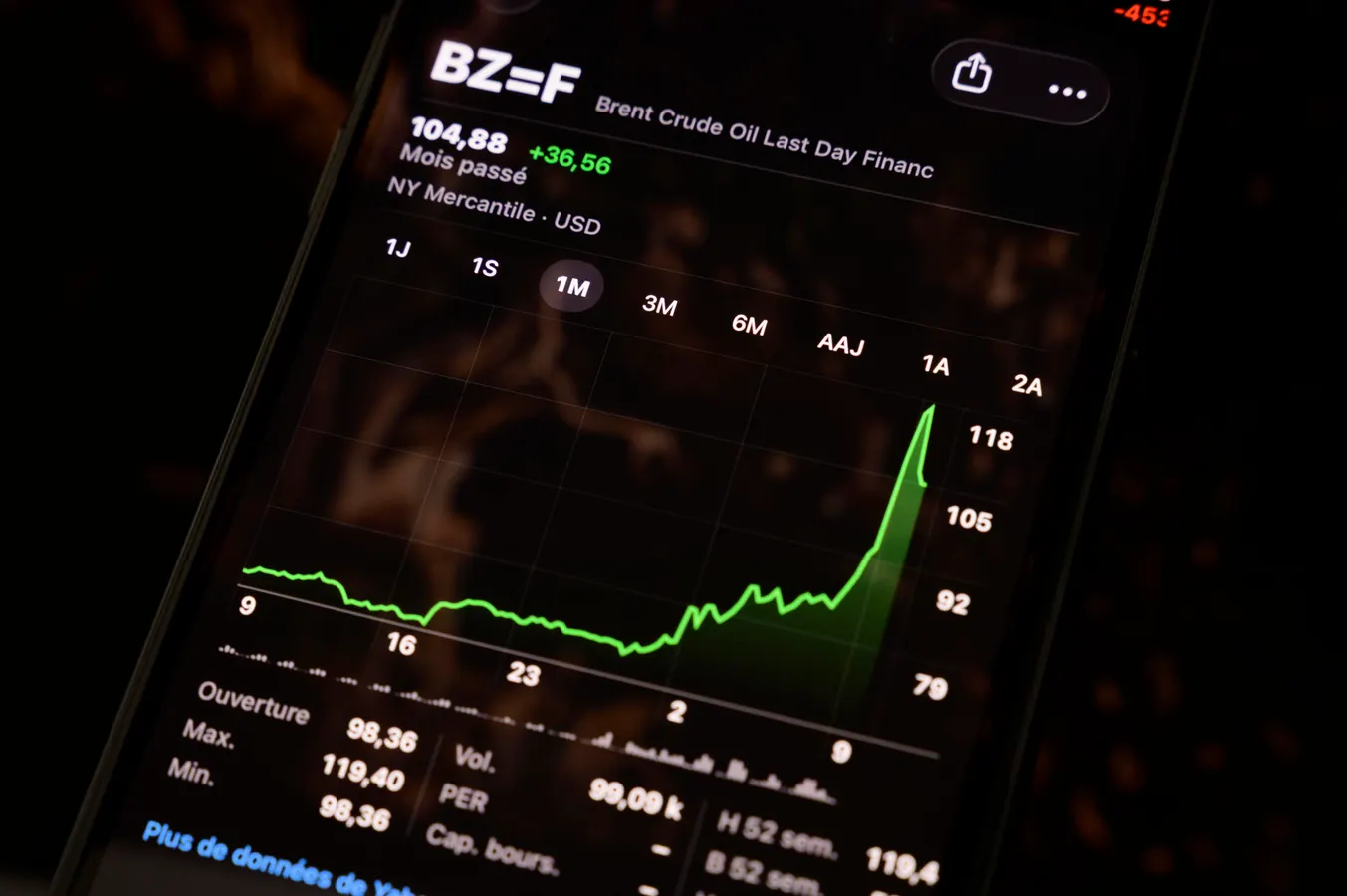

Surging Brent crude oil prices (BZ=F) on March 9, 2026 during escalating Middle East conflict.
NurPhoto via Getty Images
The price of WTI oil rose to $106 while Brent crude was $108 per barrel today. The latest rise has been partly caused by the Houthi takeover of the west coast of Yemen, and particularly Mayun island in the middle of Bab el-Mandeb Strait. This Strait is where a lot of oil is shipped from the Strait of Hormuz to European markets, and where oil is shipped from Saudi Arabia to east Asian countries. This is serious because the Bab el-Mandeb Strait at its narrowest is less wide (18 miles) than the Strait of Hormuz (21 miles).
How are oil markets dealing with the Iran war, now almost seven months old, with no end in sight? A good summary of factors that are affecting oil markets was recently published in J. of Petroleum Technology, by Trent Jacobs. It’s an insightful article that argues there are several trends affecting the industry. One is that the high price of oil has not induced elevated spending expected by oil and gas companies. A second is that exploration has veered toward lower risk goals, as larger companies have replaced commitment contracts with weaker securities such as MOUs.
A third reason concerns M&A, or merger and acquisitions. M&A in the U.S. has fallen markedly, except for a few isolated examples. The rest of this article is about M&A activities in the U.S., and in particular the Permian basin. And about potential M&A resources overseas.
M&A Activities In The U.S. And In The Permian Basin.
Jacobs makes the point that U.S. upstream mergers have declined by 76% in the second quarter of 2026, even when the mega-merger between Devon Energy and Coterra Energy, where the deal totaled $25 billion, was included. One explanation was given in terms of market volatility. This second quarter decline is actually the third great period of market volatility since the pandemic. The first was the onset of the war in Ukraine in February 2022. The second was the large-scale tariff actions by President Trump in 2025. The third is the current Iran war. The rationale is that during price volatility the negotiators, buyers and sellers, find it difficult to agree on a fair price for assets that are to be sold.
The Permian basin is a premiere basin that produces about half of total U.S. crude. As of July, Permian growth in production year-by-year was only 130,000 bpd (barrels per day), compared with 300,000 — 500,000 bpd per year during most years after the pandemic.
There remains a strong demand for Permian acreage, because Tier 1 land is profitable if oil prices stay above $50 bpd. Devon Energy and Matador Resources dominated the $4 billion spent buying leases on federal land in the second quarter. Jacobs reported there are 54,000 Tier 1 locations available in the Permian. The problem is, many of these locations have been consolidated and are unavailable for M&A.
M&A Deals In Overseas Unconventional Shale.
Why unconventional shale? Fifteen years ago, according to Jacobs, most of the oil companies in the world replaced one third of production via conventional. That figure has dropped to just 11% over the last five years. In the U.S. and Canada, this may be explained by shale oil taking off in 2009, six years after the introduction of the new shale-gas technology of long horizontal wells fracked many times along their lengths. Multiple oil and gas companies, supported by ever-present service companies, ensured the new technology spread rapidly and was optimized. Almost 40 million bpd of crude comes from unconventional plays, and, no surprise, 90% of this is from the U.S. and Canada.
There are two groups of oil companies: the majors and other large companies versus smaller independents and wildcatters. Independents and wildcatters tend to have a stay-at-home philosophy because they generally don’t have the experience of overseas exploration and production. That leaves larger oil companies looking for unconventional shale overseas.
Continental Resources have invested in Argentina’s Vaca Muerta shale plus exploration efforts in Turkey. EOG Resources has a concession in UAE in the Shilaif shale formation (a resource of up to 22 billion barrels that is technically-recoverable). EOG’s first two wells each flowed almost 1,000 bpd in the first month.
But the paucity of proven shale plays overseas is a challenge. The Vaca Muerta is the only one to have advanced to define blocks and establish leasing in areas where production is proven. The Jafurah field in Saudi Arabia was discovered in 2013, and first production was in 2025 from hundreds of exploration and appraisal wells drilled.
Beetaloo basin in far north of Australia is an excellent shale gas prospect with great geology. A frac ban has been lifted, and regulation has been fast tracked for approval. Tamboran Resources turned on their first gas in early September, when one well flowed IP20 almost 10 MMcfd (million cubic feet per day), which suggests the play is comparable to 11,000 wells in the Marcellus gas shale in the U.S. Commercial gas is ready to flow into the Northern Territory market, portending a future of jobs and industry and energy security in the Territory which is sparsely populated.
Another potential shale play is in Turkey, called the Silurian Dadas Hot Shale. This could be another Permian basin, an observer said.
Whether these are pure gas plays, or mixed gas and crude, like the Permian, the U.S. shale technology will hopefully reward these oil companies, as well as opening shale oil deposits in the parent countries.
Production Declines.
A sobering projection has been made by Wood Mackenzie about production declines from 155 companies around the world. Most of these companies will show production declines of 30 – 40% between 2030 and 2040. “More than 70 of the companies analyzed could see production fall by 50% by 2040 if they do not start investing more in finding new oil and gas reserves,” Wood Mackenzie said. These figures are unprecedented, especially if shale or tight oil in the U.S. is slowing or ending, as many believe.
This projection is astonishing, given that the oil and gas upstream sector, globally, could pull in a windfall of almost $500 billion this year, if Brent crude prices average $90 per barrel.
While there is unquestioned volatility in the market, the trends and projections indicate oil companies are making big profits, but in spending they have adopted a wait-and-see attitude.














Leave a comment