


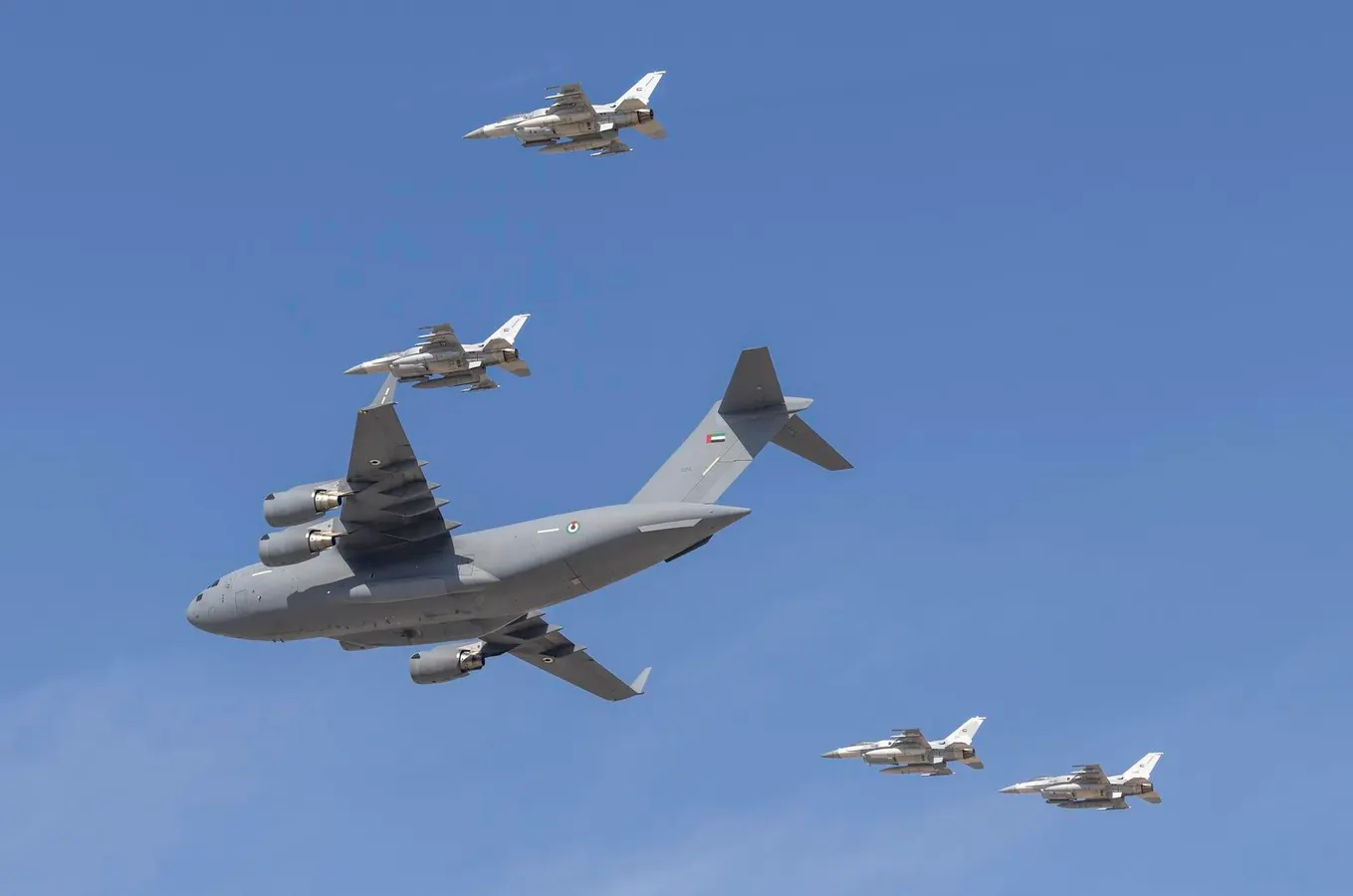

The United Arab Emirates Air Force aerobatic display team flies the fleet of Mirage 2000-9, F-16 fighter jet, helicopters, refueling aircraft at the Dubai Airshow on November 16, 2025 in Dubai, United Arab Emirates. (Photo by VCG/VCG via Getty Images)
VCG via Getty Images
In the latest sign that the Arab Gulf states are investing heavily in more cost-effective drone interceptors, the United Arab Emirates became the latest regional country to order 10,000 Advanced Precision Kill Weapons Systems on October 2. All six of the Arab states that make up the Gulf Cooperation Council have been bombarded by Iran since the war that started on February 28. Now, most of these states have scrambled to acquire more cost-effective systems and munitions for bringing down Iran’s waves of cheap Shahed drones.
On October 2, the State Department issued a press release stating that the UAE requested 10,000 APKWS-II munitions for an estimated $1.041 billion. The release noted that the APKWS-II ordered consists “of a combination of air-to-air and air-ground configurations.”
Manufactured by BAE Systems, the APKWS adds a guidance system to unguided Hydra 70 rockets, transforming them into relatively cheap precision-guided munitions. While an air-ground variant has been available for years, a new air-to-air version was more recently developed and can intercept drones. Costing $22,000 each, they are much better suited to intercepting Shahed-type drones than standard Western air-to-air missiles like the AIM-120 AMRAAM, the AIM-9X, and Meteors, all of which are used by the air forces of the GCC states.
In December 2025, the U.S. Navy awarded BAE Systems a five-year contract for APKWS kits valued at $1.7 billion. “The new contract supports increased domestic and international demand, enabling the Navy to purchase APKWS guidance kits over a five-year period,” a BAE press release read. “The kits are available to all U.S. armed forces, as well as allies via foreign defense sales.”
Since the Iran war began, orders for the APKWS have unsurprisingly soared in recent months. The UAE’s latest order follows a more modest order of 1,500 APKWS-II for $147.6 million on May 1. Abu Dhabi already has the most diversified air defenses in the region and sustained the most intensive Iranian bombardment of any of the GCC states and even more than Iran’s arch-enemy Israel. With drones proving elusive to its most high-end air defenses, it’s understandable that the UAE would want large numbers of APKWS rockets to preserve its more costly air-to-air missiles and counter large numbers of Iranian drones. Aside from being more cost-effective than other air-to-air missiles, fighter jets can also carry APKWS in significantly greater numbers.
On July 6, as part of an even larger $1.96 billion deal, Saudi Arabia also requested up to 10,000 APKWS-II “air-to-air guidance sections” and another 10,000 APKWS-II “air-to-ground sections,” according to the State Department. Riyadh ordered APKWS-II much earlier than the other Gulf states, in March 2025, when it requested 2,000 in a deal with an estimated cost of $100 million. Given its experience in the 2015 to 2022 war with the Houthis in Yemen, Riyadh had firsthand experience with how costly it is to intercept cheap drones with expensive air-to-air missiles and the strain such intercepts put on its stockpiles, which it had to replenish with new orders. During that war, Saudi F-15s fired AIM-120s to intercept drones a fraction of their price. That experience also likely motivated Saudi Arabia’s discreet order for Russian-made Pantsir-S1 medium-range air defense systems in 2021. These self-propelled anti-aircraft gun and missile systems are more cost-effective for providing point-defense of critical targets against such low-cost drones than more advanced and expensive Western systems like the MIM-104 Patriot. It’s unclear if these Russian systems were used or performed well during the Iran war or Saudi Arabia’s latest ongoing war with the Houthis that began in July.
Qatar, which operates a huge Western-equipped fleet of 4.5-generation fighters for such a small state, also endured repeated attacks from Iran. Doha ordered 10,000 APKWS-II rounds for $992.4 million on May 1, coinciding with Abu Dhabi’s initial order. As with Kuwait, Qatar is highly vulnerable to Iran’s short-range ballistic missiles and its most basic drones given its geographical proximity just across the Persian Gulf. Doha also has Patriots and the National Advanced Surface-to-Air Missile System developed by Norway’s Kongsberg Defense & Aerospace and the American RTX Corporation, formerly known as Raytheon Technologies Corporation. The NASAMS uses a ground-launched version of the AIM-120 to combat drones, cruise missiles, and other aircraft. While it’s undoubtedly a more cost-effective way to deal with drones than the Patriot, it’s still prohibitively expensive, especially when alternatives like Qatari jets armed with dozens of APKWS precision-guided munitions exist.
While Kuwait hasn’t yet ordered APKWS, it’s also taking tangible steps to build up more cost-effective drone defenses. As with Qatar, Kuwait’s close geographical proximity to Iran makes it extremely vulnerable to Tehran’s drone and missile attacks. Kuwait also operates Patriots and requested $400 million in repair and return services on October 2. It also ordered NASAMS in April to add another layer to its air defense. In June, Kuwait placed an order for $1.98 billion worth of counter-drone systems, namely the Roadrunner-Munition and Anvil-Kinetic developed by Anduril, which are reusable and can intercept drones for a fraction of the price of traditional air defense systems.
Ukraine has been eager to share its technology and extensive experience intercepting Iranian-designed Shaheds and Russian-modified versions since late 2022 with the Gulf states, in hopes of acquiring some precious Patriot missiles, of which Kyiv is in chronic short supply, in return for intercepting Russian ballistic missiles. In April, Reuters reported that Saudi Arabia and other Gulf states are interested in acquiring a Ukrainian-designed interceptor drone that costs approximately $2,500 each, a fraction of other interceptors and much cheaper than the Shaheds they would be sent up to bring down. Such cheap interceptors, acquired in numbers similar to the APKWS-II munitions, would let the Gulf states preserve their more sophisticated interceptors while still intercepting large numbers of incoming Iranian drones without rapidly depleting their inventories.
Another country the Gulf states are turning to for cost-effective drone defenses is Turkey. Turkey’s Aselsan defense corporation unveiled a new version of its Korkut anti-aircraft gun in September 2025. The 100/25 version can intercept small first-person-view drones using its 25-millimeter smart ammunition. Middle East Eye reported on October 5 that Ankara supplied Kyiv with Korkuts earlier this year, which have proven effective against cruise missiles and drones. In addition to Iraq, Qatar and Saudi Arabia have signed contracts for the newer Korkut 100/25, Middle East Eye reported in May.
Iran and its regional militia allies and proxies have repeatedly used cheap drones to push the advanced air defense and air forces of the Gulf to their limit and gradually deplete their air-to-air missile and surface-to-air interceptor stockpiles. By acquiring these cheaper interceptors in bulk, the Gulf states clearly hope to tip the present cost imbalance against Iran by eventually shooting down its drones even more cheaply than it cost Tehran and groups like the Houthis to manufacture.
















Leave a comment