


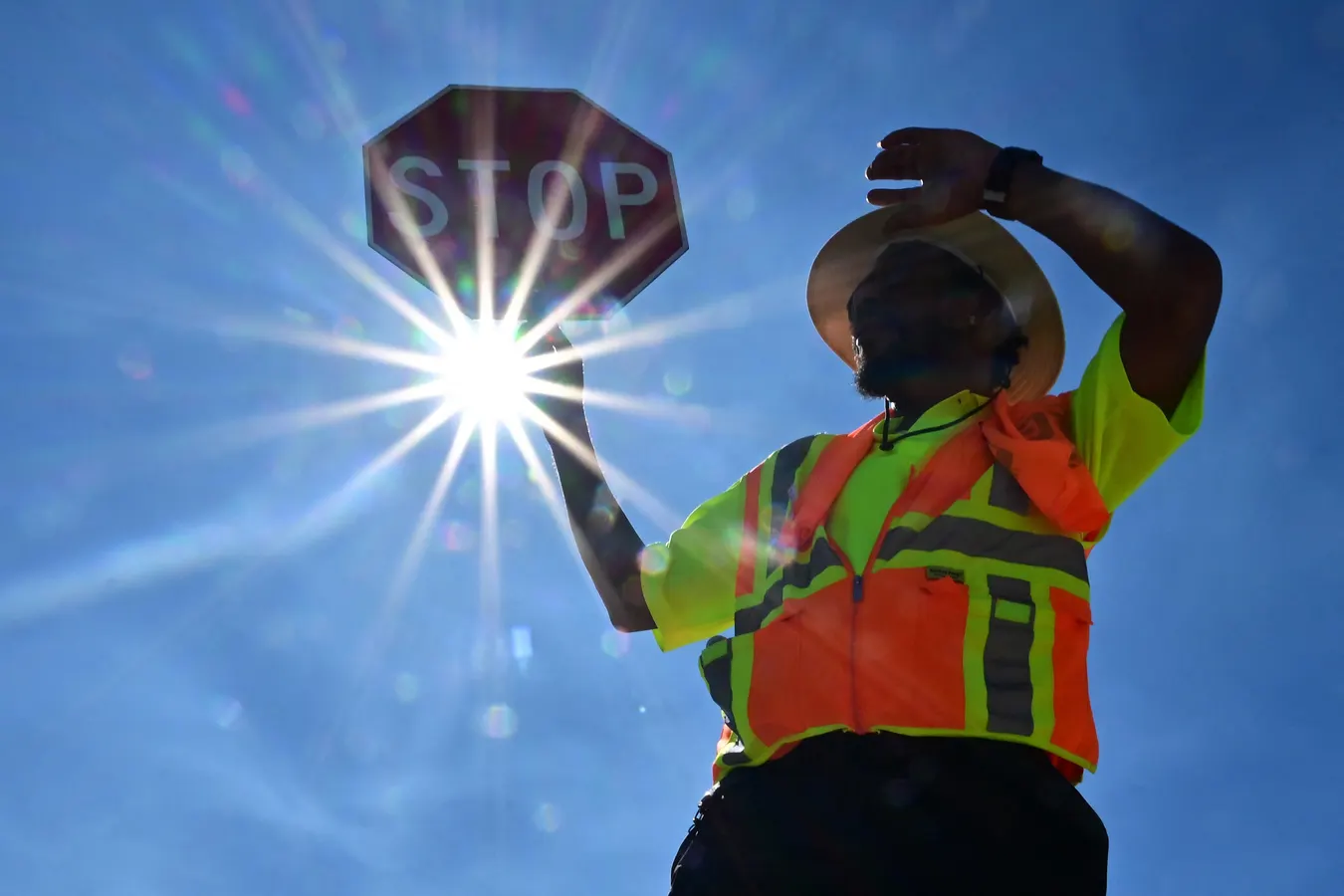

TOPSHOT – Traffic warden Rai Rogers mans his street corner during an 8-hour shift under the hot sun in Las Vegas, Nevada on July 12, 2023, where temperatures reached 106 degrees amid an ongoing heatwave. (Photo by Frederic J. BROWN / AFP via Getty Images)
AFP via Getty Images
Business leaders have spent the past several years absorbing one workforce disruption after another: a global pandemic, labor shortages, supply chain instability, rising healthcare costs, and shifting expectations around flexibility and well-being. And as heat waves, hurricanes, floods, and severe storms become more frequent and more disruptive, it’s clear that the next major challenge is already here. It’s extreme weather.
The numbers are striking. More than four in five U.S. workers report experiencing at least one weather-related disruption on the job in the past year. Nearly two-thirds of workers say those disruptions hurt their productivity, from unsafe conditions and commute delays to school closures and caregiving challenges. Yet employer preparedness has not kept pace with the risk. Only 4% of employers have assessed the weather-related threats facing their workforce.
That gap between exposure and preparation should concern every CEO, benefits leader, occupational health and safety professional, HR executive, risk manager, and policymaker in the country. The U.S. has already absorbed $12.4 billion in weather- and climate-related disaster losses in 2026 alone, and that figure captures only the damage to homes, roads, businesses, and infrastructure.
The damage accumulating inside the workforce – missed work hours, lower productivity, rising healthcare costs, staffing instability, and growing safety risks – is easier to miss but no less real. The direct healthcare costs associated with climate change, for example, are estimated to exceed $800 billion annually in the U.S. And disruptions like extreme heat were estimated to cost $100 billion in 2021, a number that is expected to grow to $500 billion per year by 2050.
AUSTIN, TX – Icy roads cause traffic delays on I-35 on February 15, 2021 in Austin, Texas. Winter storm Uri has brought historic cold weather to Texas, causing traffic delays and power outages, and storms have swept across 26 states with a mix of freezing temperatures and precipitation. (Photo by Montinique Monroe/Getty Images)
Getty Images
The Weather Risk Is A People Risk
For too long, extreme weather has been framed as an environmental issue. More recently, we have come to understand it as a public health issue. For employers, though, it is now something more immediate. It’s a workforce and productivity issue.
Heat, wildfire smoke, hurricanes, flooding, poor air quality, and severe storms shape whether workers can safely commute, remain healthy through a shift, care for their families, and perform once they arrive. And the effects do not stay neatly confined to one function or department. A heat wave may begin as an occupational safety concern for a construction crew. But it can quickly become a benefits issue when workers experience dehydration or cardiovascular strain. It becomes an absenteeism issue when schools close or transit systems shut down. It becomes a mental health issue when families face displacement, damaged homes, or financial stress. And it becomes a business continuity issue when staffing becomes unpredictable, operations slow, and supply chains break.
We saw this play out in real time after Hurricane Helene swept through the Southeast in 2024. Major employers across western North Carolina lost weeks of operations, and workers faced not only damaged homes but cascading effects on childcare, transportation, and mental health that lingered long after floodwaters receded. The companies that recovered fastest were the ones that had already built flexibility into their leave, pay, and communication policies.
ASHEVILLE, NORTH CAROLINA – Heavy rains from hurricane Helene caused record flooding and damage on September 28, 2024 in Asheville, North Carolina. Hurricane Helene made landfall in Florida’s Big Bend with winds up to 140 mph and storm surges that killed at least 42 people in several states. (Photo by Melissa Sue Gerrits/Getty Images)
Getty Images
Preparedness Has To Become Workforce Strategy
Historically, many companies have treated weather preparedness as a facilities, sustainability, or emergency response function. That’s no longer enough. Readiness, response, and recovery has to become a part of workforce strategy, embedded into benefits design, leave policies, occupational health and safety, communications, and business continuity planning.
The core question is simple: do employers know which workers are at risk, what those risks are, and what supports are in place before the next disruption arrives?
The good news is that employers don’t have to start from scratch. Earlier this year, the Health Action Alliance (HAA) launched Extreme Weather + Work to help employers better prepare for the growing workforce impacts of extreme weather. I co-chair HAA’s National Commission on Climate and Workforce Health, which serves as the advisory board to this new effort, bringing together employers, public health experts, and business leaders to build practical tools and evidence-based guidance. The initiative offers free resources including a Climate Health Cost Forecaster, a Climate and Worker Health Scorecard, and role-specific leadership guides designed to help employers project costs and stay ahead of weather-related risks.
That practical orientation matters. Employers don’t need another abstract warning about climate risk. They need a playbook. They need tools that help them identify exposed workers and regions, anticipate health and productivity impacts, design benefits that build resilience, and equip managers to communicate effectively before and during disruptions.
What Employers Can Do Now
Here are four practical steps every employer can begin taking right now:
- Assess risk: Identify which workers are exposed to heat, smoke, flooding, storms, or commuting disruptions, and which worksites are most vulnerable. Consider how health conditions, caregiving responsibilities, or housing instability amplify that exposure.
- Make readiness cross-functional: This cannot sit within a single team. HR, benefits, occupational health and safety, operations, risk management, security, and communications all have a role to play, and they must be aligned before the next event, not after.
- Update policies before the next emergency: Review heat safety protocols, remote work flexibility, paid leave, emergency communication, backup staffing, transportation support, and health coverage for weather-related needs.
- Listen to workers: Employees are often the first to see where policies fall short, and our polling shows they view employers as central to protecting their health and safety.
PHOENIX, AZ – Sharlaye Taylor wears an ice vest while working at a Chick-Fil-A franchise in Phoenix, Arizona on August 31, 2023. The ice vests are part of several measures to protect workers from extreme heat including switching workers every 30-60 minutes during the hottest days, shade structures, fans with misters, swamp coolers outside by the drive through windows and ice water available for employees.
The Washington Post via Getty Images
The Employers Who Prepare Will Lead
Preparedness is not just a corporate responsibility. It’s good business. Companies that plan ahead will better protect workers, maintain operations, reduce avoidable health costs, and retain talent. Those that wait will find themselves reacting crisis by crisis, often at greater human and financial cost.
Our workforce has always adapted to changing conditions. But adaptation has limits. You cannot retrofit a workforce mid-hurricane or train crews through a heat wave. Extreme weather is already reshaping how Americans work. The employers who plan for it will lead the next decade of work. The ones who don’t will spend it reacting.
Interested in getting involved in Extreme Weather + Work? Request more information about our growing membership coalition here.
















Leave a comment