


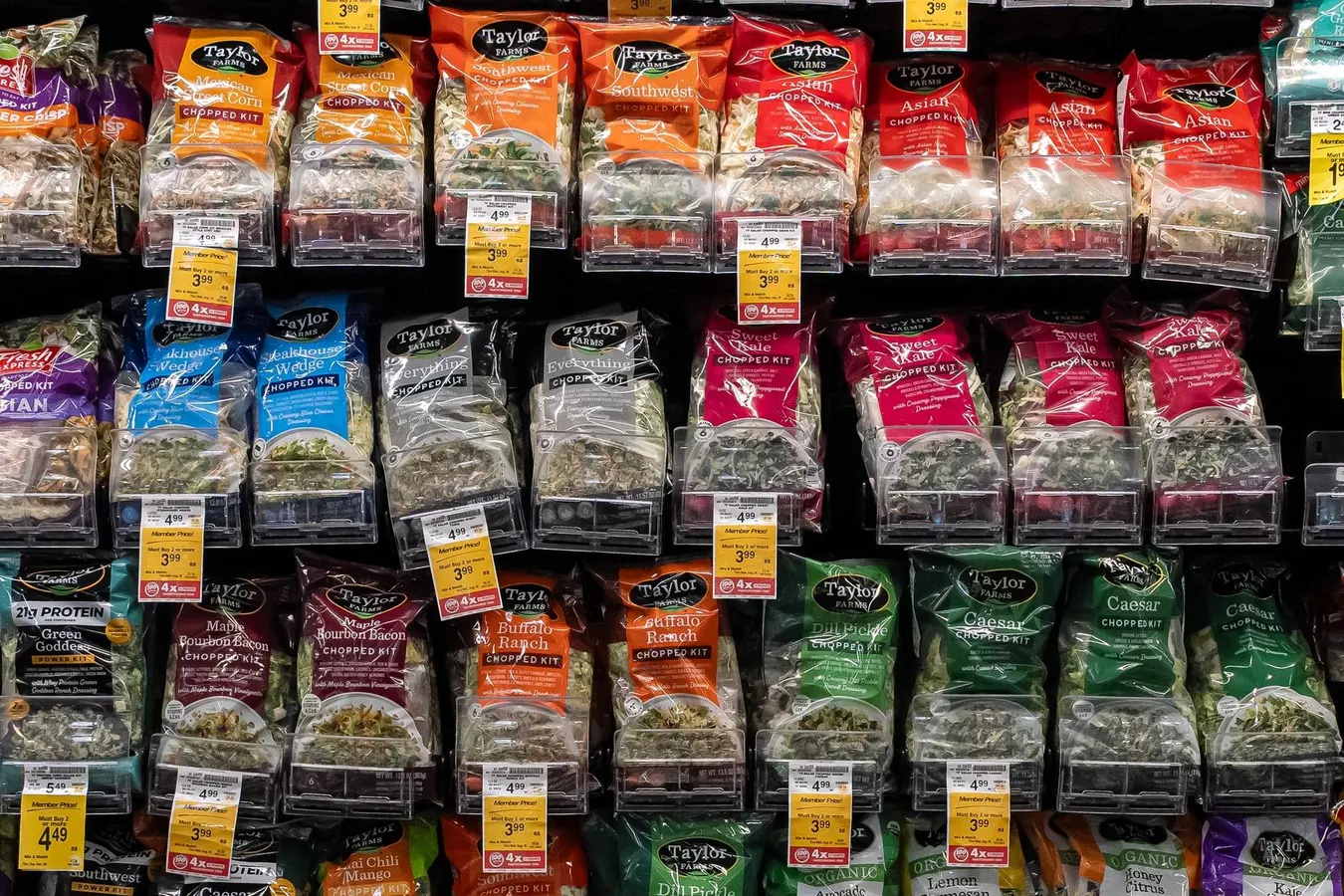

Taylor Farms bagged salad mixes for sale at a grocery store in Hercules, California, US, on Friday, July 17, 2026. Lettuce supplier Taylor Farms told US regulators the company is preparing to issue a recall of ingredients linked to a diarrhea-causing parasite outbreak that’s sickened thousands in Michigan and nearby states. Photographer: David Paul Morris/Bloomberg
© 2026 Bloomberg Finance LP
A cyclospora outbreak linked to shredded iceberg lettuce has sickened more than 1,600 people and prompted a multistate recall. Over the weekend, the Food and Drug Administration (FDA) announced a positive lettuce test, then retracted it a day later as a false positive. The reversal doesn’t change the recall or the guidance to avoid the recalled lettuce. The reason comes down to how this particular parasite gets detected. Here’s what to know.
What Happened With The Cyclospora Lettuce Recall
Cyclosporiasis has been one of the most-searched food topics in the country over the past week, with “taylor farms” drawing more than a million searches, up a thousand percent, and the terms people are typing, like “lettuce parasite,” “fda lettuce parasite retraction,” and “taylor farms false positive,” reflecting how widespread the confusion has become. Since May 1, the Centers for Disease Control and Prevention (CDC) has confirmed 1,645 domestic cases across 34 states, with 141 hospitalized and no deaths, and is analyzing more than 5,100 additional cases that may yet be confirmed. By this same point last year, the national count was 249.
The FDA’s traceback investigation identified a single supplier, Taylor Farms de Mexico, behind the shredded iceberg served at Taco Bell locations where people got sick. Taylor Farms voluntarily pulled all iceberg lettuce grown in central Mexico and began a recall, based, in the company’s words, on “information provided yesterday by the FDA.” The company has said the traceback pointed to one independent farm representing less than 1% of the U.S. iceberg supply. The recall reached past Taco Bell into Marketside-brand bagged and shredded lettuce sold at Walmart, which meant the contaminated product could be sitting in a home refrigerator.
Over the weekend, the FDA screened another sample of imported lettuce that tested positive for cyclospora. The sample was collected during import screening at the southern border and appeared to fall outside the existing recall. The FDA said it was important to communicate the result during an active outbreak as actionable public health information. By the next day, the FDA’s own laboratory experts had re-reviewed the sample, and the agency took the result back, saying it “does not represent true amplification” and classifying it as a false positive. As of July 19, the FDA reported no confirmed positive product samples for cyclospora in the outbreak at all.
Taylor Farms responded publicly, noting that the FDA has not identified “a single positive product test result” for cyclospora. The FDA agrees, and the acting commissioner said on a Monday press call that the weekend’s communications around the false positive “do not change the basis for FDA’s ongoing outbreak investigation or the epidemiological data supporting the current voluntary recall by Taylor Farms.”
Why A False Positive Happens With This Parasite
Unlike Salmonella or E. coli, the pathogens that drive most recognizable foodborne outbreaks, cyclospora can’t be grown in a lab to confirm it. That single factor is what makes it so hard to detect.
On a call with reporters Monday, the FDA’s Don Prater, acting deputy commissioner for food, said cyclospora cannot be cultured with conventional laboratory techniques and is extremely difficult to detect even with the agency’s most sensitive methods. Iceberg lettuce makes it harder still, according to an FDA official, because it moves so fast from harvest to plate that the contaminated lettuce is usually already eaten or thrown out by the time someone falls ill, which can take a week or more. The parasite also shows up at very low levels in the food even when it is present, far lower than in the people it sickens, so generating a positive result requires an enormous number of samples.
The FDA screens imported lettuce at the southern border using PCR. This rapid method looks for the parasite’s genetic material directly in the sample rather than trying to grow it. Those screening calls get made fast under the pressure of an active outbreak, and the July 19 advisory attributed the correction to “the complexity in detection of Cyclospora.” The test picked up something that turned out not to be the parasite.
Why The False Positive Doesn’t Change The Recall
The recall followed from the FDA’s traceback investigation, where investigators traced the overlapping meals of sick people back to a single supplier. “Most of the time,” Prater said, “our traceback and epidemiologic information are what allows us to determine the source of the outbreak.” Test results, he said, are difficult to obtain.
An FDA official said Taylor Farms remains the single supplier the investigation has identified. The false positive came from a separate border screening sample that appeared to fall outside the recall, and retracting it changed nothing about the case, because the case never depended on that sample.
The investigation is still active, and the FDA has said it will update its advisory if additional brands or retailers are identified. A voluntary recall is part of how that process works, which means what shoppers are watching is a system still doing its job in public.
For now, the FDA recommends that anyone with the recalled lettuce discard it or return it for a refund, and that diners unsure of the source of a restaurant’s iceberg lettuce ask before ordering. Since this is still moving, the FDA’s outbreak page is the place to check what is current.














Leave a comment