


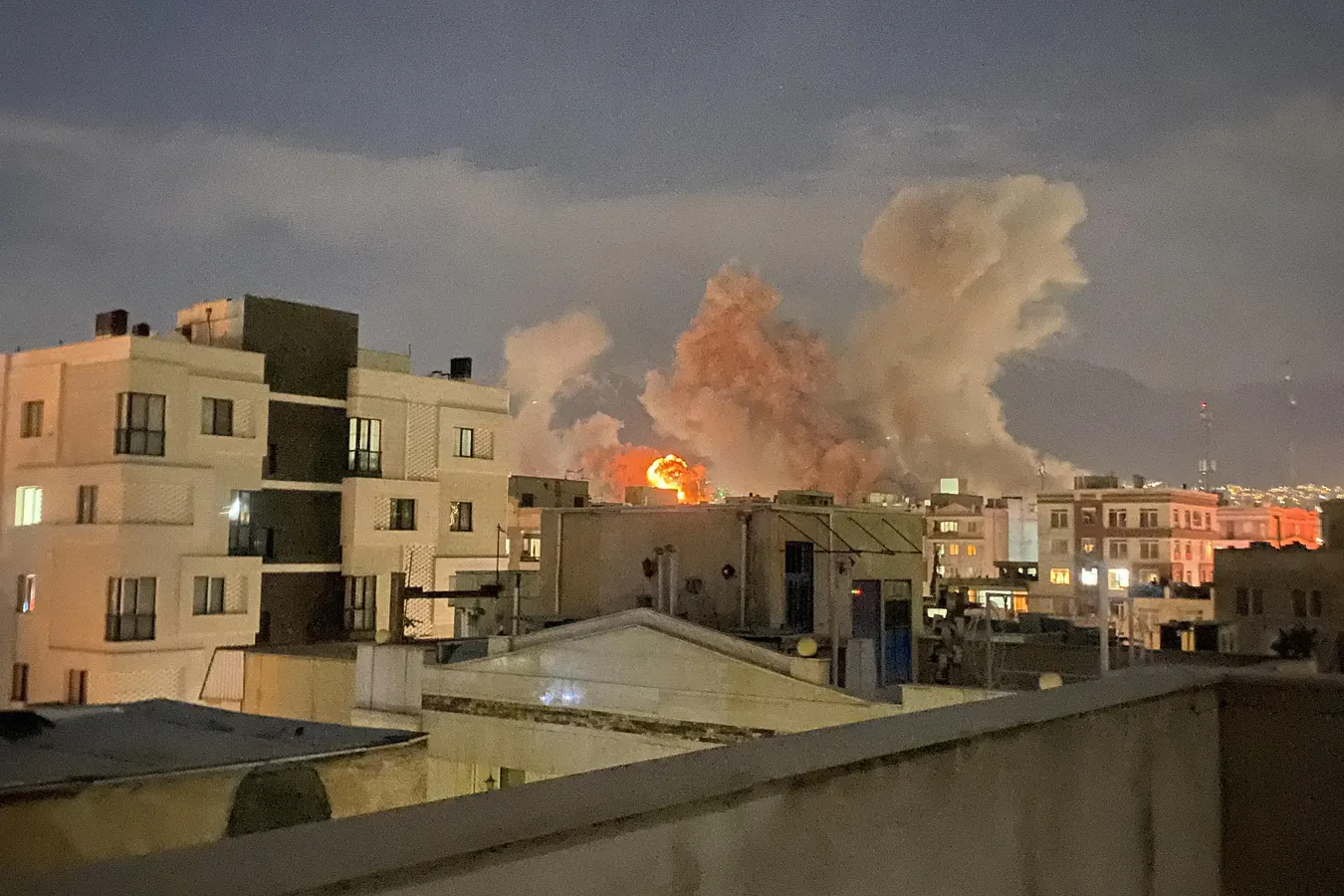

Plumes of smoke rise following reported explosions allegedly near Iran’s Ministry of Intelligence on Araqi Street in Tehran on March 1, 2026, after Iran’s supreme leader, Ayatollah Ali Khamenei, was killed a day earlier in a large U.S. and Israeli attack, prompting a new wave of retaliatory missile strikes from Iran. (Photo by Mowj / Middle East Images / AFP via Getty Images)
Middle East Images/AFP via Getty Images
If 10 to 20 million barrels a day of oil supply is lost by the Straits of Hormuz shutdown, buyers might engage in panic purchases, will those not affected could hoard their supplies. Uncertainty about the duration of the disruption will magnify the panic and hoarding, driving prices up, possibly over $100 for a time.
Not surprisingly, the punditosphere is blowing up with attempts to explain the impact of the new Iranian conflict on the oil market. Everyone expects higher prices but this is a lot of disagreement about just how high they will go. Some focus on the huge amount of oil at risk while transiting the Straits of Hormuz while others, led by IEA Director Fatih Birol, note that “The IEA is actively monitoring events in the Middle East & the potential implications for global oil & gas markets and trade flows. Markets have been well supplied to date.”
The data seem to contradict that, which has been subject to much debate in recent months. The IEA itself, having seen a surplus of about 2 mb/d last year, only found an increase in OECD stocks of about 0.2 mb/d. (The OECD is approximately half of the oil market.) Another 0.7 mb/d increase in stocks at sea and floating inventories still left a large 1.2 in the ‘miscellaneous to balance’ category: in other words, unaccounted for. This is the same phenomenon seen in 1998 when David Knapp labelled them ‘missing barrels.’
More recently, the IEA has explained at least some of the discrepancy: global inventories are estimated to have increased by about 500 million barrels last year, but about 2/3s of that either when to China (mostly government stocks) or ‘sanctioned oil on water,’ which would be unsold Iranian, Russian and Venezuelan barrels. That oil would not now be available to the market unless sanctions are lifted and/or bigger discounts are offered to attract customers.
The figure below shows reported OECD inventories, which did rise by about 100 million barrels last year and are certainly adequate. However, there remains a significant possibility that the uneven distribution of oil losses due to the closure of the Straits of Hormuz (or at least avoidance by shippers) will mean that those inventories are not sufficient to prevent panic buying, especially by countries relying on Persian Gulf oil.
OECD Oil Inventories (miliion barrels)
The author from IEA data.
It has been four decades since the massive inventory builds seen during the 1979 Iranian Oil Crisis, when stocks rose by 3 mb/d and more for months on end. Then, the fear was that the Iranian Revolution would spread to other countries in the Gulf, and that tensions between Iran and Iraq might led to war. The former proved ultimately groundless while the latter came to pass, but not until the market was glutted.
Afterwards, there was a debate as to whether the inventory build was due to panic or profit-seeking, most analysts coming down on the former theory. Because supply was so uncertain, oil companies (and consumers) employed the lifeboat analogy: when stranded at sea for an indeterminate time, ration your food supply as strictly as you can. Companies that had surplus oil in 1979/80 held onto it while those whose contracts were cancelled bid up supplies on a vanishingly small market.
Which brings up an important point: hoarding is often rational. Many laugh at consumer panics leading to a run on supplies of toilet paper—until they run out themselves. For oil consumers, telling them not to panic and hoard is usually somewhere between meaningless and counterproductive. President Carter learned this in 1979 when he urged nations to avoid bidding up oil prices on the spot market, even as he ordered U.S. companies to build heating oil inventories before the fall.
The short-term price of oil can go extremely high based partly on traders’ expectations and once prices are rising, momentum trading will push them up—until something triggers a selloff, most probably an end to the conflict, which doesn’t appear imminent.
The physical equivalent of the feedback loop that underlies momentum trading can be found in consumer hoarding: people rush out to fill their tanks, lines form, people see the lines and join them. The transfer of millions of barrels of gasoline into consumer’s tanks might not seem like much, but if it occurs over the course of a few days, it will strain the industry’s ability to deliver enough oil to calm the panic. Possibly an SPR release would calm them, but exhortations not to hoard are likely to fall on deaf ears.
If the war continues for more than a few days, there is likely to be an upward spiral in prices, and $100 a barrel is easily attainable. It wouldn’t last past the conflict, but the economic fallout could be severe in a global economy that is already showing signs of fatigue. With gasoline prices soaring 25 to 50 cents a gallon, consumer confidence will likely nosedive, inflation rise and economic activity slow. Yet another, albeit secondary, reason to wish for peace.















Leave a comment