



Less than a decade ago, Hennessy had the sort of problem most luxury businesses would consider fairly enviable: it could not make enough of the stuff.
In 2017, Forbes reported that the world’s biggest Cognac house needed to increase shipments by around 14% simply to meet demand, with bottles on allocation in several markets. By the following year, 87.4 million bottles of Cognac were being shipped to the US alone; American sales of the category had risen 59.5% from 2012 to 2017. And the boom only kept going.
In 2021, Hennessy volumes rose above pre-pandemic levels despite supply constraints, helped by a strong rebound in both China and the US. In 2022, LVMH’s Wines & Spirits division posted record revenue and earnings: €7.1 billion in sales, with operating profit above €2.1 billion.
Then Cognac hit a wall.
Exports fell 15% by volume and 24% by value in 2025. Chinese anti-dumping measures, US tariffs and an unforgiving euro all played their part; French wine and spirits exports as a whole dropped to their lowest volume in at least 25 years. LVMH’s Wines & Spirits revenue fell 5% organically that year, and operating profit dropped 25%, with Hennessy specifically dragged by weaker demand and customs duties in China and the US.
Thankfully, the category’s beginning to breathe again. LVMH reported 5% organic growth in Wines & Spirits for the first half of 2026 and an 11% rise in operating profit, with Hennessy’s improvement in China continuing after Chinese New Year.
But the old conditions have not magically returned.
On August 20, Hennessy began harvesting its 2026 grapes—one of the earliest starts ever recorded in Charente, driven by heat and a lack of water. Master Blender Renaud Fillioux de Gironde told me Hennessy itself had never started so early.
Only, two months earlier, the same man put his name to something called a Henny-Rita. And there is something wonderfully smart—wonderfully Hennessy—about that collision.
Fillioux de Gironde is making decisions about eaux-de-vie that may not prove their worth for decades, while also developing a $15.99 bottled cocktail for drinkers whose habits are changing. In 2026, the house is being pulled in many directions: by climate in Cognac, by tougher trading conditions globally, and by consumers who have considerably less patience than anything ageing in its cellars.
That makes Hennessy’s place in pop culture more commercially interesting than ever. Truth be told, few spirits brands have spent the last half-century so successfully embedded in music, nightlife and the shorthand of aspiration. And, better still, much of that cachet arrived before anybody at Hennessy could reasonably claim credit for engineering it.
Nas was rapping about it on his first album, Illmatic, in 1994, years before there was an ambassador contract to explain the enthusiasm. By 2004, Hennessy had been mentioned 47 times in songs that had reached the Billboard Top 20, more than any other brand in history. A year later, Xzibit had the house’s arm-and-axe insignia tattooed on his body.
“I just love the product,” he told Forbes at the time.
Very useful marketing, especially when nobody had to approve the copy. And brilliant context for Hennessy’s current line-up, which could otherwise resemble an unusually expensive game of celebrity bingo.
Swizz Beatz, Alicia Keys, Nicki Minaj and Nas attend Nas’ private birthday dinner, presented by Hennessy, in 2017 (Photo by Bennett Raglin/Getty Images for Hennessy)
getty
There’s Bad Bunny, the Puerto Rican megastar whose DeBÍ TiRAR MáS FOToS world tour carried Hennessy as its official global presenting sponsor. There’s Tems, the Nigerian Grammy winner who became a global ambassador after Hennessy backed her Leading Vibe Initiative for women working across African music. This year’s Hennessy Cypher brings six rappers from Cameroon, Côte d’Ivoire, South Africa, Ghana, Kenya and Britain together under Nigerian producer Sarz. In Asia, Jackson Wang fronts V.S.O.P and X.O. Lang Lang, one of the world’s most famous classical pianists, gets Paradis.
And the geography is almost as interesting as the names. Today, Hennessy’s three biggest markets are the US, China and South Africa, where Hennessy commands around 90% of the Cognac market overall.
Alexandre Arnault, deputy CEO of Moët Hennessy, also recently called Africa the company’s most attractive continent for future growth. Arnault described those numbers as “genuine cultural adoption”, built over more than 20 years rather than one clever campaign. Distribution gradually moved from small liquor stores into restaurants, hotels and nightlife across the country.
And China is returning.
LVMH says the improvement Hennessy saw around Chinese New Year continued through the first half of 2026, after a torrid period for Cognac in the country. At the same time, Hennessy is putting Jackson Wang across Mid-Autumn editions of V.S.O.P and X.O, pairing the former with Oolong Iced Tea and the latter with Pu’er tea ice.
And Arnault has form here. Years before moving into Moët Hennessy, he was asked about Rimowa’s much-discussed collaborations with Supreme, Off-White and others. “Authenticity was key,” he said. He did not want to partner with Supreme simply to “target millennials”; the collaborator needed legitimacy in their own world, and the result needed to make sense for both sides.
He was even blunter with Business of Fashion: if a brand starts carving consumers into demographic targets and trying to look cool at them, “I feel it immediately and I kind of run away.”
And Hennessy is fortunate enough to have proof that people cared long before these more recent collaborations hit shelves.
Hennessy: The Foundations
For anyone whose Hennessy knowledge starts and ends with “Henny”, it’s time to take a closer look at the initials on the bottles. V.S is younger, robust and happy in a cocktail. V.S.O.P moves up in complexity and age. X.O—a designation Hennessy itself created in 1870—sits richer and older again. And above them are the rare expressions: Paradis, Richard Hennessy and releases made in numbers that begin to look faintly absurd.
Across Cognac as a category, V.S represents 55.2% of global sales, V.S.O.P another 38% and X.O 6.8%. Nearly 80% of Cognac worldwide is consumed in cocktails. Truthfully, that enduring image of a balloon glass beside a fire hasn’t reflected the way most people drink the stuff for quite some time.
A guest attends the Hennessy pop up at the Bad Bunny concert at the Tottenham Hotspur Stadium on June 28, 2026 in London, England. (Photo by Eamonn M. McCormack/Getty Images for Hennessy)
Getty Images for Hennessy
Which is why the pairing of artists and bottles is worth noticing. The African Cypher sits around V.S. Bad Bunny gets V.S.O.P. Jackson Wang spans V.S.O.P and X.O.
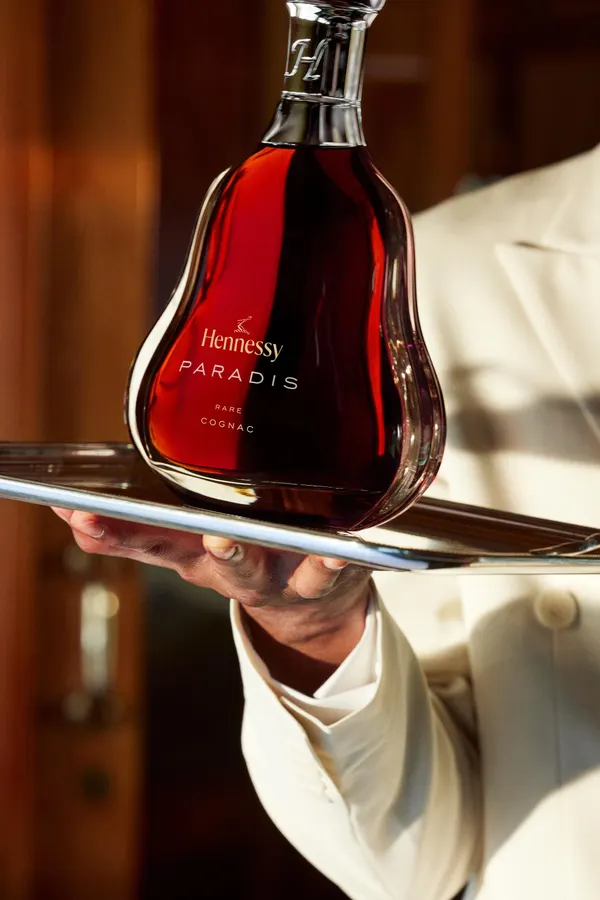
Then Lang Lang gets Paradis. And Paradis, for me, is where Hennessy really earns its reputation.
Maurice Fillioux created it in 1979 from eaux-de-vie held among the house’s rarest reserves. A classical music obsessive, he conceived the blend in orchestral terms: adding more instruments achieves remarkably little if they cannot play beautifully together.
It doesn’t bludgeon you with age or oak. The first impression is almost confusingly elegant (florals, particularly jasmine, then warm cinnamon and fruit), while the palate gets fuller and silkier (without losing that lightness), before hanging around for what feels like an indecent length of time. Hennessy describes a long, persistent finish. That part, at least, is an understatement. And the latest launch makes the ceremony around it considerably more dramatic.
Renaud Fillioux de Gironde, the eighth-generation Master Blender for Hennessy
Hennessy
For the first time, Paradis is available in a three-litre Jeroboam: around 100 exceptional eaux-de-vie, aged for at least 25 years, inside a vast French-made decanter requiring more than 10 stages of glassmaking. It arrives in an oak case with two Paradis glasses and a precision 2cl pipette based on the sampling ritual inside Hennessy’s cellars.
“I really enjoy it very much,” Lang Lang tells me, despite not being much of a drinker by his own admission.
When I ask about the collaboration, he spends a surprising amount of time talking about Fillioux de Gironde. The artistry of a man who guided a novice through aromas, flavor, and eaux-de-vie originating in radically different periods.
Fillioux de Gironde is the eighth generation of his family in Hennessy’s blending lineage. From a single vintage, he tells me, the tasting committee can work through thousands of individual eaux-de-vie. Plenty will become very good younger Cognacs. Only a tiny proportion show the structure and potential required for the house’s longest-lived future blends.
Of course, the process doesn’t end once the spirit goes into oak. And there’s an extraordinary amount of liquid riding on the million judgments thereafter.
At the end of 2025, Cognac producers collectively held stocks equivalent to around 2.2 billion bottles ageing in oak. Only 143.6 million bottles were exported that year. The equivalent of another 41 million bottle simply disappeared into the air as the Angel’s Share.
In good years, that inventory is a source of enormous value. In a downturn, it’s tomorrow’s supply sitting patiently in a market that has changed its mind. And climate only adds another challenge.
Ugni Blanc accounts for more than 98% of the Cognac vineyard. Its high acidity, low sugar and relatively late ripening make it particularly useful for producing the delicate, low-alcohol wines that become eaux-de-vie with good ageing potential, but those timings are moving.
“The weather is getting warmer and warmer,” Fillioux said, with harvest arriving earlier each year. Hennessy is experimenting with shade as a short-term protection for grapes and researching varieties better suited to hotter conditions over the longer term.
Then came August 20. An unprecedented start to the harvest, and a fairly blunt reminder that the future is not simply a more expensive version of the past.
And while Fillioux is working out which grapes and eaux-de-vie might still make sense decades from now, Hennessy’s customers are changing rather more quickly. Which brings us back to the Henny-Rita.
“When I discussed the idea with our master blender,” Hennessy CEO Charles Delapalme said, Fillioux’s worry was simple: “I have to do something that tastes like Hennessy.”
The finished drinks come in 375ml glass bottles at $15.99. Henny-Rita and Henny Iced Tea landed at 18% ABV; Henny Berry needed 20% before enough Cognac character came through. Hennessy chose glass rather than cans to keep its premium cues intact.
Of course, there was plenty of commercial encouragement. US ready-to-serve dollar sales rose 22% in the 52 weeks ending May 2, according to Nielsen data, while brandy and Cognac volumes fell 6.5% in 2025. Moët Hennessy US CEO Chris Gabaldon said younger drinkers want something “lighter, brighter and fresher”—and, increasingly, something that works outside of bars and clubs. Which now leaves Hennessy spanning a rather unprecedented amount of ground.
At one end, a $15.99 half-bottle designed for ice and very little prior Cognac knowledge. At another, three litres of Paradis, an oak case and a pipette. Elsewhere, a $39,000 Zodiac release made from eaux-de-vie going back more than 150 years. Bad Bunny carries V.S.O.P through stadiums. Tems fronts a programme for women building careers in African music. Jackson Wang puts X.O over frozen Pu’er. Lang Lang wraps gold piano notes around a limited-edition Paradis bottle.
It would be easy to dismiss that breadth as luxury-brand restlessness, but the history makes it harder to do so.
Hennessy became prominent in pop culture before anybody could reverse-engineer the phrase “cultural relevance” KPI. Artists drank it, wrote about it and occasionally tattooed it onto themselves. Consumers gave “Henny” a life that belonged partly to the brand and partly to everyone using it. A hell of an advantage during a downturn.
Still, Arnault’s old warning about demographic targeting feels particularly apt here. People can tell when a brand has arrived to mine their culture for attention. Hennessy’s current strength lies in knowing it was invited into many of these rooms a long time ago, and chose its next ones with some real curiosity and care.
That, really, is what 261 years of pop-cultural prominence is worth. And if it gets the next person as far as the glass, LVMH can take it from there.














Leave a comment