


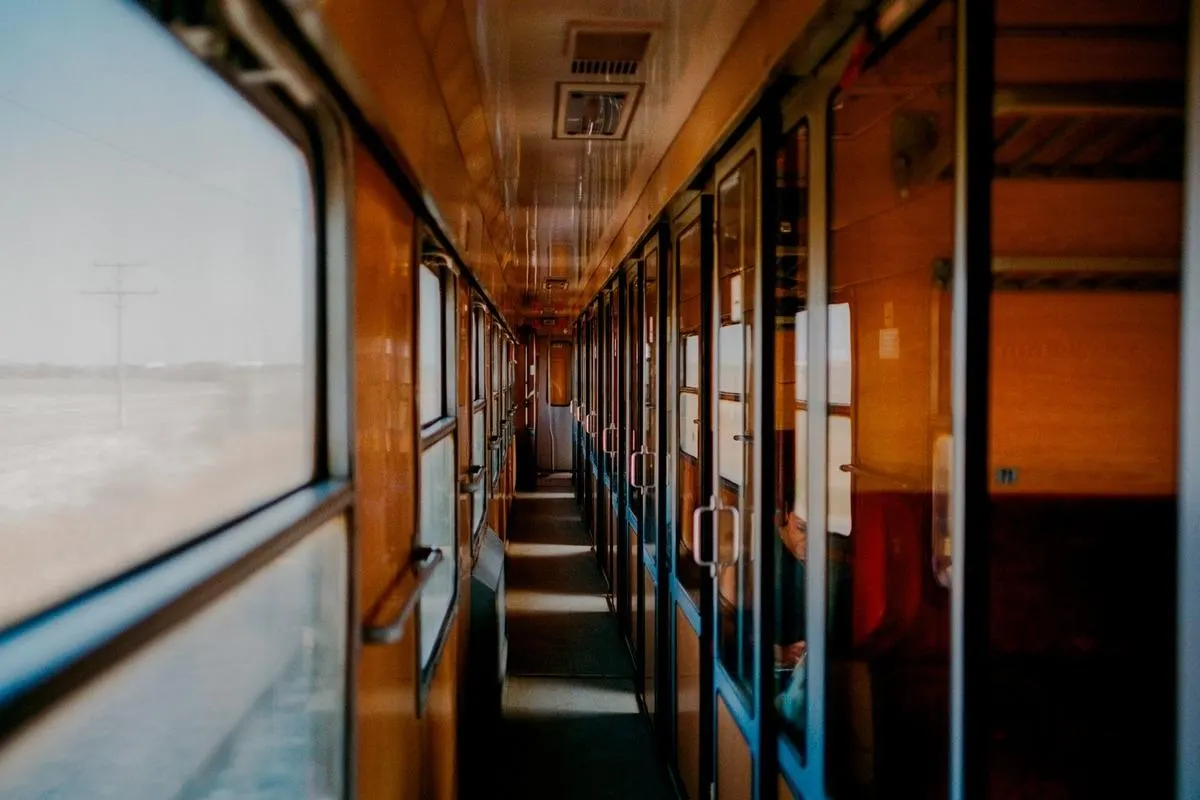
A train corridor aboard a Bulgarian train traveling from Sofia to Plovdiv, illustrating the slower, more immersive rail journeys at the heart of Interrail, formerly Eurail, as the brand reimagines travel for the digital age.
Interrail B.V.
After 67 years, Eurail is gone as a consumer brand. In a sense, the recent rebranding announcement was uncomplicated. The pass didn’t change. Neither did the rail network behind it. What changed was the name — and, with it, the story the company wants to tell about what travel is for.
Historically, European travelers knew the brand as Interrail; Americans knew it as Eurail. Eurail began in 1959 with access to 13 countries; Interrail followed in 1972 as a pass for young Europeans. More than 10 million people had used Interrail by its 50th anniversary, and the network now spans 33 countries.
By making Interrail the unified brand, the company says the change brings travelers worldwide under one global community. Its existing community platform currently has more than 30,000 members and tens of thousands of discussions and replies.
The Case For Leaving Travel Unresolved
As AI increasingly optimizes travel itineraries, Interrail is embracing the unexpected, encouraging travelers to rediscover the freedom of exploring Europe without a rigid plan.
Interrail B.V.
A product designed around 30,000 possible destinations is inherently difficult to reduce to a perfectly optimized itinerary. What does that mean for companies like Interrail, which has its own AI task force, at a moment when technology is making it possible to optimize almost every part of a trip?
McKinsey reported in March that 84% of travelers who had used generative AI for travel-related tasks said it improved their experience. More recent 2026 research shows AI increasingly entering travel discovery and itinerary planning, while travelers still turn to traditional sources and trusted brands before booking.
The process of booking the perfect trip is becoming increasingly optimized by algorithms. Interrail has decided to sell the opposite proposition: the value of leaving some details to chance.
“The challenge is ensuring digital touchpoints empower spontaneity and real-world connection rather than trapping travelers inside their screens,” said Özlem Birkalan, the Chief Brand and Commercial Officer at Interrail. “Digital efficiency must serve the human experience, not replace it.”
Algorithms And Accidental Travel Experiences
A shared meal aboard a European train captures the spirit of Interrail’s new brand philosophy: the most memorable travel experiences aren’t always the ones you plan.
Interrail B.V.
The travel industry has spent decades making travel more efficient via online booking, dynamic pricing, mobile boarding passes, digital maps, algorithmic hotel and restaurant recommendations, and now generative AI itinerary construction. The next frontier, potentially, is agentic travel, where the machine doesn’t merely recommend the trip but assembles and executes it. Yet the better technology gets at planning travel, the less room there may be for the accidental experiences that make travel memorable.
That tension is especially consequential for Interrail. Spontaneity, no longer an incidental benefit of the product, is increasingly the product’s selling point. If Interrail loses its accidental moments, it loses itself.
It isn’t just Interrail. Writing in the Annals of Tourism Research in August, a team from Kyung Hee University in South Korea described what it calls a “paradox of convenience”: technologies designed to enhance travel can also undermine the conditions for meaningful experience.
“Algorithmic recommendation, optimization, and connectivity each promise enhancement,” the authors conclude, “while eroding the variety, disorientation, and presence on which discovery depends.”
The Luxury Of Friction
Interrail is betting that the joy of European train travel lies in unexpected moments and human connections, not perfectly optimized itineraries.
Interrail B.V.
For the travel industry, the takeaway is less academic: Once the logistical necessities are handled, the ability to leave some of the experience unoptimized can itself become valuable.
“For years, the travel industry attempted to hide or apologize for any element of friction, selling a fantasy of perfectly frictionless travel,” Birkalan said. “But real transformation does not happen when everything goes smoothly according to a rigid plan. ‘Positive friction’ is the heart of what we call The Interrail Effect. When I was backpacking alone across Asia earlier in my life, it was exactly those moments of stepping into the unknown, navigating unfamiliar languages, dealing with unexpected route shifts, or working through minor travel hiccups that really shaped who I became.”
When taking a train across Europe, friction points arise organically: travelers don’t know the local language, miss a connection, or end up sharing snacks and stories with a stranger in a compartment because of an unexpected delay.
“It forces you out of your bubble, builds personal resilience, and creates shared human moments that stay with you long after you return home,” Birkalan said. “Lean into those unexpected moments rather than hiding them, because what you gain from navigating those small disruptions is what makes the trip truly life-changing.”
If the old luxury was removing friction, the emerging luxury is having enough margin that everything doesn’t have to go according to plan.














Leave a comment