


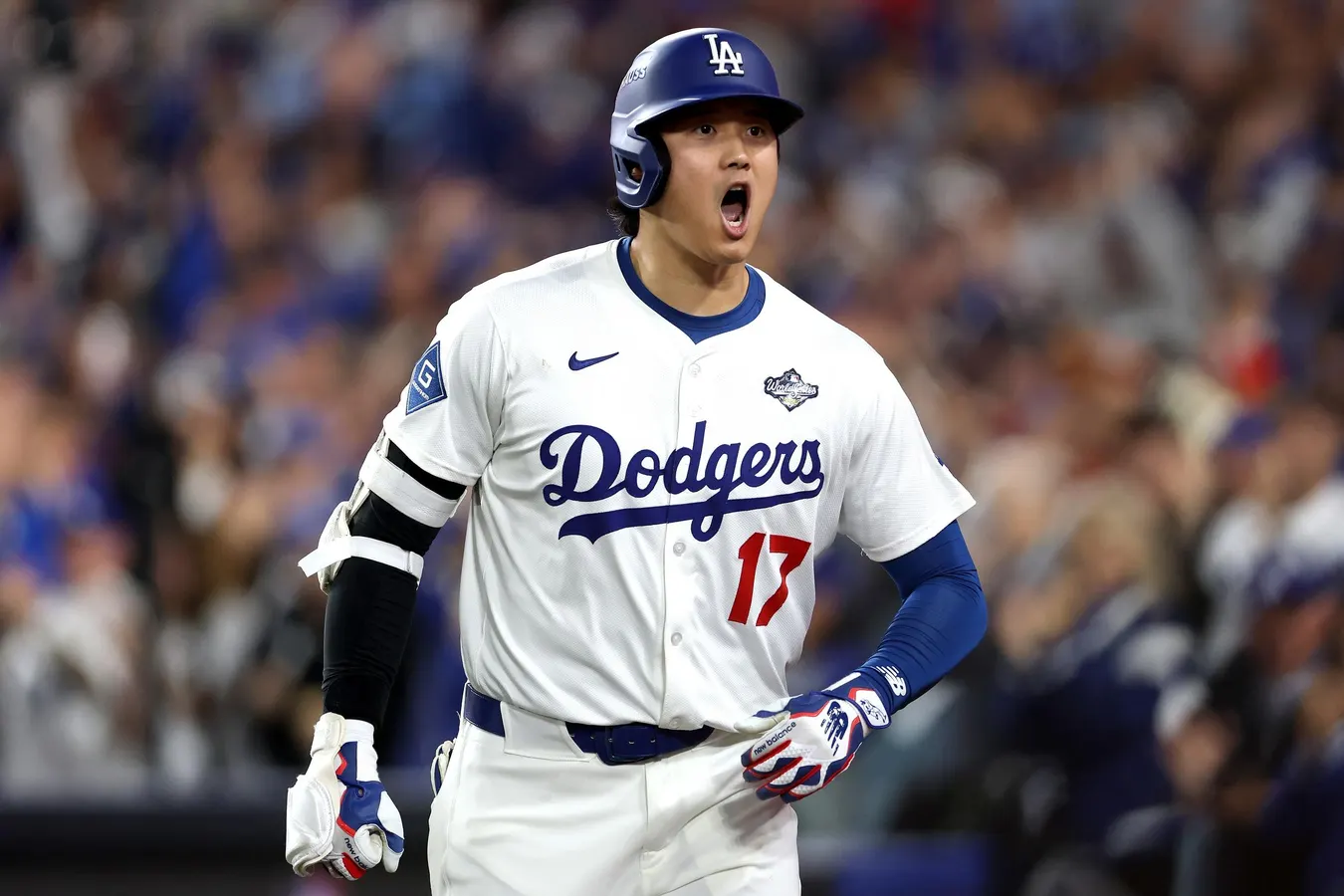

LOS ANGELES, CALIFORNIA – OCTOBER 27: Shohei Ohtani #17 of the Los Angeles Dodgers celebrates after hitting a home run during the seventh inning against the Toronto Blue Jays in game three of the 2025 World Series at Dodger Stadium on October 27, 2025 in Los Angeles, California. (Photo by Sean M. Haffey/Getty Images)
Getty Images
While most know the Los Angeles Dodgers for their Japanese stars, including Shohei Ohtani and Yoshinobu Yamamato, the overall roster includes another Japanese player, one from Venezuela, one from South Korea…The Dodgers would quite simply not be World Champions without players from around the world. Thank goodness for P-1A Visas.
The Dodgers’ perch atop the proverbial baseball pyramid came to mind after a recent speech by Vice President JD Vance. He indicated that the Trump administration is “suspending” several technology firms, Microsoft most notably, from an existing program that allows H-1B workers to apply for green cards. Speaking about Microsoft’s hiring of more recent vintage, “For every worker that Microsoft laid off, they replaced that worker with one-and-a-half foreign indentured servants.”
The view here is that Vance’s words won’t age well. And that’s not just because last year’s H-1B filings by Microsoft for new employees accounted for merely 1 percent of the firm’s total employee head count. Facts are stubborn things as Ronald Reagan once quipped, and the facts reject Vance’s characterization of Microsoft’s hiring, and tech hiring more broadly.
Vance’s portrayal was evidently meant to give the impression that technology companies are actively seeking low-cost, relatively low-skilled technology workers to replace higher-cost, higher-skilled Americans. Nothing could be further from Vance’s manufactured truth.
For evidence, consider a recent report by Carnegie China. Indicated within is that “China has established a commanding lead as the largest originating source of elite AI talent globally.” Which on its own is not a bad thing. As the report further indicated, it’s largely “a one-way flow of talent” from China to the United States. And it’s substantial.
As stated in the report, “When it comes to brain gain vs. brain drain, the United States saw a net gain of +2,145 researchers in 2025 while China registered a net loss of -1,729 researchers.” Translated, the U.S. lead in artificial intelligence or AI is very real, but it’s crucially an effect of talents inflows into the U.S. from around the world. Indentured servants these are not.
Still, it’s increasingly a known quantity that Chinese AIs are inching ever closer to those of the American leaders. Notable about shrinkage in the proverbial China/U.S. AI gap is that it’s begun to reflect in the flow of technology talent. A major factor in the evolving origins of tech’s greatest brains has been increasingly difficult restrictions from the Trump administration on foreign AI workers. See Vance’s comments on H-1B’s, the administration’s “suspension” of companies like Microsoft from the H-1B program, not to mention past “settlements” (think restrictions on H-1B workers) with top technology companies like OpenAI and Meta.
The reality seemingly ignored by Vance is that opportunities for AI’s best and brightest increasingly exist outside the United States. See the Carnegie China report yet again. Hopefully Vance will: While in 2022 46% of the world’s top undergraduate AI talent came out of China, in 2025 the China share is 57%. The U.S.’s? It’s down to 13%. The story gets worse.
Amid the growth of China as the world-leading source of AI talent, the share of Chinese AI workers working in China has increased from 57 percent in 2022 to 69 percent in 2025. Is Vance listening? If not, hopefully his boss is.
President Trump has said that whoever wins in Super Intelligence wins. Ok, but the winning stateside won’t happen without global talent. See not just the Dodgers, but the primary location of so much of the world’s leading technology talent.











Leave a comment