


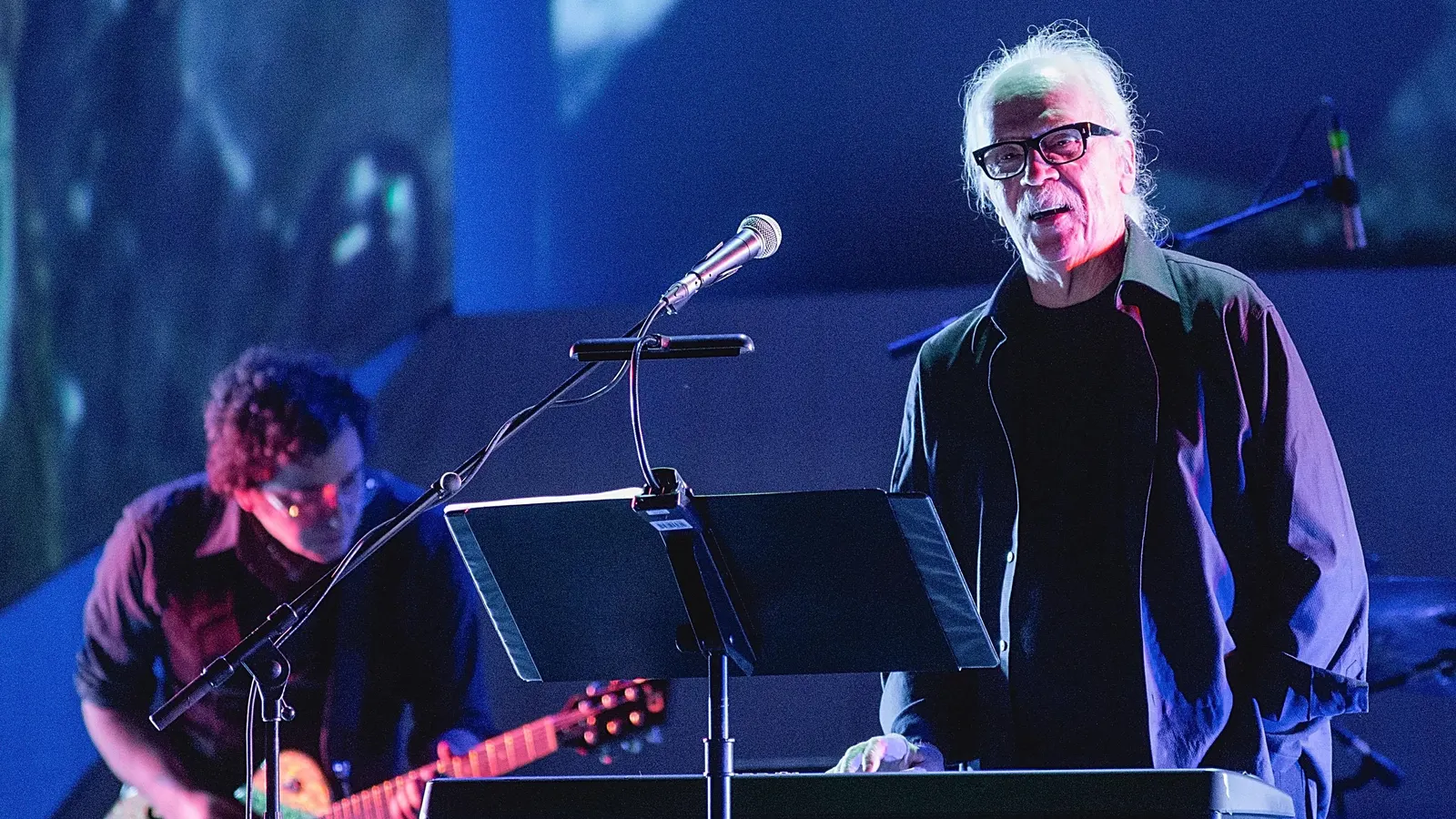

AUSTIN, TX – JUNE 23: Composer/director John Carpenter performs onstage during ‘John Carpenter: Live Retrospective’ at ACL Live on June 23, 2016 in Austin, Texas. (Photo by Rick Kern/WireImage,)
getty
For director John Carpenter, storytelling is paramount. Even in an era where story frequently takes a backseat to effects, properly developing and driving narrative remains crucial.
The son of a music teacher, Carpenter has long composed much of the music in his films, crafting iconic scores like that of Halloween, one which utilizes an instantly memorable, relentlessly catchy piano melody.
‘Cathedral,’ the debut full-length graphic novel from director John Carpenter, is now available via Storm King Comics
Cover art courtesy of Storm King Comics
Taking things further, Carpenter has worked over the last decade with his son Cody Carpenter and godson Daniel Davies (the son of legendary Kinks guitarist Dave Davies) on Lost Themes, a series of four albums which finds the trio building lush, cinematic soundscapes.
His latest project Cathedral ties all of it together. Born out of a John Carpenter dream, the trio quickly set to work fleshing out an outline musically via the creation of the group’s first metal album.
Eventually, Cathedral would become Carpenter’s first full length graphic novel, one created alongside wife Sandy King, founder of Storm King Comics, a horror story set in an evil, abandoned church in downtown Los Angeles. But, this time around, the music actually came first, with the 14 instrumental tracks each marking a chapter in the King/Sean Sobczak co-written graphic novel, a collaborative effort that finds Carpenter creating an immersive new world across multiple mediums.
I spoke with John Carpenter about the marriage of music, imagery and words that drives the Cathedral narrative and the way in which Carpenter-directed films like They Live remain sadly relevant decades later. A transcript of our video call, lightly edited for length and clarity, follows below.
‘Cathedral,’ the latest project from director John Carpenter is now available as a graphic novel and album
Album art courtesy of Storm King Comics
Jim Ryan: So, obviously you’ve dabbled in comics but Cathedral is your first full-length graphic novel. Did executing this idea as a graphic novel as opposed to a film allow you to maintain a bit more creative control?
John Carpenter: Yes. Oh, big time. Huge. Of course, it is my wife who is the editor and publisher of the comic. But she’s a lot more forgiving than the studios.
Ryan: I was surprised to learn that the music came first. How did the music kind of wind up driving the creative process, the art as well as Sandy and Sean’s writing process?
Carpenter: Well, I had a dream in 2014. And it was a long narrative dream. I usually don’t have dreams like that. Usually, my dreams are frustration dreams. I’m directing a movie and no one will listen. Or I’m directing a movie, I want to get it finished and everybody else is telling jokes and laughing. But this dream was a story. From top to bottom. And I woke up from it and thought, “My god, where did that come from?” Well, I’ve come to find out it comes from Greek mythology and all sorts of other places all meshed together.
So, I told my bandmates, Cody Carpenter, my son, and Daniel Davies, my godson. We have a band together. And we decided to do an album based on the chapters of the dream. So, that’s what we did. That’s how it happened.
I had an outline from the dream. And then, from there, Sandy King Carpenter, my wife, and Sean Sobczak, the managing editor of the comic, wrote the graphic novel based on the dream. So, it all comes from a dream.
HOLLYWOOD, CA – OCTOBER 25: (L – R) Filmmaker John Carpenter, film score composer Cody Carpenter and musician Daniel Davies attend a signing event for the “Halloween” Soundtrack at Amoeba Music on October 25, 2018 in Hollywood, California. (Photo by Michael Tullberg/Getty Images)
Getty Images
Ryan: I get frustrated these days because I feel like in virtually every artform, story takes a backseat. I don’t exactly see kids breaking down song lyrics in 2026. Storytelling seems to take a backseat to effects in films. But it’s front and center on multiple levels with Cathedral. How important is the idea of storytelling to you?
Carpenter: If it’s a narrative project, like a graphic novel or a movie or a book, the story is everything. That’s it. It’s king. Not so much on an album. Not so much musically. Music is a different, kind of soaring, artform that reaches beyond the words. That’s why it’s so incredible.
Ryan: Whether it’s a songwriter, a screenwriter, a poet, author or anybody else, who are some favorite storytellers of yours?
Carpenter: You know, I grew up watching movies. So, a lot of Hitchcock. Howard Hawks. John Ford, I suppose. My favorite authors. I was a Ray Bradbury fan. Too many to count.
Ryan: You mentioned the dream. A particularly cinematic dream as you’ve described it. Dreams come from such a whimsical place, a place where anything is kind of possible. How does that idea inform the Cathedral story?
Carpenter: Well, you know, it comes from the unconscious is where it comes from. And whatever is scurrying and brewing around in there. For this one night, for this one particular period of time, it comes from… you know, I don’t know. I have a natural genetic makeup for storytelling and telling stories. And it must have been brewing around inside there in the unconscious.
‘Cathedral,’ the debut full-length graphic novel from director John Carpenter, is now available via Storm King Comics
Artwork courtesy of Storm King Comics
Ryan: Well, you trust your wife, you trust your son, you trust your godson. It seems like maybe there’s a level of trust that could be unique to this project. How did that inform your approach to Cathedral?
Carpenter: I don’t want to badmouth the studios too badly. They’re all great until they’re not great. And then they’re horrible. But I always go into a project with the idea that everybody puts their best foot forward. So, I do too. I trust everyone – until they prove to me that they’re not worthy of trust. And then we’re off on a different foot.
But it is true. This family project – and the family business. Every part of this is with a lot of trusted folks.
Ryan: With Cathedral, the album really does help drive the narrative. You are creating this immersive world on a number of different levels even if it’s not on a big screen. But soundtracks feel like kind of a lost art to me too these days. When they’re functioning optimally, which is obviously not always a guarantee, how can music and images kind of combine to enhance the storytelling?
Carpenter: Oh, it’s the best there is. In terms of movies, just look at classic films. They’re a combination of a lot of things. But music and image married together. Plus, the editing, the acting, all of these different things come into play.
Movies are a complicated endeavor. Music is a lot less complicated. It’s less expensive to produce or make something. Different worlds.
Ryan: “Everything I know about evil I learned in that small town of Bowling Green, Kentucky.” I’ve heard or read you say something along those lines many times. How did that formative experience shape the worldview you’d begin taking into your art and through life?
Carpenter: You know it. I grew up in the Jim Crow south in the 50s. That’s what it was. It was rough. I’m not sure how much it’s changed, you know? I know John Roberts believes the south has changed. But I’m not so sure about that.
LAS VEGAS, NV – OCTOBER 29: Film director and composer John Carpenter (C) performs with scenes from the movie “They Live” playing as he kicks off his tour at The Joint inside the Hard Rock Hotel & Casino in support of his new album “Anthology: (Movie Themes 1974-1998)” on October 29, 2017 in Las Vegas, Nevada. (Photo by Gabe Ginsberg/Getty Images)
Getty Images
Ryan: You’ve never been afraid to address what’s going on in the world in your work or rebuke American politics. But we see that less today. How important is it for art to do that?
Carpenter: Well, I don’t know if it’s important or not. Movies are movies. And they’re important to me. But, in the scheme of things, I don’t know. That’s a question I don’t know.
Ryan: I watched They Live last night. And that particular movie may be more relevant now than it was 38 years ago. What’s it like to see a film continually speak to contemporary times the way that one has now for decades?
Carpenter: Good man. It’s a good thing! I’m happy. I’m not happy about what’s behind it. But They Live is a documentary about the 80s. And the 80s never went away. They’re right here and they’re just bubbling away.
Ryan: The graphic novel is such a unique form of storytelling. And I know you kind of allowed the creatives to do their thing on this project in terms of the writing and illustration. How important was that collaborative spirit to this project?
Carpenter: I don’t want anybody telling me about my stuff. So, I don’t tell them about theirs. And it seems to work. Let’s all flourish together is my motto.
Ryan: Well, working to tell a full story the way you did with the graphic novel and album for the first time. What was it like working to deliver your storytelling in this particular way?
Carpenter: Well, I let others write it and flesh out my dream – but it’s incredible. I’m really, really proud of this project altogether. It’s fun narrative. It’s a fun way of storytelling and making music altogether. I’ve always had an impulse to score my movies. So, I have an impulse to score my stories. And this is the way to do it.








Leave a comment