


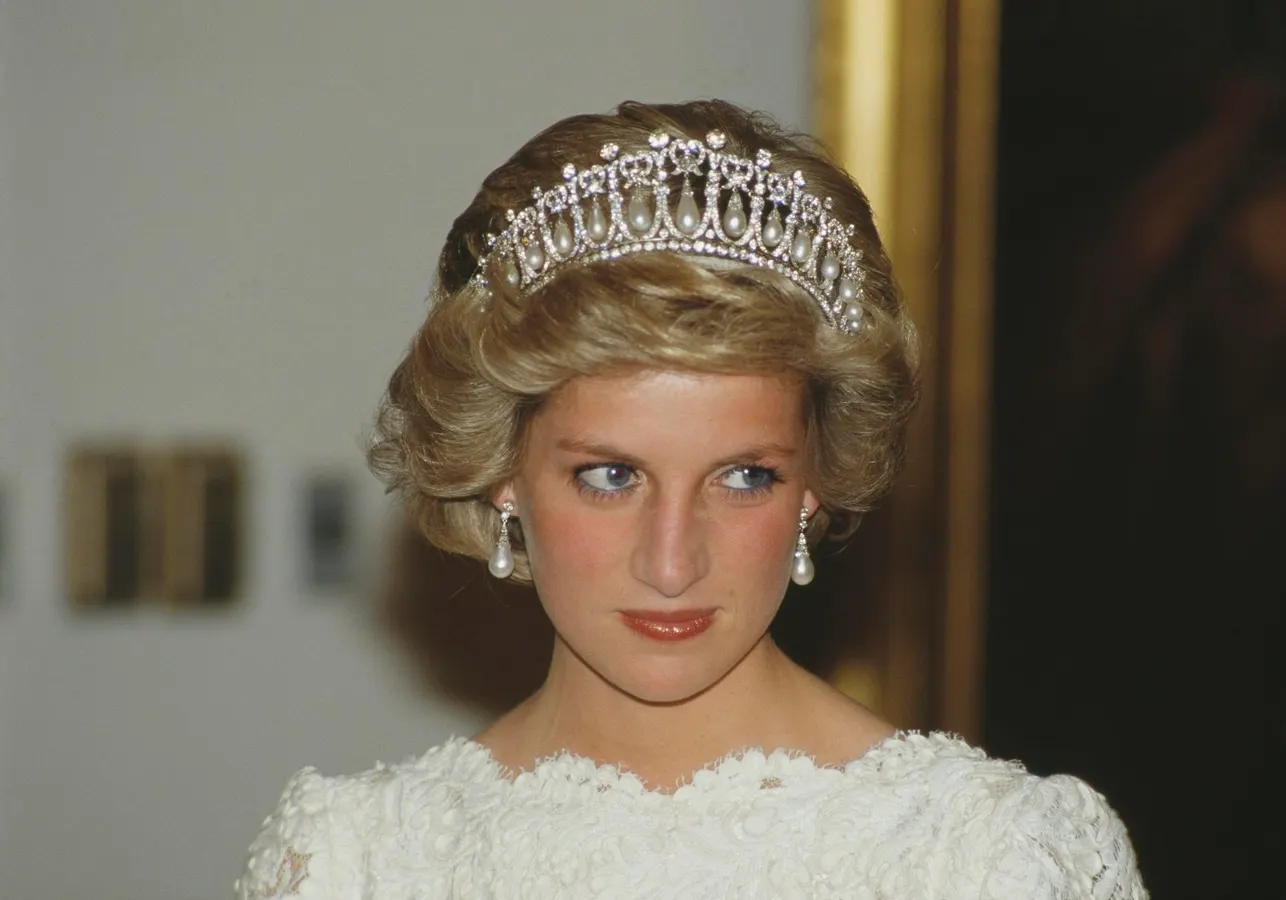
For young women who did not live through the Diana years, her life offers an enduring lesson: find yourself before you find your prince.

Diana, Princess of Wales (1961 – 1997) attends a dinner at the British Embassy in Washington, DC, November 1985. She is wearing an evening dress by Murray Arbeid and the Queen Mary tiara. (Photo by Terry Fincher/Princess Diana Archive/Getty Images)
Getty Images
I was in the eighth grade, preparing to enter high school, when Lady Diana Spencer married Prince Charles.
Some of the girls from my junior high softball team spent the night at our house because we had the big television—the kind not every family had in 1981. My mother woke us at around five o’clock in the morning so we could watch the royal wedding live from London.
She made tea and crumpets, little tea sandwiches and all kinds of treats. We gathered around that television, sleepy and excited, waiting to see the prince, the carriage and the beautiful young woman in the enormous ivory dress.
There were no smartphones, no social media, and no livestreams we could replay later. There was simply the television and the shared experience of watching a real-life fairy tale unfold before our eyes.
And we believed in it.
Girls of my generation grew up with Cinderella, Sleeping Beauty, and Snow White. Cinderella was my favorite. I still may have the pop-up book somewhere. Those stories taught us that the beautiful girl endured hardship until a prince arrived, recognized her worth, and carried her into a better life.
Marriage and motherhood were presented as the destination. And let me be clear: they remain worthy and beautiful aspirations. This is not an argument against men, love or family.
But girls of my generation were taught to find the prince. We were not always taught to find ourselves first.
Sixteen years later, the fairy tale we were all sold ended tragically in a tunnel in Paris.
Reflections on The Week She Died
August 31, 1997, I was a young investigative committee counsel working on Capitol Hill. My mother—the same mother who had prepared tea, crumpets and little sandwiches for a house full of excited schoolgirls—was with me again.
Together with several of my colleagues and friends, we walked from Capitol Hill to the British Embassy on Massachusetts Avenue to sign the condolence books.
As I recall, we waited in line for nearly five hours.
The line seemed to stretch endlessly. Yet people were patient and pleasant with one another. Some spoke quietly. Some stood in silence. Some openly cried. There was none of the pushing, irritation, or restlessness one might expect from thousands of people waiting for hours.
There was simply sadness.
It was unlike anything I had ever experienced. People who had never met Diana were grieving as though we had lost someone we knew. Before smartphones and social media allowed the world to respond collectively and instantaneously, people left their homes and offices and physically gathered to mourn her.
Over 60 million Flowers covered the gates of Kensington Palace. Condolence books were filled with names and messages. Crowds assembled across Britain and outside British embassies around the world. Queen Elizabeth II addressed the nation. An estimated 2.5 billion people watched Diana’s funeral.
As I reflect on that extraordinary week now, I understand that we were mourning more than the death of a beautiful young princess.
We were mourning the death of the fairy tale.
Diana had been the living embodiment of everything girls of my generation had been taught to believe. A beautiful young woman had been chosen by a prince. She entered a palace, wore magnificent gowns and jewels, gave birth to two sons, and was expected to live happily ever after.
Instead, she was dead at 36.
The prince had not rescued her. The palace had not protected her. Beauty, wealth, motherhood, public adoration, and one of the most famous titles in the world had not guaranteed her love, security, or happiness.
That realization was devastating. But 29 years later, it also carries an enduring lesson for young women who did not live through the Diana years:
Find yourself before you find your prince.
That does not mean women should stop believing in love. It means we must stop expecting love to do the work that belongs to us.
Diana was only 36 when she died. Her divorce had been final for barely a year. She was entering a second act, discovering what her influence might become outside the monarchy and trying to build an identity that did not depend upon being the wife of the future king.
But she was still searching. Still looking for love. Still learning who Diana was when she was no longer Her Royal Highness.
There is nothing shameful about that. The desire to love and be loved is among our deepest human needs. Diana’s tragedy was not that she wanted love. It was that she had been taught, as so many girls were, to look for her value in being chosen before she had been allowed to find that value within herself.
Her unfinished life offers young women at least three enduring lessons.
Know Your Value Before The World Assigns It To You
Diana became one of the most famous women on Earth before she had fully become an adult.
The world assigned her value almost overnight. She was beautiful. Young. Aristocratic. Virginal. Suitable. She could produce an heir and a spare. She fit the role the monarchy needed her to play.
But being valued for the role you can fill is not the same as being known for the person you are.
Young women today receive their own versions of those messages. Be beautiful, but not intimidating. Be accomplished, but not too ambitious. Be desirable, but never demanding. Build the career, find the husband, become the mother, and make all of it look effortless.
Before the world tells you what makes you valuable, decide that for yourself.
Know your character. Know your gifts. Know your boundaries. Know what you believe and what you will not surrender—not for a relationship, a title, an institution or the approval of people who benefit from your silence.
Your value must be rooted in something deeper than whether someone chooses you.
Do Not Confuse Status With Power
Diana had palaces, jewels, global fame, and one of the most recognizable titles in the world. Yet for much of her royal life, she possessed remarkably little control over her own story.
A title can give a woman status without giving her agency. Wealth can create comfort without producing freedom. Public admiration can coexist with profound private loneliness.
Real power begins with the ability to make choices about your own life.
Real power begins with the ability to make choices about your own life.
That is one of the great differences between Diana and the royal women who followed her. Princess Catherine and Duchess Meghan (her daughters-in-law, and mothers of her grandchildren) entered royal life as adult women with university educations, life experience and identities formed beyond palace walls. Meghan was a millionaire in her own right at age 36 when she married Harry—the same age Diana was when she died.
That single fact tells us how much royal life, and the women who inhabit it, has changed.
Diana entered the monarchy before she had the chance to discover who she was. Meghan entered knowing who she was—and when royal life became untenable, she and Harry built a life outside it.
The lesson is not that every woman must leave her marriage or reject institutions. It is that no woman should enter either without knowing that she has a voice, choices and an identity of her own.
Let Love Add To Your Life—Not Become Its Entire Meaning
A healthy relationship should not rescue you from yourself. It should allow you to bring your whole self into partnership with another whole person.
Marriage and motherhood are beautiful aspirations. So are meaningful work, friendship, service, creativity, faith and the pursuit of purpose. A full life may hold all of these things or only some of them. There is no single formula for womanhood.
A man may love you, support you and walk beside you. But he cannot give you an identity, a purpose, or a sense of worth that you have not begun to build for yourself.
A man may love you, support you, and walk beside you. But he cannot give you an identity, a purpose or a sense of worth that you have not begun to build for yourself.
Women do not need less love.
We need love that does not require the surrender of self.
Diana was beginning to understand that. After her marriage ended, she narrowed her public work and turned her extraordinary visibility toward causes that reflected her natural compassion. She confronted the stigma surrounding HIV and AIDS. She walked through a minefield in Angola. She went and cuddled sick babies at a hospital in Harlem. She connected with people whom the powerful often overlooked.
The monarchy had given Diana a platform. But her humanity was what gave that platform meaning.
Her second act had begun. Tragically, she did not live long enough to finish it.














Leave a comment