


Imagine a school where learning regularly happens beyond classroom walls, with forests, fields, and seasonal change used as part of the curriculum. Students read nonfiction texts about biodiversity beneath a tree canopy, study local wildlife adaptations in science, and practice fractions and decimals using real data from a campus weather station.
For many of us, this feels far removed from the school experiences we’re used to, where time outdoors—for learning or play—is limited.
I first heard this approach described by Jay Renfro, the founder and executive director of Tennessee Nature Academy (TNA), at Tennessee SCORE’s Connecting the Dots Symposium, and it immediately caught my attention. It spoke to questions many of us are asking about engagement, well-being, and how children learn best—questions that feel increasingly personal to me. As a grandfather to nine children between the ages of four and thirteen, I think often about what kind of learning environment will shape not only their intellect, but their character and resilience. And as a physician, I know how profoundly environment influences long-term physical and emotional health. My curiosity led me to visit the school recently.

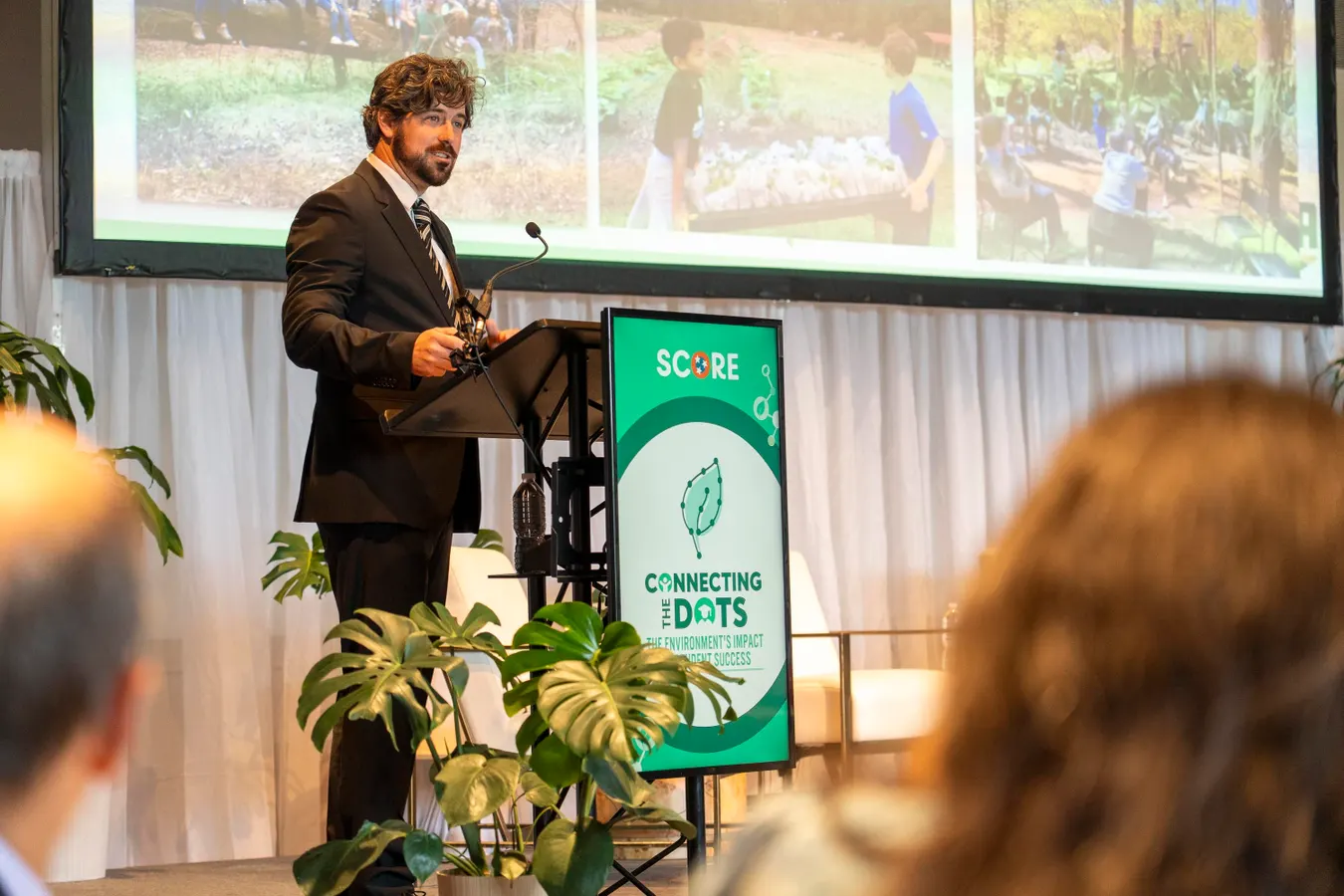
Jay Renfro shares about Tennessee Nature Academy’s unique learning model at SCORE’s Connecting the Dots Symposium in Nashville.
Tennessee SCORE / Mark Mosrie 2025
TNA is a free, nature-based public charter school serving a diverse student population in Southeast Nashville. The model grew out of Renfro’s experience leading an outdoor program at his previous school, where he saw students become more joyful, focused, and engaged. Convinced this approach shouldn’t be reserved just for enrichment or for families who can afford private options, he set out to build a full public school around it.
Opened in 2023, TNA is guided by a simple mission: to cultivate happy, healthy young people who are knowledgeable about the world around them, passionate about the outdoors, and motivated to do meaningful work. During my visit, I saw that mission come to life.
What “Nature-Based” Looks Like in Practice
At TNA, nature is at the center of how the entire school operates.
Students spend at least an hour outside every day, year-round, in unstructured play, exceeding Tennessee’s new recess requirements. Academic classes are also taught outdoors in spaces like the Forest Learning Lab, where lessons are grounded in observation and direct experience. Students extend that learning through projects tied to conservation, agriculture, and land stewardship.
When students describe what stands out most, they point to immersive experiences: fishing on a camping trip, harvesting sassafras to make root beer, or traveling to Illinois to witness a total solar eclipse. These moments support students’ physical, emotional, and social growth.
Research helps explain the impact. Time outdoors is linked to stronger attention, improved emotional regulation, and higher academic engagement. Environmental neuroscientist Marc Berman’s work shows access to green spaces supports cognitive development and self-control, especially for students under stress. In medicine, I’ve seen how environment influences both short and long-term health; seeing those insights applied so intentionally in a school setting was striking.
TNA also incorporates daily practices designed to shape who students become, reinforcing core values of resilience, connectedness, sustainability, and awareness of impact. Here, nature strengthens learning and character at the same time.
Building Resilience and Awareness of Impact
That purpose is easy to see in the art classroom, where shelves are lined with student-made clay sculptures of crayfish. Middle school art teacher Mr. Weeks explained that the project begins outdoors, in local rivers in the Mill Creek watershed—home to the endangered Nashville crayfish. Students wade in to harvest clay using Indigenous techniques, then bring it back to school to test, refine, and transform it.
TNA art teacher Mr. Weeks describes how students use native river clay to connect art and place.
TNA art teacher Mr. Weeks describes how students use native river clay to connect art and place.
Bill Frist, MD
As chair of the global board of The Nature Conservancy, I spend much of my time thinking about how we cultivate the next generation of environmental stewards. Through my conservation work, I’ve learned that care for ecosystems is rarely taught through abstraction; it grows from direct, lived experience like this. Paired with conservation research, this project asked students to persist through messy, demanding work while helping them examine how human choices shape the natural world and communities. Resilience and awareness of impact were built into the process.
The same approach runs throughout the day. With significant time spent outdoors in unstructured settings, students face challenges that can’t be smoothed away. At a moment when many children have fewer opportunities for unstructured play—something social psychologist and author Jonathan Haidt notes is essential for learning conflict resolution—adults at TNA step back, giving students room to navigate disagreement, collaboration, and repair.
As students get older, additional experiences push students beyond their comfort zones. Phone-free overnight campouts and a seven-and-a-half-mile trek at Fall Creek Falls help them discover what they’re capable of.
Fostering Connection in a Disengaged Generation
Renfro often describes today’s students as “the most disconnected generation that has ever walked the Earth.” Rebuilding connection—to learning, to one another, and to the natural world—is central to TNA’s design. I saw that clearly in the Forest Learning Lab.
Ms. Bourlas guides the class through a discussion where they work to identify leaves in TNA’s Forest Learning Lab.
Bill Frist, MD
Ms. Bourlas guides the class through a discussion where they work to identify leaves in TNA’s Forest Learning Lab.
Led by two fifth graders, Jackson and Ethan, I followed a wooded path to a white tent tucked among the trees. Inside, students were studying grade-level science standards on photosynthesis and seasonal change as part of their project-based Nature Explorations course. Guided by Ms. Yarden Bourlas, they examined plants growing around them, identified edible species, and discussed how vegetation adapts to Tennessee’s soil and climate. I joined in—sharing what I knew about river cane, wild ramps, and making sorghum—and was struck by how focused and present the students were.
TNA fifth graders Jackson and Ethan lead the way to the school’s outdoor classroom.
Bill Frist, MD
That presence contrasts national trends. Roughly 40 percent of Gen Z K–12 students say what they’re learning doesn’t feel interesting or important, while children now spend more than seven hours a day on screens outside of schoolwork—often at the expense of outdoor time, and with real consequences for attention and emotional regulation.
TNA has responded intentionally. The school adopted a phone-free policy well before it was required by state law. Having served in the United States Senate, I understand how slowly policy often moves. What struck me here was that the school did not wait for mandates. It acted based on what it believed was best for children. Ms. Jabasini, a paraprofessional who works closely with students with disabilities, described the shift simply: “Our students have extremely rare opportunities to disconnect from the online world. They’re developing strong social skills, imaginations, and character traits.”
Designing for Sustainability
Sustainability at TNA extends beyond environmental stewardship, though that remains visible through practices like recycling and plans for composting and beekeeping on the future campus. More fundamentally, sustainability here means designing a school that enables students and educators to thrive.
That focus responds to real pressures. Nearly one-third of U.S. teens report that anxiety and depression are common at their school, and nearly half of new teachers leave the profession within five years. Supporting well-being has become one of public education’s central challenges.
At TNA, sustainability shows up in the daily rhythm. Students meet high expectations, but with regular 15-minute breaks built into the schedule. “We get mental breaks and go outside between classes,” seventh grader Aliyah told me. “It’s really calming.”
For teachers, communication is streamlined, class sizes are manageable, and the calendar includes built-in time for rest and reflection. The result: 100 percent teacher retention in the school’s first year. As Ms. Yarden Bourlas put it, “Joining the founding team at TNA has been the most inspiring and vitalizing career decision I have made.”
Preparing Students for What Comes Next
Their nature-based approach is also preparing students for a workforce increasingly shaped by climate change and sustainability. Beginning next year, all ninth graders will take an agriscience course that fulfills Tennessee’s lab science requirement, introducing food systems through hands-on learning. From there, students can pursue pathways in agribusiness, animal science, and natural resource stewardship—moving steadily from play-based learning into work-based learning.
Those pathways will take shape on a donated 23-acre campus near a park. With forest, wetlands, and farmland, the site will support a schoolyard farm, beehives, and outdoor learning spaces where students grow food and manage resources. Standing there at the end of my tour, I could easily imagine the learning ahead. As Renfro put it, the goal is simple: connect learning to real work, in real places—so students graduate with practical skills and an understanding of the systems they will be asked to steward.
Renfro shares the vision for TNA’s future campus during our construction site visit.
Bill Frist, MD
Where Schools Can Start
TNA offers a full-school model, but schools don’t need to replicate it to benefit from nature-based learning. Many of the most impactful shifts are simple and within reach.
A few places to begin:
- Protect time for unstructured outdoor play. Treat outdoor play as part of learning, not a break from it. Time to explore builds resilience, social skills, and self-regulation.
- Use the spaces you already have. Hold lessons outside when possible. Schoolyards, courtyards, and nearby green spaces can become classrooms for science, writing, art, or social studies.
- Build partnerships. Local parks, environmental organizations, and outdoor learning institutes, like the Great Smoky Mountains Institute at Tremont, can provide training, curriculum, and support.
My visit reinforced something easy to forget: the natural world is one of the most powerful learning tools we have. When schools make space for students to move, observe, and experiment outdoors, they rediscover curiosity and agency. Teachers regain joy and purpose. And schools take a meaningful step toward reconnecting young people to learning, to one another, and to the world around them. For my grandchildren, and for communities across Tennessee, that reconnection may be one of the most important investments we can make.













Leave a comment