


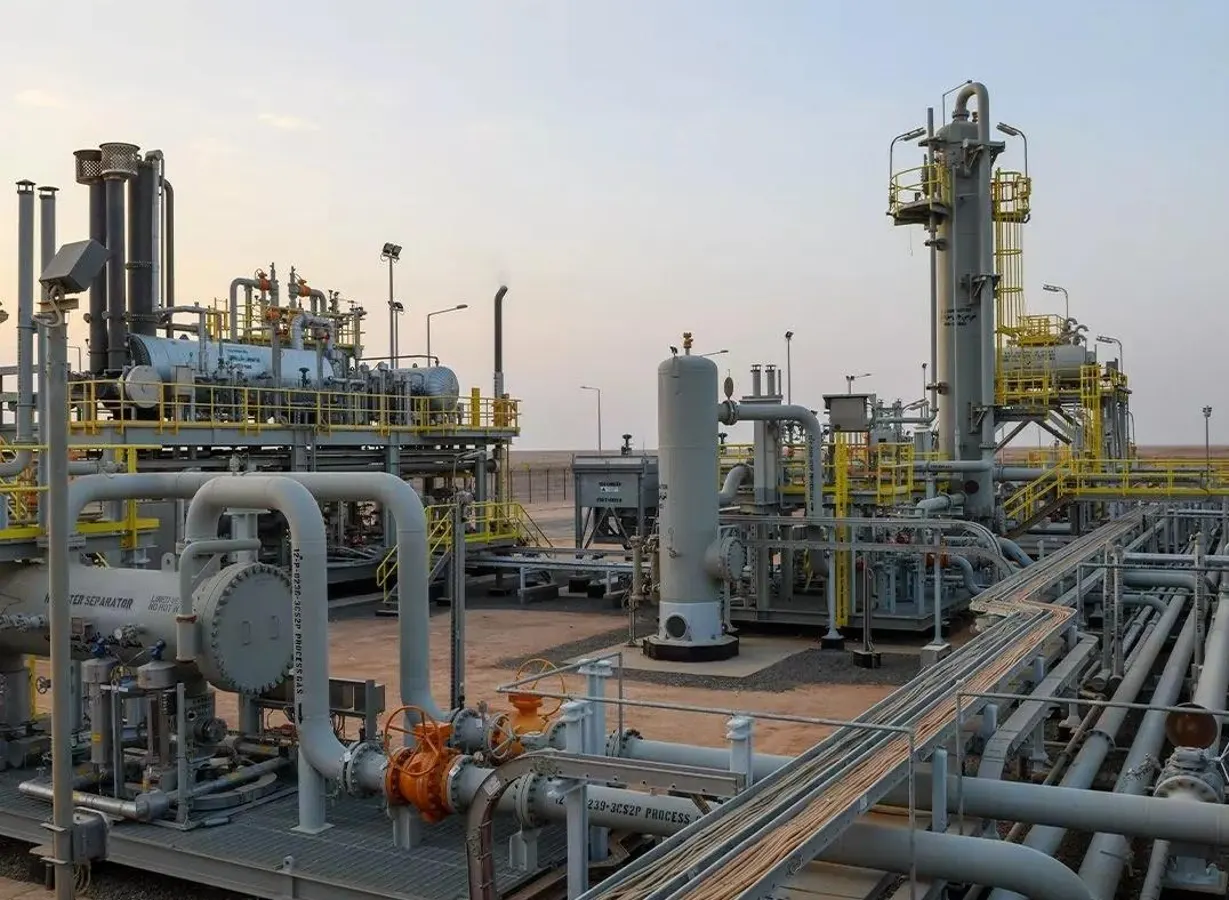

Production facilities at Saudi Aramco’s Jafurah gas field – one of the largest liquid-rich shale gas fields in the Middle East and a part of the Kingdom’s evolving energy landscape.
Saudi Aramco
Energy leaders in the Middle East – widely acknowledged as major oil producers – have been shifting their attention as well as petrodollars to natural gas in recent years.
In a post-Covid world, the initial idea behind this unsubtle shift at the turn of the current decade might well have been to deploy more natural gas in domestic markets to power critical services. These include water desalination, manufacturing, petrochemical industries and diversification to a digital economy banking on artificial intelligence and hyperscale data centers.
But the Iran War, which began on February 28, and the disruption of energy cargoes in the key maritime artery of the Strait of Hormuz, brought another dimension into sharp focus – guaranteeing energy security.
Increasing natural gas investments in a post-Iran War region is being targeted toward domestic infrastructure, storage expansion, and the exploration of alternative export routes to counter regional shipping blockades and supply shocks.
This investment drive is being led by the region’s three major powerhouses – Saudi Arabia, United Arab Emirates and Qatar.
The Big Three Take Charge
Energy infrastructure and cargoes of all three were targeted by Iran during the war and its their investments that have been the boldest in the face of turmoil. And while the pace and scale of planned investments may have picked up, the policy initiatives for doing so were in place well before war broke out between the U.S. and Iran that brought unanticipated turmoil to the region.
These include Saudi Arabia’s 2030 vision, UAE’s 2050 Net Zero strategic initiative and Qatar’s clean LNG infrastructure plan. The execution of the energy aspect of each nation’s policy rests with state-owned energy companies Saudi Aramco, ADNOC [“Abu Dhabi National Oil Company”] and QatarEnergy respectively.
Saudi Aramco is investing billions in natural gas to expand domestic supply, lower local oil burning, and grow its international footprint by boosting its production capacity by roughly 80% by 2030, compared to 2021 levels.
The development of its flagship Jafurah gas field is expected to be a major part of that journey. It is one of the largest liquid-rich shale gas fields in the Middle East and the centerpiece of Saudi Arabia’s journey to producing more than 16 bcf/d within five years from a current production level 10 bcf/d.
The $100 billion-plus gas project is estimated to contain 229 trillion standard cubic feet of raw gas and 75 billion of condensate. Alongside Jafurah, the company is also “putting in place the infrastructure required to access new unconventional reserves in fields such as North Arabia and South Ghawar.”
Meanwhile, ADNOC made two eye-catching moves in July in quick succession. On July 6, the company launched its own global LNG marketing and trading platform.
Targeting 47 million tonnes per annum of combined marketable LNG by 2035, ADNOC’s platform will rank among the leading global LNG players to optimize its growing LNG portfolio and Abu Dhabi’s position as a global energy trading center.
Just a few weeks later, on July 21, it reached a $6.2 billion final investment decision on Umm Shaif Gas Cap to unlock more than 600 million cf/d of natural gas and associated gas liquids, equivalent to almost 10% of the UAE’s current daily gas consumption.
A truck drives past an ADNOC Gas facility in Abu Dhabi. (Photo: Ryan Lim)
AFP via Getty Images
It is the country’s longest-operating offshore field that will now see a 14-well drilling program. ADNOC’s project partners include TotalEnergies, Eni and China National Petroleum Corporation with production expected by 2030. Both moves, while amplifying the UAE’s role as a global energy supplier, will likely reinforce the its energy security.
QatarEnergy, for its part, is in repair and restore mode with its LNG facilities having been targeted by Iran in the initial stages of the war.
These include repairs to two out of 14 liquefaction trains at its Ras Laffan LNG complex which could take three to five years, and cost up to $20 billion, according to Saad Sherida Al Kaabi, Qatar’s minister of energy and CEO of QatarEnergy. It has also resumed work on its North Field LNG expansion targeting a doubling of output from the field.
A Matter Of Timing In A Changed Landscape
While QatarEnergy’s moves are all about getting its product volumes back as the world’s second-largest LNG exporter after the U.S., for Saudi Aramco and ADNOC it appears to be as much about export potential as it is about using gas strategically for domestic ends and building resilience.
With multibillion dollar investments in the frame, what senior executives of all three and their international partners say at Gastech, one of the world’s largest summits in the natural gas industry’s calendar due to be held in September, will likely be keenly anticipated by the wider market.
That’s because global energy markets and natural resource supply chains are at a critical inflection, and targeted investments by the Middle East’s energy leaders will have wider ramifications, according to Wood Mackenzie.
To quote Dr. Sultan Ahmed Al Jaber, UAE’s Minister of Industry and Advanced Technology and ADNOC’s CEO, the core idea in a changed energy market that has seen considerable turmoil is to “unlock lasting value” for his country, the region and its customers.
“ADNOC is accelerating its integrated gas strategy to further harness the UAE’s vast gas resources and expand our global LNG platform, as global demand for natural gas continues to rise.”
Unsurprisingly, the International Energy Agency forecasts more of the same from the Middle East’s energy leaders whose priorities are visibly shifting toward building resilience, furthering of domestic energy resources, and, of course, export diversification.
Furthermore, the IEA expects investment in natural gas to reach $330 billion in 2026. That would be a high mark for the industry in a decade, and one that’s driven partly by the deployment of artificial intelligence and rising numbers of hyperscale data centers. But also predicated on building resilience.
And even if traffic through the Strait of Hormuz returns to normal, the security concerns exposed by the crisis are likely to influence natural gas investment decisions for years to come.
Disclaimer: The above commentary is meant to stimulate discussion based on the author’s opinion and analysis offered in a personal capacity. It is not solicitation, recommendation or investment advice to trade oil stocks, futures, options or products. Oil markets can be highly volatile and opinions in the sector may change instantaneously and without notice.










Leave a comment