


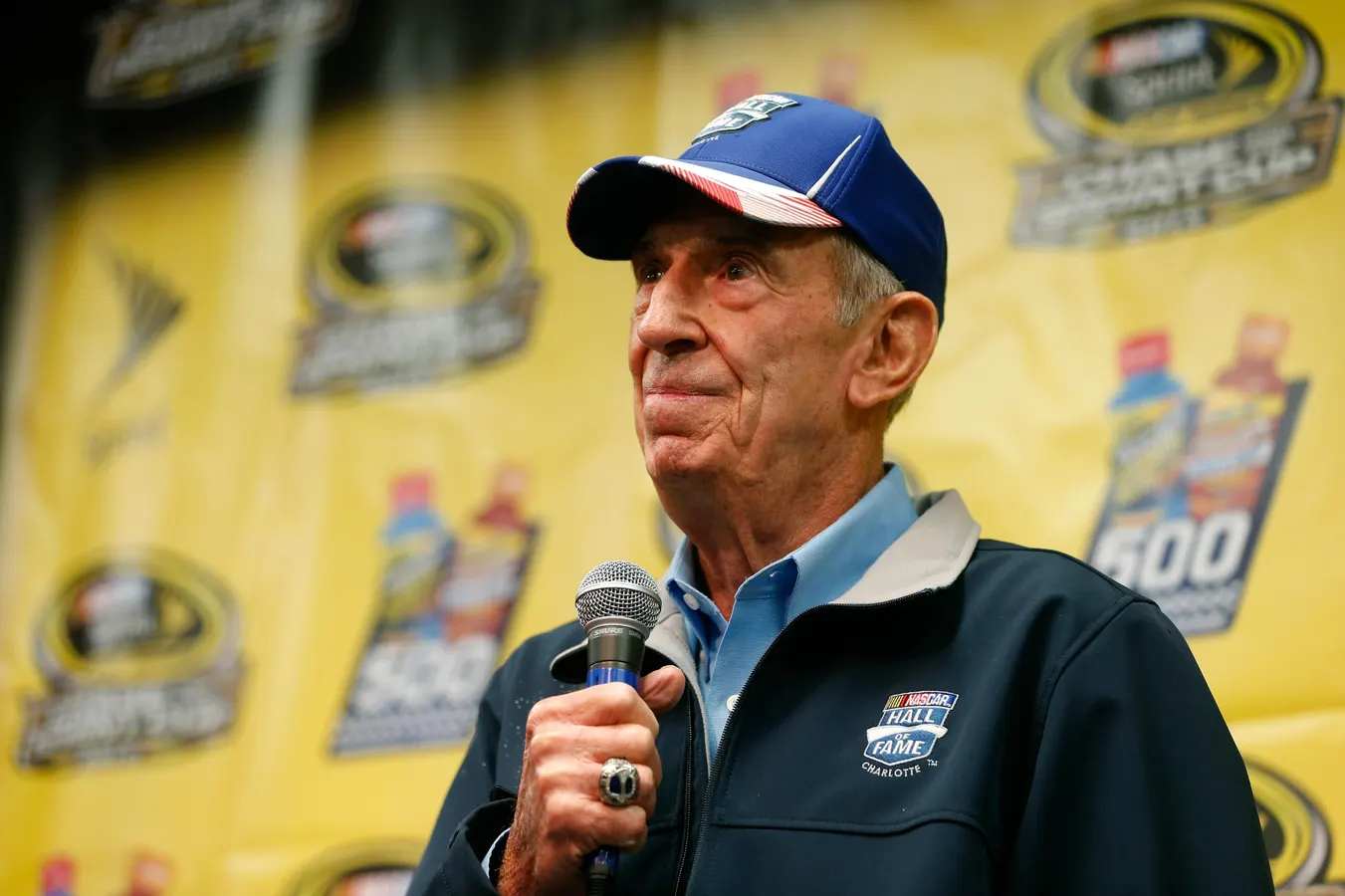

MARTINSVILLE, VA – NOVEMBER 01: NASCAR Hall of Famer Ned Jarrett speaks with the media during a press conference prior to the NASCAR Sprint Cup Series Goody’s Headache Relief Shot 500 at Martinsville Speedway on November 1, 2015 in Martinsville, Virginia. (Photo by Brian Lawdermilk/NASCAR via Getty Images)
NASCAR via Getty Images
When the story of a professional American sports league is written, each chapter contains the stories of those who have left fingerprints on its evolution. In NASCAR, few fingerprints are more visible than those of Ned Jarrett.
NASCAR’s tale contains the stories of champions, broadcasters, and ambassadors. Ned Jarrett was all three. His name appears in pages chronicling the early days of the sport, the years when television brought the sport to the masses, explaining stock car racing to generations of new fans, and in the modern era serving as an example for modern drivers and broadcasters to follow.
Ned Jarrett died this week at age 93.
The native of Newton, North Carolina started racing as more of a hobby than a career. Legend has it he won his first racecar in a poker game. And after spending time in the lower tier Sportsman series, he wanted to move up to the Cup series, then known as the Grand National Series, but had to do it all on his own.
He needed a car to race, a team was building a car for another NASCAR legend, Junior Johnson, and were willing to sell it: for $2000.
DARLINGTON, SC: Ned Jarrett straps on his helmet as he prepares for a practice session for the Rebel 300 NASCAR Cup race at Darlington Raceway. (Photo by ISC Images & Archives via Getty Images)
ISC Archives/CQ-Roll Call Group via Getty Images
“I went down to the shop the next Saturday morning, said I’ll write a check for it.” Jarrett said during his NASCAR Hall of Fame induction press conference in 2011. “I said, When the bank closes Friday, I’ll write them a check, take off to Myrtle Beach, there was a hundred-mile race, pays $950 to win.
“There was another race on Sunday afternoon in Charlotte, that pays $950 to win. That’s $1900. I can cover that check on Monday morning.
You can’t be foolish enough to try that, but I did… I was cocky enough to believe if Junior Johnson could win races in that car, I could, too. I did that. Bargained for not only the car, but also I got the truck and trailer they hauled it on, got the pit equipment and their two mechanics to go with me that weekend all for $2,000 and an extra set of tires. We were able to pull it off.”
Pull it off, he did. Jarrett would go on to score 50 wins, 51 if you count a 1959 win in the convertible series. He won his first NASCAR Cup series championship in 1961, the second in 1965, the same season of perhaps his most famous victory, at Darlington Raceway, where he won 14 laps ahead of the rest of the field, a record that still stands today. But 1965 was also the same year he broke his back in a crash at Greenville-Pickens Speedway. An injury that would force him into retirement at age 32 the following year.
1965: Ned Jarrett poses during the NASCAR Cup season in the Bondy Long-owned Ford. Jarrett took his second NASCAR Cup title, winning 13 of 54 races, and scoring 45 top-10 finishes. All of his victories came on short tracks, with the exception of the Southern 500 at the Darlington (SC) Raceway, a win that Jarrett considers the biggest of his career. (Photo by ISC Images & Archives via Getty Images)
ISC Archives/CQ-Roll Call Group via Getty Images
During his career behind the wheel, Jarrett cultivated a reputation as a gentleman driver — quiet, non-confrontational and relentlessly determined. After leaving the car, he transitioned first to radio and then television. There, alongside broadcasters such as Ken Squier, he helped make NASCAR understandable to casual viewers at a time when the sport was beginning to reach beyond its Southern roots.
His most famous call came at the end of the 1993 Daytona 500. Late in the race, his youngest son Dale took the lead from Dale Earnhardt.
“C’mon, Dale, go baby, go,” the elder Jarrett said on the broadcast as Squier and Neil Bonnett went silent. “… Don’t let him get to the inside of you coming around this turn. Here he comes, Earnhardt; it’s the Dale and Dale show as they come off Turn 4.
“You know who I’m pulling for, it’s Dale Jarrett. Bring her to the inside, Dale, don’t let him get down there. He’s gonna make it! Dale Jarrett’s gonna win the Daytona 500! Alright!”
Auto Racing: NASCAR Daytona 500: Dale Earnhardt (3) in action vs Dale Jarrett (18) during race at Daytona International Speedway. Daytona, FL 2/14/1993 CREDIT: Bill Frakes (Photo by Bill Frakes /Sports Illustrated via Getty Images) (Set Number: X43963 TK1 R1 F11 )
Sports Illustrated via Getty Images
It remains one of the most memorable moments in NASCAR broadcasting history — a father momentarily forgetting he was supposed to be an analyst and reminding everyone he was still a dad.
Jarrett stepped away from the full-time television grind in 2000. His final appearance in a broadcast booth came in 2017 as part of a throwback broadcast at Darlington Raceway.
Named one of NASCAR’s 50 Greatest Drivers in 1998, Jarrett was inducted into the second class of the NASCAR Hall of Fame in 2011. By then, his place in the sport’s history had long since been secured.
In his later years, Jarrett largely stepped away from the spotlight. It was a well-earned retirement for a man who had spent decades helping build the sport from both behind the wheel and behind the microphone.
Unlike the sudden losses that sometimes jolt a sport—most recently Greg Biffle and Kyle Busch—Jarrett’s passing feels more like the closing paragraph of a remarkably long chapter. He lived nearly a century, witnessed NASCAR’s transformation from a regional curiosity into a major American sport, and with his final chapter now complete, the gentleman driver now becomes part of the story he helped write.
CHARLOTTE, NC – JANUARY 28: NASCAR Hall of Famer Ned Jarrett (left) talks with his son and NASCAR Hall of Fame inductee Dale Jarrett during NASCAR Sprint Media Tour at the NASCAR Hall of Fame on January 28, 2014 in Charlotte, North Carolina. (Photo by Jared C. Tilton/NASCAR via Getty Images)
NASCAR via Getty Images
Championships eventually become statistics. Television broadcasts fade into archives. Race cars become museum pieces.
But the people who help shape a sport’s identity endure long after all of them are gone.
For more than six decades, Ned Jarrett helped define what NASCAR was, what it became, and how generations of fans came to understand it. Few figures in the sport’s history can claim a broader impact, or a more lasting one.
He arrived when NASCAR was still finding its footing. He lived long enough to watch it become a major American sport. And in more ways than one, he helped make that happen.
We should all be so lucky.
















Leave a comment