


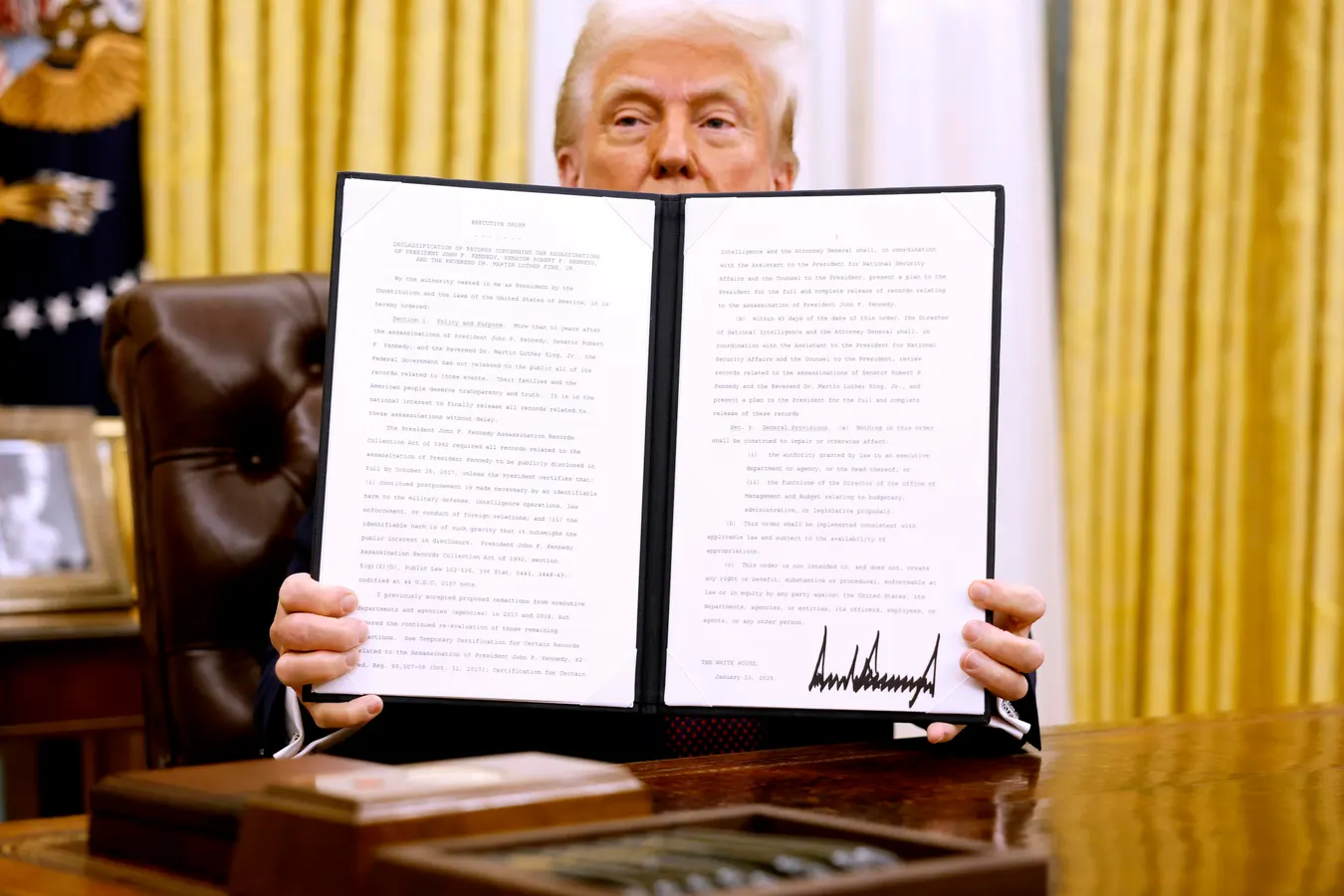

Beyond pardoning those convicted for actions associated with January 6, President Trump has relatively few pardons to his second administration. While he has been different about granting clemency early in his term, those have been plagued with backlash on a pay-for-play to get those pardons … but does that tell the whole story?
Getty Images
CBS’s 60 Minutes recently examined what it called the “pardon economy,” looking at lawyers, lobbyists and self-described pardon brokers charging enormous sums to people hoping to obtain presidential clemency. The program described a world of high fees, access and promises, with no guarantee that anyone can deliver the one thing the client wants, the signature of the President of the United States.
There is good reason to scrutinize this business. Nobody should be able to buy a presidential pardon and by all accounts that is not happening within the administration. Anyone who suggests that payment guarantees clemency deserves scrutiny, particularly when desperate families may be willing to spend their life savings believing that someone has special access to the White House. This is particularly true for those who are seeking a commutation to cut their sentence while they are in prison.
But focusing exclusively on the people charging large fees misses a more fundamental problem. Why has access become so valuable in the first place?
The answer is uncomfortable. The presidential clemency process does not provide most applicants with a reliable path to get a deserving case before the one person who can grant relief. The application is not necessarily the hardest part. Getting someone with credibility and access to champion the case is.
The Founders Expected Presidents To Use Clemency
The pardon power is not a loophole in our criminal justice system. It is part of the constitutional design.
Article II, Section 2 gives the President the power to grant reprieves and pardons for federal offenses, except in cases of impeachment. The power has roots that predate the Constitution, but the Framers deliberately placed it in the hands of the President.
Alexander Hamilton defended the power in Federalist No. 74, arguing that criminal law needed what he described as “easy access to exceptions in favor of unfortunate guilt.” He understood something that remains true more than two centuries later. A system of laws can produce a lawful result that nevertheless deserves mercy.
Purpose
A commutation can correct a sentence that, with the passage of time, appears excessive. A pardon can recognize that someone who committed a crime, accepted the consequences and rebuilt his or her life should not necessarily carry the full burden of that conviction forever. Clemency can also address exceptional circumstances that courts, prosecutors or Congress could not have anticipated.
Accountability matters, victims matter and the rule of law matters. But mercy has always been part of justice too.
That principle becomes particularly important when we consider the thousands of people who have left federal prison and done precisely what society asked of them. They served their sentences. They returned home. They found jobs. They raised children. They paid taxes. They volunteered. They stayed out of trouble. They became productive members of their communities.
At some point we must decide what we mean when we talk about rehabilitation and second chances. If someone can serve a sentence, transform his life and live productively for decades, there ought to be a realistic mechanism for the government to recognize that transformation. If we tell people to accept responsibility, serve their sentences and become good citizens, there should be circumstances in which the government recognizes that they succeeded.
The Numbers Show The Problem
The Department of Justice’s own statistics demonstrate the enormous mismatch between applications and relief.
During President Obama’s eight years, DOJ recorded 3,395 pardon petitions and 33,149 commutation petitions received through its process. There were 212 pardons and 1,715 commutations granted through that system, many addressed long prison terms for drug crimes. During President Trump’s first term, DOJ recorded 1,969 pardon petitions and 10,109 commutation petitions received, with 144 pardons and 94 commutations granted through the traditional process. President Biden’s term similarly generated thousands of applications. These statistics do not include every form of categorical clemency or every grant handled outside the traditional Office of the Pardon Attorney process, but they demonstrate the scale of the demand.
The backlog has since become even more striking. DOJ’s fiscal year 2027 budget materials state that the Office of the Pardon Attorney had more than 19,000 pending applications as of March 2026.
For an applicant, “pending” can mean waiting while having little understanding of whether anyone close to the President will ever hear the story. DOJ’s public case status system itself says that when a case is pending, the petition is under review and details about that review cannot be shared.
That is where access becomes important.
Who Gets Into The Room?
Consider some of the most recognizable clemency cases of recent years.
President Joe Biden pardoned his son Hunter Biden in December 2024. Hunter Biden did not have an access problem. His father was the President. Biden said that he believed his son had been selectively and unfairly prosecuted and issued a full and unconditional pardon covering federal offenses during a period extending from January 2014 through December 2024.
Scooter Libby was another prominent Washington figure. He had served as chief of staff to Vice President Dick Cheney and held senior positions at the State Department, Defense Department and White House. President George W. Bush commuted Libby’s prison sentence, and President Trump later issued him a full pardon in 2018.
These examples do not establish that either grant was improper. Presidents possess extraordinarily broad constitutional authority to grant clemency. They do, however, illustrate an obvious reality, which is prominent people and people connected to powerful institutions have ways of getting their cases noticed. Most current and former federal inmates do not.
Alice Marie Johnson demonstrates the importance of advocacy from another direction.
Johnson was serving a life sentence when Kim Kardashian began publicly advocating for her. Kardashian met with President Trump at the White House in May 2018 and discussed Johnson’s case. Trump commuted Johnson’s life sentence days later. In 2020, he granted Johnson a full pardon.
Johnson had previously been denied clemency during the Obama administration. Her circumstances had not suddenly materialized when Kardashian walked into the White House. What changed was that someone with a national platform had the ability to put her story before people who could act on it.
Advocacy Is Not The Same As Buying A Pardon
There is a difference between paying someone to prepare and advocate a clemency case and paying someone who claims he can deliver a pardon because of political connections.
The first is a legitimate professional service. Attorneys, consultants and advocates are routinely paid to present matters to government officials. They research facts, obtain records, interview witnesses, prepare applications and explain why their client deserves relief.
The second becomes troubling when someone implies that money purchases presidential action.
60 Minutes was right to examine that world. A person seeking clemency is unusually vulnerable. A prisoner or former prisoner may believe a pardon is the last opportunity to reclaim a career, professional license or reputation. Families seeking a commutation may believe it is their only chance to bring someone home. That desperation can create a market for exaggerated claims of influence.
But eliminating pardon brokers would not eliminate the underlying demand for access. The demand exists because there are thousands of applicants and only one President.
Organizations Can Help Bridge The Gap
This is where organizations devoted to identifying and publicizing clemency cases can play a useful role. For years, Amy Povah, who also received a Presidential Pardon (Clinton) ran CAN-DO Foundation; Clemency for All Nonviolent Drug Offenders. She helped dozens of people sincer her own pardon.
Cynthia Hughes did not go to prison but her nephew went to prison for participating in the January 6 events at the Capitol. Hughes was instrumental in helping the nearly 1,700 defendants get clemency under President Donald Trump. She has now started an organization called Weaponization Watch that gives applicants and their families an opportunity to tell their stories and draw attention to cases they believe warrant review.
Hughes told me, “There are thousands of people seeking clemency whose names and stories may never rise above the enormous volume of applications. They are ordinary Americans without celebrity friends, powerful connections or enormous financial resources, and they need a voice loud enough to make sure they are seen and heard.”
The Kind of Case Pardons Were Made For
Jeremy Harrell’s case illustrates why the pardon power should not be viewed only through the lens of wealthy applicants and well connected pardon brokers. Harrell is a U.S. Army combat veteran who served more than eight years, including deployment to Iraq during the 2003 invasion. After leaving the military, he devoted much of his life to helping other veterans, eventually founding Veterans Club Inc., a nonprofit assisting veterans struggling with PTSD, homelessness, mental health challenges and substance abuse. He took no salary from the organization.
Harrell was convicted in 2024 of theft of government funds involving VA disability payments and served his sentence at Federal Prison Camp Ashland, leaving prison in June 2025. He was ordered to pay $207,000 in restitution and has already paid more than $90,000.
His life after conviction is also part of the story. Harrell voluntarily completed intensive programs addressing trauma, emotional regulation and post traumatic growth, while continuing his work with veterans. A pardon would not erase what happened. It would recognize what came before and what has happened since. Cases like Harrell’s demonstrate an important purpose of clemency: allowing a President to look beyond a conviction and consider the totality of a person’s life.
Fix The Process, Not Just The Optics
The current debate risks becoming too simple.
Those with financial means are paying lobbyists. Lobbyists claim access. Therefore the problem is people paying for pardons. That may describe part of the problem, but not all of it.
The more important question is why a market for presidential access became so valuable.
A functioning clemency system should identify compelling cases, verify the relevant facts, obtain appropriate input from prosecutors, victims and other stakeholders, and move deserving applications through a process capable of putting them before presidential decision makers within a reasonable period.
It should not require knowing a celebrity. It should not require knowing someone in the White House. And it certainly should not require believing someone who claims that a large check can buy a presidential signature.
Hughes expanded on the current controversy around pardons saying, “There is much work to be done in the quest for mercy. But one thing should be absolutely clear: nobody can guarantee a presidential pardon, nobody can buy a presidential pardon, and no desperate family should ever believe they must pay enormous sums of money simply to have their loved one’s story heard. Mercy should never become a marketplace.”













Leave a comment