


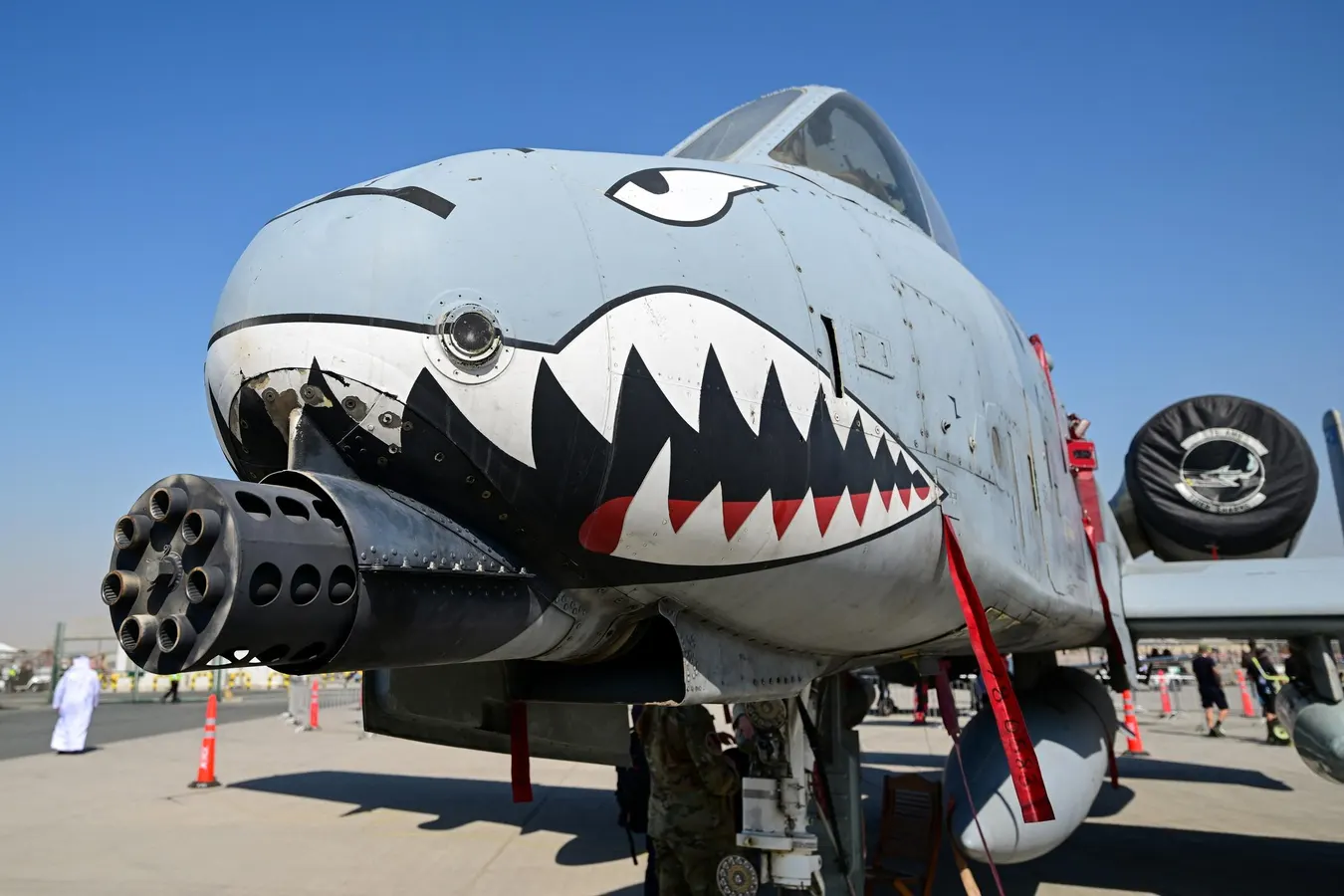

An A-10 Thunderbolt II is displayed at Al-Maktoum International Airport during the Dubai Airshow 2025 in Dubai on November 20, 2025. (Photo by Giuseppe CACACE / AFP) (Photo by GIUSEPPE CACACE/AFP via Getty Images)
AFP via Getty Images
Recently scheduled for complete retirement by the end of this decade, the Fairchild Republic A-10 Thunderbolt II, dubbed the “Warthog,” once again put its unique capabilities on display in combat during the Iran war. Aside from the tank-busting plane performing a maritime role against Islamic Revolutionary Guard Corps’ fast attack boats in the Persian Gulf, the Warthog also executed its original close air support role during the rescue mission of the two downed F-15E airmen in April.
Today, the subsonic attack aircraft, which has long had both fierce advocates and critics, is expected to fly until 2030. If Congress passes a new bill, its service life could be extended until fiscal year 2033, or even FY2037, if the U.S. doesn’t develop and deploy a credible replacement close air support aircraft in the meantime.
Arguably, if it weren’t for the Iran war launched last February 28, the A-10 could have made its last flight this September, per the original timetable. The U.S. Air Force decided in April to keep the plane flying through FY2030, with Secretary of the Air Force Troy E. Meink announcing the decision in a post on X. Previously, it had been scheduled for complete retirement by the end of FY2029.
Air Force Gen. Dan Caine, chairman of the Joint Chiefs of Staff, acknowledged the significant role played by Warthogs in the Iran rescue mission. A-10s, flying in their specialized “Sandy” combat search and rescue role in coordination with other aircraft and drones, he said, “audaciously penetrated enemy territory in broad daylight” and were “violently suppressing and engaging the enemy in a close-in gunfight.”
Despite such acknowledgments of its continued relevance in modern war, TOPGUN Navy Fighter Weapons School instructor Paul “Gu$” Garcia outlined how the USAF still hasn’t met the financial commitment required for preserving the A-10’s combat power. Writing in a June editorial for The War Zone, he warned that this lack of commitment will result in an “irreversible loss of A-10 combat capability” in mere months. Without urgent action, he added, “the A-10 will transition from a combat asset to a line item waiting for liquidation.”
The author, who flew both the F/A-18 Hornet and F-22 Raptor during his career, underlined that the A-10, in service since 1977, wasn’t merely preserved out of nostalgia but rather because it has once again “proven useful in ways many planners understand.”
“Today, it provides unique value unmatched by any of its peer tactical aircraft,” he wrote. “It operates from austere locations, supports standoff and maritime strike, and validates emerging lower-cost weapons that reduces pressure on more expensive strike aircraft.”
Congressman Abe Hamadeh also wants to preserve the A-10’s combat capability and service life and introduced H.R. 9780 to the House of Representatives along with Representative Don Davis and four more lawmakers on July 20. Titled the ‘Bolstering Recognition, Resurgence, Retention, and Remembrance of the Thunderbolt Act of 2026,’ or ‘BRRRRT Act,’ in reference to the sound the powerful seven-barrel 30mm GAU-8/A Avenger autocannon the A-10 is built around makes, it defends the Warthog’s service record and lays out a comprehensive plan for keeping it in operation. If passed, the legislation would, among other things, prevent the Department of Defense from reducing the A-10 fleet below 126 fully operational aircraft from FY2027 and restore sufficient capacity to support a 126-strong A-10 fleet until at least FY2033.
BRRRRT outlines specific criteria for what would qualify as an acceptable replacement for the venerable Warthog. For one, it must resume the A-10’s primary missions, including close air support and combat search and rescue. That requirement would make it more difficult for the Air Force to argue with any credibility that the existing fighter jets from fourth-generation F-15 and F-16s to fifth-generation F-22s and F-35s could feasibly replace these primary missions of the A-10.
“Surplus A-10 aircraft may retain value for security cooperation, partner burden-sharing, contingency operations, or recoverable storage arrangements,” reads the bill. “It is possible that such aircraft could be transferred to eligible foreign partners through existing authorities, maintained in recoverable status for future foreign military sales or excess defense articles consideration, or used to support contingency basing or coalition interoperability requirements.”
On July 8, 2024, the Senate Armed Services Committee suggested that Washington could potentially transfer “retiring A-10 aircraft to Jordan” if deemed feasible. As argued here at the time, Jordan could find close air support aircraft useful in bolstering its border security against various threats.
Aside from preserving the A-10 and its capabilities, the bill calls for “a plan to carry out competitive experimentation, prototyping, and operational assessment of autonomous, semi-autonomous, artificial intelligence-enabled, and adjunct aircraft capabilities relevant to the A-10 mission set.”
Further down, it proposes: “An assessment of the applicability of A-10 operational lessons to human-machine teaming, autonomous collaborative or adjunct aircraft, artificial intelligence-enabled mission planning and targeting support, digital battlefield communications, distributed air-ground integration, and other emerging capabilities.”
Additionally, it advocates integrating “private-sector and nontraditional defense partners” for such “operational experimentation or testing using A-10 units.”
In other words, proponents of the A-10’s continued operational service don’t envisage keeping the 50-year-old aircraft flying in its original form, which it wasn’t in any case. As noted here last year, the A-10 has already seen some substantial upgrades and modifications in the first half of the 2020s. For example, software upgrades have made it compatible with the GBU-39B small-diameter bomb, which it can carry 16 at a time, enabling a plane designed for close air support to execute precision standoff strikes. It’s also compatible with the Advanced Precision Kill Weapon System, which converts small unguided 70mm Hydra 70 rockets into precision-guided munitions, of which the bulky Warthog can carry 38 per mission. Costing approximately $22,000 each, these rockets are much cheaper than most traditional PGMs. The FALCO system was also recently cleared for use on the A-10, enabling it to accurately fire APKWS rockets at drones as well as surface targets. So, while the A-10’s primary mission remains close air support, it’s been gradually gaining several secondary combat capabilities the longer it stays in service.
With the high rate of costly munitions expended during the Iran war, the Pentagon is seeking more cost-effective weapons, from drones to cruise missiles, that it can produce faster and at scale. Garcia’s observation that planners already understand that the A-10 “validates emerging lower-cost weapons that reduces pressure on more expensive strike aircraft” suggests it could partially meet such demands for more cost-effective systems.
Should the BRRRRT Act pass, these recent system upgrades and the incorporation of additional, relatively low-cost armaments likely won’t mark the last to be made to the A-10, with even a potential autonomous model in its future. And the 2026 Iran war may not go down in history as the Warthog’s last combat hurrah.















Leave a comment