


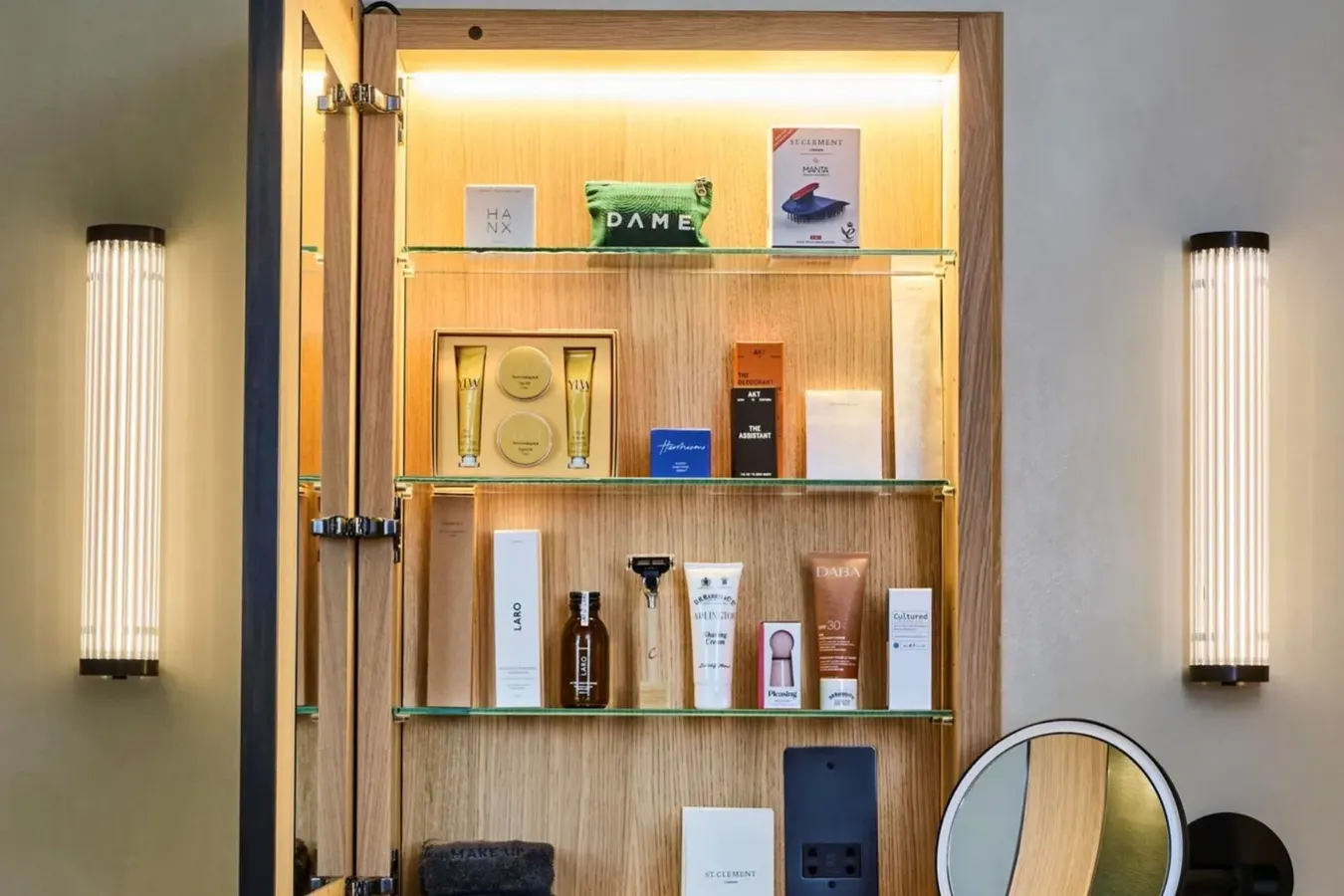

At St. Clement in London, the traditional hotel amenity cupboard becomes a cabinet of discovery, a small example of how generosity can create value long after the transaction.
St Clememt Hotel
There is something peculiarly dispiriting about arriving at an exceptional hotel, settling into a room that may have cost $1,000 a night and discovering that the bottle of water beside the bed will cost another $10. It is, quite simply, a mood killer.
Spending much of the year travelling internationally provides plenty of opportunities to experience almost every version of this. Beautiful hotels where opening the minibar feels like entering into a financial agreement; extraordinary resorts where a bottle of water beside the pool manages to irritate far beyond its actual cost. Places spend millions considering the architecture, scent, lighting, flowers, linen and service, then allow one tiny transaction to change the temperature of the experience.
Yet something interesting is happening at the other end of the spectrum. Some luxury businesses are giving more away. At London’s newly opened St. Clement, the hotel from Soho House founder Nick Jones, the minibar is included and laundry is complimentary. Its mirrored bathroom cabinet, described as a bathroom minibar, is stocked with full-size and deluxe products guests are encouraged to discover and use.
It is an interesting proposition at a moment when businesses across travel, entertainment, retail and digital services have become increasingly sophisticated at separating experiences into smaller chargeable parts. We have become very good at finding one more thing to monetise. Perhaps we need to become equally good at knowing when not to.
The Generosity Dividend
I describe this as ‘The Generosity Dividend’. It is what happens when a business deliberately chooses not to monetise a moment it could because what it creates in perceived value, memory, loyalty and, crucially, trust may ultimately be worth considerably more than the immediate revenue surrendered.
This isn’t an argument for giving everything away or against premium pricing. Luxury businesses should charge handsomely for experiences worth paying for. It is about understanding the difference between extracting the maximum value from a transaction and creating the maximum value from a relationship, and those two things are not always the same.
The $10 water illustrates the problem beautifully because the amount itself is almost irrelevant. The customer can afford it, the business is entitled to charge it and plenty of people will pay it. But being willing to pay something and believing you should have been asked to pay it are very different consumer responses. Studies into ancillary fees supports that distinction, with research across service industries finding that perceptions of fairness fall as ancillary charges increase and that the way additional charges are presented can affect willingness to recommend.
Consumers don’t judge price in isolation. We judge context, fairness and intention too, and every one of those judgements contributes to trust.
The False Economy Of The Quick Win
The additional $10 is beautifully measurable; the value of not charging it is not. That may appear later in a return visit, additional spend, a recommendation or simply greater preference for the brand.
Yet is seems it demonstrates the false economy of the quick win. Businesses can become so focused on measuring what they successfully take from customers that they miss what the act of taking may cost them in trust. The strongest brands know that not every interaction needs to generate its own margin. Some moments earn money; others earn the relationship.
Luxury Without The Mental Arithmetic
St. Clement makes that choice particularly visible. Open the bathroom cabinet and there is Pleasing alongside Hershesons, AKT London and a collection of skincare, grooming and dental products. This property is not alone in understanding the value of removing the mental arithmetic from luxury. Hôtel Fouquet’s Paris includes complimentary minibar treats within parts of its Palace experience, while The Upper House in Hong Kong explicitly includes its Maxi Bar and unlimited filtered water.
On the Venice Simplon-Orient-Express, dining and selected wines are included, while Grand Suites offer free-flowing Champagne, 24-hour butler service and bespoke robes, slippers and keepsakes. Each belongs naturally to the rituals and mythology of the journey, with the keepsakes allowing a small piece of the experience to travel home.
There is an ease that comes from not having to ask Is this included? How much is that? Should I put it back? True luxury has always been partly about removing effort. Perhaps that is one of the most overlooked forms of modern luxury, not having to think about money every few minutes after you have already decided to spend it.
Don’t Chip Away At The Wonder
Families may arrive ready to spend, but every additional charge changes the experience. The commercial opportunity is not always the same as the commercially intelligent choice.
getty
The same principle becomes particularly visible in theme parks and attractions, businesses that spend billions of dollars creating wonder and magic only to risk chipping away at it through a succession of additional charges. For a family that has already paid for tickets, travel and perhaps accommodation, each new transaction brings the real world back into an experience specifically designed to help them escape it.
There are considerable commercial opportunities once somebody walks through the gates, but there is a difference between extending an experience commercially and repeatedly interrupting it commercially. For parents, another charge can mean another decision and another moment of saying no. Enough of those moments and the emotional texture of the day begins to change.
What Else Are We Monetising Because We Can?
This becomes much bigger than hospitality. Think of the expensive television bought partly because it promises to turn a blank screen into art, only for much of that experience to sit behind an ongoing subscription. Or the luxury ecommerce customer discovering a surprisingly ungenerous returns policy after a substantial purchase, the premium airline passenger encountering yet another additional charge, or the retailer that spends heavily acquiring a customer only to irritate them over a relatively insignificant service fee.
Technology has made businesses extraordinarily good at identifying what else customers might pay for. The danger is assuming that because they will pay, it was wise to ask. The transaction may show up as a success on the balance sheet while the small erosion of trust it created remains completely invisible.
Leaders should be looking closely at where relatively insignificant revenue creates disproportionate friction, and whether removing a charge could make the overall experience – and relationship – feel more valuable. The real question is whether we are optimising for the extra revenue we can extract today, or the trust that will bring the customer back tomorrow.
Playing The Long-Game
There is confidence in generosity. A business prepared to leave something on the table is making a bet that the relationship will ultimately be worth more than the revenue it could extract from every individual encounter. That isn’t commercial naivety; it is a longer view of where value comes from.
‘The Generosity Dividend’ therefore asks something more difficult of leaders than simply deciding what should be free. It asks them to recognise which moments should generate revenue and which should build preference, memory and trust, particularly as technology gives businesses ever more sophisticated ways to monetise the customer experience.
The next competitive advantage may not come from finding another thing customers are willing to pay for, but from knowing when not to ask them to. In a business culture increasingly capable of measuring every transaction, the companies that win the long game may be those equally determined to value what cannot be counted quite so easily.
Trust. Preference. The desire to come back.
Those are not the things left on the table. They are the return.












Leave a comment