


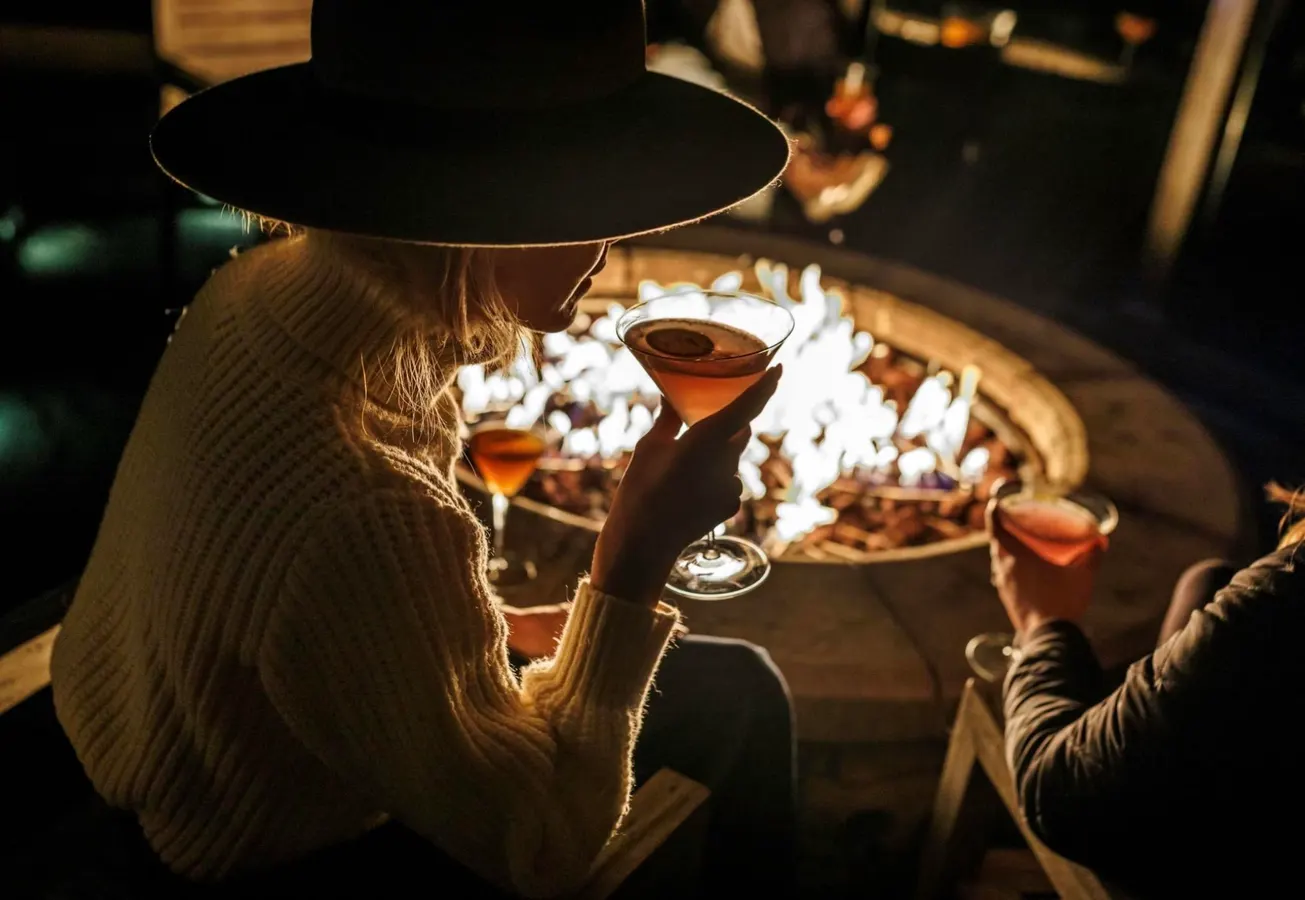

The new luxury is as likely to be found beside a fire, with space, privacy and a beautifully made drink, as it is behind a velvet rope. High-net-worth consumers are spending on experiences that help life feel richer, not simply look more glamorous
Hart Howerton / Primlands
High-net-worth consumers are investing in privacy, protected landscapes and time with the people who matter. At Primland in Virginia’s Blue Ridge Mountains, nature is not an added amenity – it is the value.
Luxury has always sold access, be that the best room, rarest object or the restaurant table nobody else could secure.
Today, some of the most valuable things are those we once took for granted: silence, darkness at night, an uninterrupted view, room for children to roam and time with other people that is not continually broken by a screen.
This is beginning to further influence where consumers travel, what they buy and, increasingly, where they choose to own a residence. It is not a rejection of beautiful things or brilliant service – those still matter, yet there is now a further filter: does they this add more noise to an already crowded life, or do help to quieten it?
In other words, luxury spending is beginning to divide in two: the money used to make everyday life frictionless, and the money spent putting the right kind of friction back into it.
The figures give us an indication of the scale of this change. The global wellness economy reached $6.8 trillion in 2024, according to the Global Wellness Institute. Wellness real estate was its fastest-growing sector, expanding at an average annual rate of 19.5 per cent between 2019 and 2024. It is clear that wellbeing has moved far beyond just the quick fix of treatments and spa weekends, and is further influencing the places people want to inhabit and the lives they hope to create there.
Luxury spending is increasingly about experiences that enrich life
Primland stretches across 12,000 acres of Virginia’s Blue Ridge Mountains, where protecting the scale, quiet and character of the landscape is central to its value
Hart Howerton / Primlands
Primland sits within 12,000 acres of wilderness in Virginia’s Blue Ridge Mountains. It is a vast and beautiful piece of land, acquired in the 1970s by the late Didier Primat and used by his family as a retreat for almost 50 years.
The estate is now home to The Lodge at Primland, Auberge Collection, with its spa, Highland golf course and extensive outdoor experiences. For the first time, the Primland story is also expanding into homeownership.
The Auberge Residences at Primland comprise just 25 furnished homes, with three to five bedrooms, designed by Hart Howerton. There are also 26 Estates homesites, positioned along a miles-long mountaintop ridge. These range from two acres to just under five acres, with prices beginning at $1.2 million.
Kevin Primat, who is building a home at Primland for his own family, says buyers are purchasing something much larger than their individual plot.
“When someone buys a home at Primland, they’re not simply buying the land underneath their house,” he explains. “In a sense, they’re buying the experience of everything around it: the views, the forest, the trails, the quiet, the people they meet, and the knowledge that the landscape around them will be looked after.”
Scarcity is a familiar device in luxury. We see it used to create urgency, increase desirability and protect premium pricing. Primat’s explanation is more grounded.
“I don’t really think about scarcity as a sales strategy,” he says. “Scarcity is a consequence of stewardship. If protecting what makes Primland special means building less, then we build less.”
That may prove to be one of the defining tests for the next generation of nature-led luxury developments. Once landscape, peace and privacy become commercially desirable, there will always be pressure to sell more of them. Yet every additional building, vehicle and guest can gradually diminish the thing that made the place exceptional.
Stewardship therefore has to mean more than carefully chosen language in a brochure. Sometimes it must be visible in what a developer decides not to build.
A home with a community wrapped around it
Designed by Hart Howerton, The Auberge Residences at Primland will draw on the native stone, wood and natural textures of the mountain setting rather than compete with it
Hart Howerton / Primlands
A second home has traditionally been sold through its architecture, address and investment potential. Those remain significant, but high-net-worth buyers are looking more closely at what will happen once they arrive.
Will the house make family life easier? Can friends gather there without every visit becoming a logistical exercise? Does it offer privacy while still providing hospitality, activity and a sense of belonging?
John Warsing, Director of Real Estate says those questions are playing a much bigger role in purchasing decisions.
“Today’s luxury buyer is prioritising space, privacy and a deeper connection to nature, particularly when considering a second home,” he says. “It’s about more than just the home itself. Luxury property purchases are increasingly becoming about the experiences they offer, and how you can create long-lasting memories with family and friends.”
The latest global research from Savills shows that buyers still expect the practical benefits of a branded residence, from concierge and housekeeping to fitness facilities, but are increasingly looking for wellness and experiences that enhance the way they live.
Barbour is part of Primland’s carefully chosen retail offer, alongside the resort’s own resort-core merchandise. It shows how shopping can become part of the place and the life a guest is buying into
Primlands / Barbour
At Primland, an owner might hike in the morning, play golf, take the children onto an arial adventure course or go fly fishing. There is plenty of dining options, and of course retail-therapy with premium brands like Barbour and Ralph Lauren and throughout the reassurance of Auberge hospitality.
“The house is really only the starting point,” says Primat. “You can build a beautiful house in many places. A beautiful life around that house is much harder to create.”
His own decision to build at Primland is rooted in memories rather than a property specification. As a child, he explored the land with his father, rode ATVs across the estate and dug into the cliffs for shiny rocks he was certain were gold. Now, he wants his children to know the same landscape in their own way.
“The most valuable homes aren’t necessarily the ones you admire most,” he says. “They’re the ones that become part of your family’s story.”
Why nature still reaches us
Expedition leader, survival consultant and bestselling author Megan Hine believes this is “less a new trend and more a return to something deeply human,” giving our brains a chance to reconnect with a world they instinctively recognise
Megan Hine
It would be easy to call this an escape from technology, yet that explanation feels too simplistic.
Megan Hine, an international expedition leader, survival consultant and bestselling author, believes the desire to return to nature speaks to something much older than digital fatigue.
“I think what we’re seeing is less a new trend and more a return to something deeply human,” Hine explains.
“From a survival perspective, our brains evolved to be constantly reading the natural world: changes in light and weather, the landscape around us, where food and water might come from, what was safe and what required our attention. Modern life has changed incredibly quickly; our biology hasn’t.”
Modern consumers process a remarkable amount of information every day, much of it designed to demand an immediate reaction. Messages, alerts and news arrive whether or not they bear any relationship to the place in which we are physically standing.
“Nature gives our brains something they recognise,” Hine says. “It engages our senses, brings us into the present and gives us a sense of agency and connection to the world around us.
“I think that’s what people are searching for: not necessarily escape from modern life, but a chance to feel more human within it.”
For me, that is the heart of this shift. Consumers do not necessarily want to surrender modern life, and nor do they want luxury stripped of comfort. They want technology and service to work brilliantly without dominating the experience. They want some space left for instinct, spontaneity and each other.
Nature moves through the luxury wardrobe
Baobab Collection’s Halona candles place the colours and fragrances of the American West back into the home, linking the luxury object to the open landscapes, running horses and sense of freedom that inspired it.
Baobab
Luxury retail is seeing a similar shift. Resort shops are moving beyond the same familiar offer found everywhere else, choosing products that are intrinsically linked to the setting. At Primland, many brands including Maui Jim and Holderness & Bourne sit alongside the venue’s own resortcore merchandise, giving guests something more personal to take home.
Nature’s influence does not stop at the wardrobe. It is also shaping luxury interiors and fragrance, including Baobab Collection’s Halona range, which takes the American West as its inspiration. Its hand-blown glass vessels use mineral blues, frosted whites, amber and saffron tones, while its fragrances are built around rosemary, cedarwood, vetiver and moss.
Blue World recalls the vastness of the sky and the blue of cold desert nights. White World looks to salt plains, pale dust and winter light. Yellow World draws upon sun-warmed canyons, dry grass and the feeling of a cabin in winter. Available as candles and oversized Totem diffusers, the collection ranges from $155 to $1,150.
More than a fashionable backdrop
There is a risk in all of this, of course, as soon as nature becomes a profitable luxury code, it becomes tempting to apply it everywhere.
A few trees, a walking itinerary and an earthy colour palette do not amount to a meaningful nature proposition. Affluent consumers are more discerning than that. They will notice whether a landscape has been respected or merely styled, and whether claims of privacy and wellbeing survive once a development reaches capacity.
The opportunity for luxury businesses is not to turn nature into another amenity. It is to understand what consumers hope to recover when they return to it.
For some, that will be serenity of the place. For others, adventure, freedom or time with their family. What connects them is the desire to feel present in their own lives again.
Primat describes today’s definition of luxury as “less about what you can acquire and more about what is increasingly difficult to access: space, silence, privacy, time and genuine connection.”
“For people who already have access to beautiful things,” he says, “there’s a yearning for something deeper: walking in the woods with your family, sitting around a fire with friends, or waking up somewhere where the first thing you hear is birdsong.”
Luxury will continue to make and sell extraordinary things. But its most persuasive promise may no longer be that it can give the consumer more.
It may be that, for a little while, it can give them their attention and a ‘sense of self’ back.











Leave a comment