


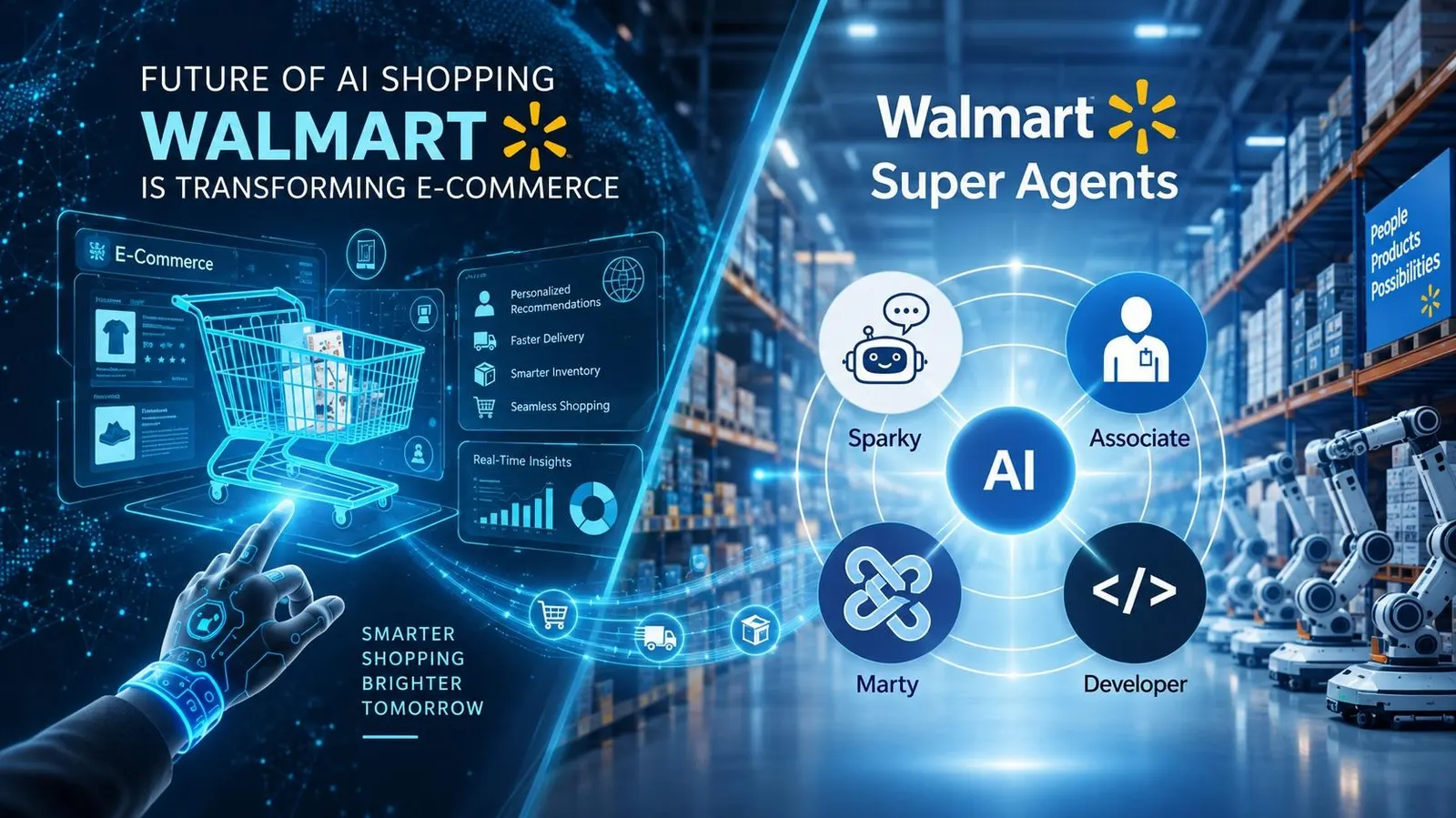

Walmart is leveraging AI to transform consumers food shopping with in-store food and adding delivery
TerahniOnTech, Getty
One of the more consequential restaurant stories this September came from a company that does not operate restaurants: Walmart.
After earlier moves with Subway and Dunkin’, Walmart announced on September 10 that it was adding Papa Johns to its expanding restaurant delivery business. The partnership will allow customers to order pizza through Walmart’s digital ecosystem and combine restaurant meals with groceries and household purchases. The rollout begins in select markets this fall, with plans to expand nationwide.
At first glance, this looks like another delivery partnership.
It is also another indication of how quickly the boundaries separating restaurants, retailers, marketplaces and technology companies are disappearing.
And the timing matters. Artificial intelligence is beginning to change both sides of the food transaction: how consumers decide what to buy and how restaurants produce, sell and deliver it.
The emerging competition is no longer simply restaurant app versus third-party delivery platform. It is becoming a broader contest over who influences the food decision, who owns the transaction and who maintains the customer relationship.
The Consumer Is Changing, Too
Much of the restaurant AI conversation has centered on the operator: labor, productivity, order accuracy, scheduling, throughput and margins.
But another technology shift is happening on the other side of the counter.
McKinsey reported this year that 68% of U.S. consumers had used at least one AI tool during the previous three months. Among AI users, 19% were already using the technology to discover or decide among brands, products and services.
That changes the purchasing journey.
A consumer does not necessarily have to open a restaurant app, search for a particular brand or scroll through a delivery marketplace. Increasingly, the starting point can become a question:
What can I feed four people tonight for under $40, have delivered quickly and still give everyone something they want?
When that happens, restaurants are no longer competing only to be selected from a list. They are competing to become part of the answer.
How U.S. consumers are using AI, including product research and purchasing decisions. Source: McKinsey ConsumerWise Global Sentiment Survey, February 2026.
McKinsey
That shift is already reaching restaurant decisions. DoorDash’s 2026 Restaurant Industry Trends Report, based on a nationally representative survey of more than 3,000 U.S. consumers, found that 22% had used AI to help choose a restaurant. Another 64% said they would prefer a single app for managing delivery, pickup and reservations.
Meanwhile, restaurant loyalty is under pressure. Tillster’s 2026 Phygital Index found that 45% of diners said their favorite restaurant chain had changed during the previous year, compared with 33% in 2025. Thirty-six percent reported visiting grocery chains more frequently, while 33% were visiting convenience stores more often.
The percentage of diners reporting that their favorite restaurant chain changed rose from 33% in 2025 to 45% in 2026. Source: Tillster Phygital Index.
Tillster
Consumers are more selective, more digitally enabled and increasingly willing to move across traditional food channels.
AI adds another layer to that choice.
Restaurants Are Building Their AI Capabilities
Restaurant companies are hardly standing still.
National Restaurant Association research shows that approximately 26% of operators currently use AI technologies. Among those operators, applications already span marketing, administrative work, menu optimization, employee scheduling, customer ordering, recruitment and inventory management.
The important signal is not one particular technology or pilot. It is the breadth of experimentation.
Wendy’s FreshAI is bringing AI into drive-thru ordering. Burger King has been testing Patty, an AI-powered assistant operating through employee headsets, in approximately 500 U.S. restaurants. The system helps employees with operational questions, inventory information and customer interactions.
Across the industry, AI is moving into ordering, employee assistance, scheduling, personalization, inventory and customer service.
Where restaurants already using AI are applying the technology across their operations. Source: National Restaurant Association, 2026 Hiring and Staffing Report. Percentages reflect operators using AI, not all restaurants.
National Restaurant Association
Papa Johns offers a particularly useful example of how these technologies are being connected.
The company selected PAR Technology to anchor a next-generation point-of-sale and operations platform across approximately 3,200 U.S. restaurants. Its Google Cloud-powered AI ordering capabilities support natural-language ordering and personalization, while a partnership with Deliverect is designed to unify orders fulfilled by company drivers and third-party delivery partners. The U.S. dispatch rollout is targeted for completion by the end of 2027.
Now add Walmart distribution to that technology stack.
Papa Johns is simultaneously strengthening its own digital infrastructure while making the brand available through another powerful consumer ecosystem.
That reflects an emerging reality: restaurant companies need strong first-party capabilities while also being present wherever consumers increasingly choose to transact.
Wonder Pushes The Technology Conversation Further
The technology shift does not stop when the order reaches the restaurant.
Wonder, the food-tech company founded by Marc Lore, offers one of the clearest examples yet of where the convergence of AI, automation and food production could lead.
In August, Wonder introduced its Infinite Makeline robotic meal-assembly system at its Midtown East location in New York. The system has the capacity to produce up to 500 bowls per hour from 68 ingredients. Wonder expects the technology to reach tens of locations during 2027.
The technology originated with Spyce, which Wonder acquired from Sweetgreen late last year for $186.4 million. Sweetgreen continues operating approximately three dozen machines under a licensing agreement.
At Midtown East, Infinite Makeline automates roughly 80% of what goes into a bowl in about three and a half minutes. People still prepare ingredients, replenish the system, finish orders and handle packaging.
That human-machine combination matters. Automation does not necessarily mean removing people from hospitality. It changes where their work creates the most value.
More revealing is what Wonder is building around the machine.
The company is developing automated sauce production, working with Serve Robotics on autonomous ground delivery and planning aerial delivery with Zipline. Wonder is also developing MEL, an AI platform intended to use food preferences, health goals and personal health data to generate individualized meal recommendations.
Then came another significant development.
On September 15, DoorDash and Wonder announced a strategic agreement involving DoorDash’s proposed $300 million acquisition of Wonder’s Grubhub Campus Dining business and a separate $125 million investment in Wonder.
The agreement would extend DoorDash’s presence in campus dining while supporting Wonder’s expansion and continued investment in robotics and AI. The acquisition remains subject to closing conditions.
The announcement provides another example of how delivery platforms, food production and technology are becoming increasingly interconnected.
Taken together, Wonder’s initiatives begin to connect almost the entire food occasion:
Discovery. Decision. Transaction. Production. Fulfillment. Data.
That is why the restaurant technology story is becoming larger than any individual robot, voice-ordering system or AI application.
The opportunity—and the strategic challenge—is increasingly about connecting the pieces.
Walmart Is Worth Watching From The Other Direction
There is another set of Walmart moves worth watching.
Walmart Business has expanded its B2B purchasing capabilities. This year, Walmart also launched Upstream Facility Services, taking expertise developed maintaining its enormous store network and offering HVAC, refrigeration, electrical, plumbing and other services to outside multi-location businesses.
It also introduced Prepaid Consolidation, which simplifies inbound supplier logistics by allowing products to move through a single national purchase order before Walmart distributes inventory across its 42 regional distribution centers.
Distribution Strategy Group recently characterized these moves as Walmart assembling many capabilities associated with wholesale distribution.
Walmart has not announced plans to become a broadline foodservice distributor, and that distinction matters.
It does not have to replace traditional foodservice distributors to become more relevant to restaurant operators. Restaurants buy far more than food. Capturing even some standardized operating purchases or services could create another point of connection with the restaurant ecosystem.
So Walmart becomes worth watching from both directions: as another route to the restaurant consumer and as a company building capabilities around the businesses serving that consumer.
The Competition Is Moving Upstream
For much of the past decade, restaurant digital strategy centered on the transaction.
Whose app does the customer use? Who delivers the meal? Who gets the customer data? How much commission changes hands?
Those questions remain important.
AI is beginning to move the competition one step earlier—to who influences the decision itself.
AI is entering restaurant discovery: 22% of surveyed U.S. consumers have used AI to help choose a restaurant, while 64% prefer one app for delivery, pickup and reservations. Source: DoorDash, 2026 Restaurant Industry Trends Report. The figures represent different survey questions.
DoorDash
At the same time, technology is moving deeper inside the restaurant, from discovery and ordering through production, fulfillment and customer engagement.
Consumers will move among restaurant apps, retailers, delivery marketplaces, search engines, social platforms and AI assistants. Restaurants will operate across increasingly connected ordering, production, labor, fulfillment and data systems.
The objective cannot simply be to own every interaction. It will be to remain visible, relevant and trusted wherever the food decision gets made—while understanding who owns the customer relationship and the data generated along the way.
And people remain central to that equation. National Restaurant Association research found that 94% of operators said their technology investments over the previous two to three years had not resulted in permanent job elimination.
Restaurants remain a hospitality business. Technology can remove friction, improve consistency and strengthen economics. People still create much of the experience.
The companies gaining ground will not necessarily be those announcing the most AI pilots.
They will be the ones that understand where technology changes the economics, where it strengthens the customer relationship and where human interaction still creates differentiation.
Walmart’s expanding food ecosystem is one signal. Wonder’s effort to connect personalization, production and fulfillment is another. The accelerating restaurant technology inventory is a third.
And consumers beginning to use AI to help decide what they buy may ultimately be the most consequential signal of all.
As the industry heads toward 2027, the question is becoming less about whether restaurants will adopt AI.
They already are.
The bigger question may be what happens when the consumer adopts it faster.
The forces reshaping how food is discovered, produced and delivered don’t operate in isolation. For my monthly perspective on the signals changing the food system—and what they mean for business—subscribe to Food System Volatility™, my independent newsletter.












Leave a comment