


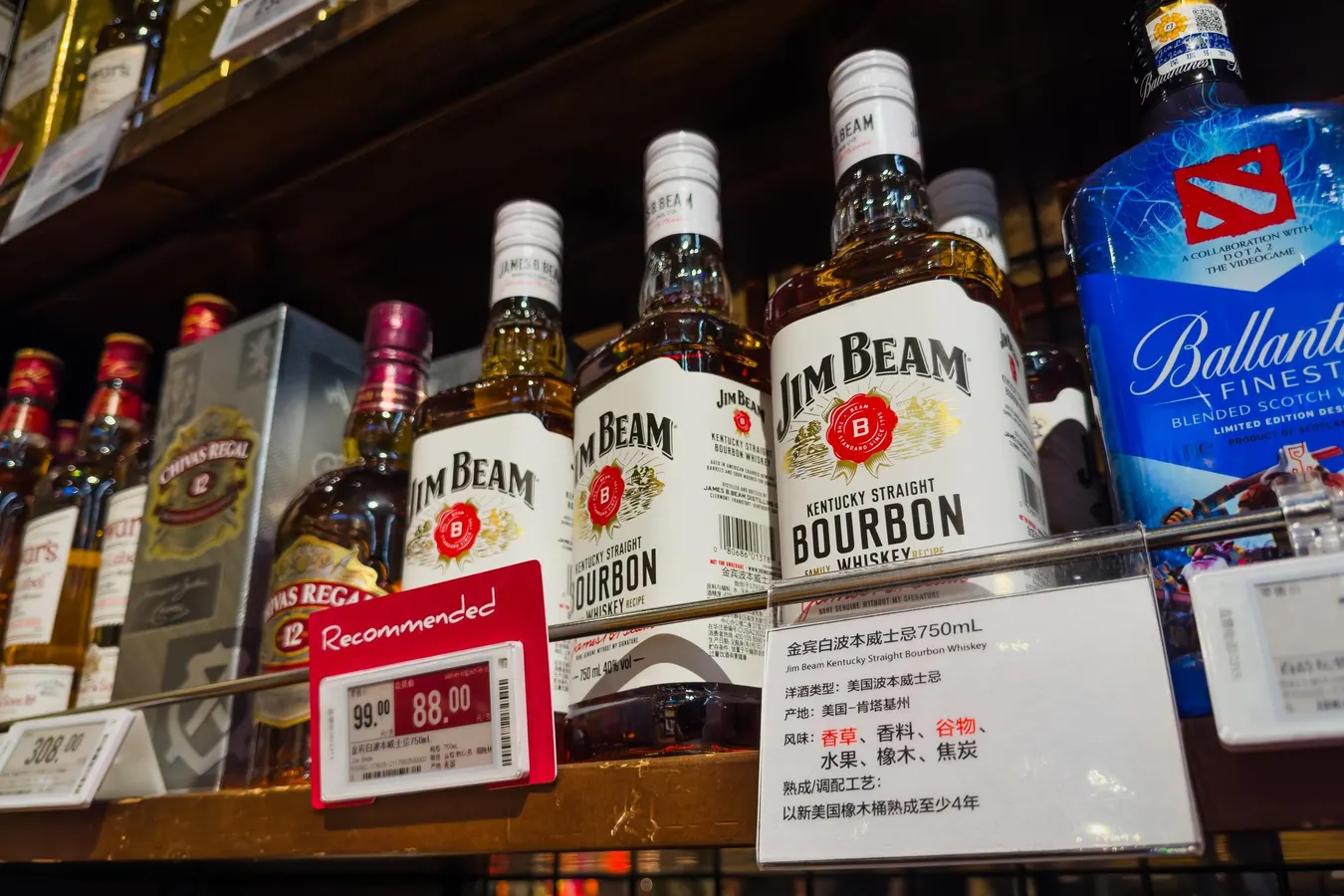

Kentucky Bourbon
Getty Images
It has been over a year since President Trump announced “Liberation Day”, a sweeping series of tariffs imposed by the U.S. against foreign countries. Since then, foreign tax policy has been in a state of flux as new tariffs have been imposed or retracted (or threatened to be imposed or retracted) on a constant basis, and countries have responded by imposing their own tariffs back on U.S. exports.
A seemingly unlikely casualty of this tariff war has been American whiskey. For example, following the initial wave of tariffs in 2025, every Canadian province pulled U.S. spirits off government store shelves, and U.S. spirits exports to Canada collapsed by roughly 70%. In July 2026, the Trump administration responded with a 50% tariff on Canadian goods, including whiskey.
Recently published research suggests that these tariffs imposed on whiskey actually impact market competition and product pricing, suggesting that there are unintended consequences of tariff policy when it comes to Americans picking their spirits.
How Trump’s First-Term Whiskey Tariffs Set Today’s Stage
The 2025 tariffs are not the first time that Trump sought to impact U.S. foreign trade policy via tariffs. In March 2018, the first Trump administration imposed Section 232 tariffs on steel and aluminum imports on national security grounds. The EU, Canada, Mexico, and China all retaliated with tariffs on symbolic American products such as Harley-Davidson motorcycles, Levi’s jeans, soybeans, and American-made bourbon and whiskey.
Bourbon and whiskey were not selected at random. The states of Kentucky and Tennessee produce the overwhelming majority of these products, and Kentucky is the home state of then-Senate Majority Leader Mitch McConnell. The EU settled on a 25% tariff on American whiskey, and other trading partners followed with their own tariffs. EU exports fell from $552 million to $440 million between 2018 and 2021, and Brown-Forman, the maker of Jack Daniel’s, estimated the tariffs would cost the company $125 million.
In addition to the Section 301 tariffs the same administration placed on China, that round of tariffs depressed corporate investment broadly. The whiskey tariffs specifically were suspended in 2021 as part of a broader U.S.-EU truce, and that suspension kept getting extended until the recent round of trade wars commenced.
Research Suggests Whiskey Tariffs Impact Product Pricing
Even though the whiskey tariffs imposed during Trump’s first term are from the late 2010s, those tariffs provide a means for researchers to analyze how the latest rounds might be impacting product pricing.
A study accepted for publication in The Accounting Review titled “Domestic Product Market Impacts of Politically Motivated Foreign Tariffs,” asks a simple question of when a foreign government retaliates against a domestic industry’s exports, what happens to the prices that industry charges at home? This study is co-authored by Carly Burd (NC State University) and Duke Ferguson (University of Kentucky).
Using the NielsenIQ dataset covering weekly retail prices and sales, drawn from 11.4 million store-week observations across 2,514 products, 989 brands, 8,674 stores, and 97 retailers, Burd and Ferguson compared the sales of U.S.-produced whiskey (hit by the foreign tariffs) to foreign-produced whiskey (such as Crown Royal, Fireball, and Jameson, which faced no such tariffs) before and after the 2018 tariffs took effect.
The study finds that U.S. whiskey producers lowered the domestic prices of their products during this time by approximately 22 cents per bottle relative to importers. This decline led to a 2.8% increase in weekly sales for the U.S. products with an implied demand elasticity of an unusually high value of -3. The deepest cuts occurred in states where whiskey is not consumed as much and averaged about 44 cents per bottle. U.S. whiskey producers also pulled back advertising spending across the US, which is consistent with trimming discretionary costs as margins compressed, and less need for advertising amidst lower prices.
Looking at the states where over 85% of US whiskey is produced, Kentucky and Tennessee, led to a different and interesting narrative. In these states, producers raised prices on their own locally-made products by 17 to 22 cents relative to the same products sold elsewhere, and advertising spending was unchanged despite it falling in other states. Sales still grew. The interpretation of this finding is that consumers were effectively willing to pay a premium to support an industry they saw as under political attack.
“A retaliatory tariff is a tax that can land at home as well as abroad,” is how Burd frames the takeaway for the business and policy community. What surprised Burd and Ferguson was not that there was an effect in states like Kentucky and Tennessee but, instead, how strong and consistent this effect was. This result serves as a reminder that pricing power in a market with genuine brand loyalty and local identity looks nothing like pricing power in a commodity market with none.
In looking toward future research, the authors state that it can be important to understand what happens when tariffs begin to get scaled back. As the U.S.’s tariff policy seemingly goes up and down at will, it can be important to understand this complete picture.
The Whiskey Tariffs Lesson For Today’s Trade War
We can look no further than today to begin to understand the impacts of the unwinding of tariff policy on a specific good or set of goods. On September 13, 2026, President Trump announced at the trophy ceremony for the Irish Open that he would remove the 10% U.S. tariff on Irish whiskey, according to Bloomberg. Trump said Taoiseach Micheal Martin and tournament winner Shane Lowry had both raised the issue with him during his visit, telling reporters “everybody has been bugging me” to make the change.
The move follows a similar decision in early 2026 to lift tariffs on U.K. whiskey, including Scotch, after a state visit from King Charles and Queen Camilla. The Irish Whiskey Association had been pushing for the exemption for months, and Ireland’s deputy prime minister, Simon Harris, called the announcement “a welcome announcement of economic significance.”
The timing captures something the research helps explain. Whiskey keeps getting pulled into trade disputes despite it not being the source of these disputes. Interestingly, it keeps getting pulled out of these trade wars through gestures that are viewed as mostly symbolic.
Burd and Ferguson’s work shows that once whiskey tariffs lands, the response inside the industry is not uniform. It depends on brand loyalty, regional identity, and how visible the fight becomes in local media. The current environment shows that removal can be just as personal and just as political as imposing the tariffs in the first place. In an industry like American whiskey manufacturing, where the product must age for years before it even hits the shelf, the uncertainty can be a real cost on those creating the product. While pricing and advertising can be levers easily pulled to maintain their business, the manufacturers must decide how much those levers should be used.









Leave a comment